Speakers in Berlin traced how Germany’s rearmament, US-led violence abroad and the repression of solidarity at home are converging in a dangerous drive toward war. BEN CHACKO reports


 Latest editorial

The military-industrial complex has never had it so good
ALEX GORDON outlines the real battle for workers in Britain and Europe, to break the state capture by arms firms and the new finance-technology capitalists
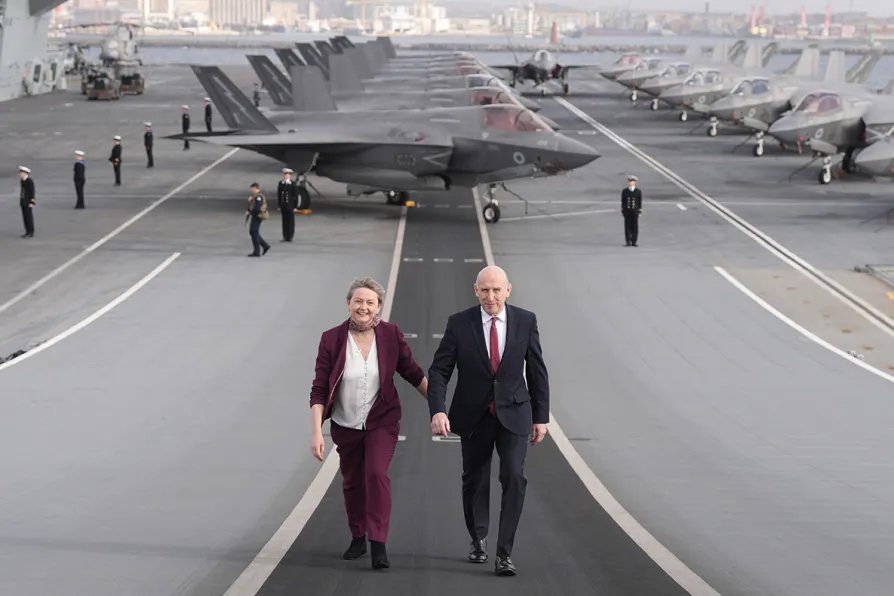 Defence Secretary John Healey and Foreign Secretary Yvette Cooper during a visit to Royal Navy carrier HMS Prince of Wales in Naples, Italy, November 17, 2025

Ahead of an important CND webinar, ULRIKE EIFLER argues that militarisation is not only draining social budgets — it is reshaping everyday life, preparing society for war and demanding a socialist response rooted in the labour movement
As Holyrood sets the Budget, the gulf between rich and poor is wider than ever. PETER OLECH of Unite Community Scotland argues that only by taxing extreme wealth can we properly fund public services and deliver justice for working-class communities
Israel’s recognition of Somaliland has little to do with self-determination and far more to do with strategy, offering Israel a potential military foothold near Yemen, says JE ROSENBERG
Statement of the Tudeh Party of Iran





IN MARCH 2025, EU president Ursula von der Leyen announced “ReArm Europe” — subsequently rebranded “Security Action for Europe” because SAFE sounds so much nicer — a promise of €800 billion (£660bn) of EU military support to continue the war in Ukraine.
While this enormous sum grabbed headlines, the EU’s proposal for private capital loans of €150bn (£130bn) to fund this military spending bonanza left member states to raise the remaining €650bn — over three-quarters of the proposed arms package.
Despite the evident enthusiasm of generals, arms dealers and bourgeois politicians for cutting public education, healthcare, housing and civil infrastructure investment to pay for military spending, no European government has yet succeeded in the wholesale switch of public spending from welfare to warfare necessary to fulfil their demands.
In June 2025 at its Hague Summit, Nato states committed to allocate 3.5 per cent of GDP to “defence” and a further 1.5 per cent of GDP to “defence and security-related expenditure” by 2035.
However, support was not universal, with Spanish PM Pedro Sanchez calling the pledge “unreasonable” with damaging consequences for Spain’s economy and social welfare.
According to the IMF, 17 out of 27 EU member states already breach the EU Stability and Growth Pact target of 3 per cent of GDP deficit and 60 per cent of GDP debt.
While Germany abolished its own domestic debt brake rule in March 2025 to boost military spending, Slovakian PM Robert Fico, with a budget deficit in 2025 of over 5 per cent of GDP, said his country would not support increases in defence spending in 2026.
The British government committed to the new 5 per cent Nato pledge without any public or parliamentary debate and announced plans to increase the British defence budget to 2.6 per cent of GDP by 2027 by cutting international aid. But Keir Starmer’s attempts to cut welfare met powerful public and political protests, indicative of the real-world difficulties of slashing the welfare state to create a warfare state.
The fact that Starmer, Friedrich Merz and Emmanuel Macron have now achieved the lowest historical poll ratings of any ruling party leaders in their respective countries indicates the failure of the ruling class in Europe to win popular support for the creation of warfare states.
Then on January 7 2026, President Donald Trump pledged to increase the Pentagon budget by 50 per cent to a record $1.5 trillion, to create his “dream military.”
A dream for Pentagon contractors and a nightmare for everyone else. By this stage, it seems as though he is just making numbers up to stabilise share prices. In a world of stock markets inflated by vast quantities of fictitious capital, fictitious military spending plans assume critical importance.
The US military addiction to dysfunctional and unworkable military systems such as the F-35 fighter, the impossibility of a leak-proof Golden Dome missile defence system, and a scheme to spend up to $2trn on new nuclear weapons will waste tens of billions of dollars every year for a long time to come.
In 2025, the USS Harry Truman proved unable to keep Red Sea shipping routes open when confronted with relatively low-cost drone and missile attacks launched from Yemen. Two Super Hornet fighters, worth around $67 million (£50m) each were lost overboard after falling from the flight deck when the $13bn aircraft carrier was forced to carry out evasive manoeuvres. The mighty warship was rapidly withdrawn.
Trump’s latest proposal would add $5.8trn to US national debt over the next decade and is more than the entire military budget of China, Russia and Iran combined.
Trump made his surprise arms spending announcement hours after publicly criticising the performance of major Pentagon contractors, which sent arms company share prices plunging.
The real meaning of the torrent of headline-grabbing announcements of increases in arms spending by Trump, von der Leyen, Starmer, Merz and Macron, is their attempt to boost share prices in arms and technology firms on US and European stock markets.
The threat of state capture by arms companies through increasing military budgets is a phenomenon recognised as long ago as 1961 by US president Dwight Eisenhower in his farewell address when he described the “conjunction of an immense military establishment and a large arms industry” to warn of the dangers of the military-industrial complex.
Today, the largest arms firms have become fused with the FinTech (financial technology) sector. Modern arms firms focus on AI, autonomy, big data and cybersecurity. Major arms firms are acquiring and partnering with tech companies to integrate these capabilities.
EU institutions are creating funds and programmes (the European Defence Fund, InvestEU Defence Equity Facility) to drive private capital funding into arms research and production and create collaboration and mergers between finance capitalists and the arms industry.
Recent Pentagon moves to reduce oversight of arms contractors, alongside Trump’s “braggadocious” Truth Social posts, are a recipe for increased waste, fraud, and profiteering on the part of Pentagon contractors, but also serve as a promise of further state subsidy to a vastly inflated US stock market bubble dominated by the “Magnificent 7” Big Tech stocks.
The politicians’ promise of endless riches for the merchants of death has little popular support. European rearmament is intensifying deindustrialisation and driving a fall in living standards and fewer jobs.
The message to the working class who compose the majority in all our societies is that the enemy is at home. Anti-militarism is the cornerstone of our common work as socialists, trade unionists and anti-imperialists in exposing and confronting the military-industrial complex.
Alex Gordon is vice-president of CND UK, former president of RMT trade union and co-author of the Alternative Defence Review. He will be speaking at the CND webinar “Welfare not Warfare: How Militarisation is Destroying Our Societies” on Wednesday January 14 2026 at 6pm. Also speaking will be Ulrike Eifler, German trade union activist and part of the “Nie wieder Krieg — Die Waffen nieder” peace initiative, and Marc Botenga MEP, Parti du travail de Belgique, Member of European Parliament’s commission on security and defence.
To register for the event go to cnduk.org/events.
