


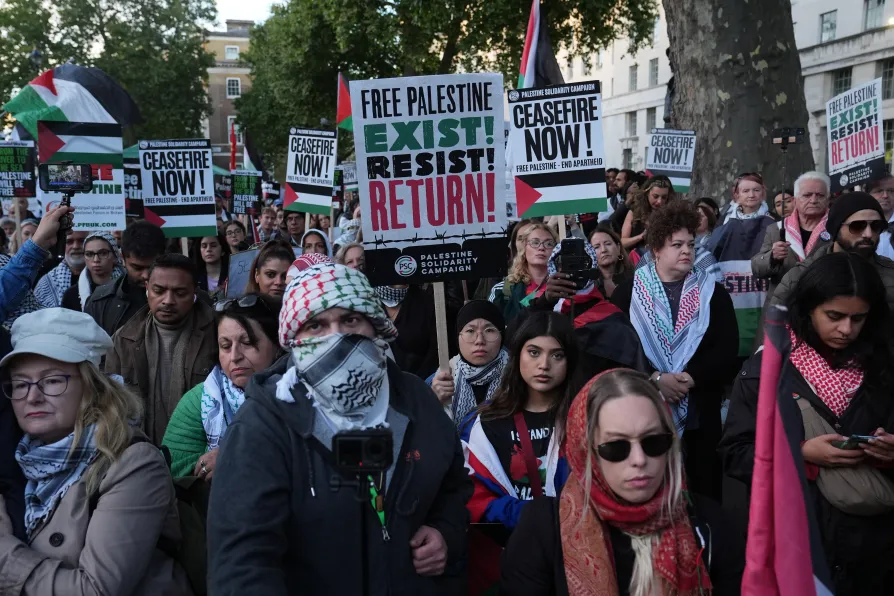
 People take part in a Palestine Solidarity Campaign rally on Whitehall in central London. Picture date: Wednesday September 11, 2024





THE Councillor Pledge for Palestine can help make anti-imperialism a doorstep issue in next spring’s local elections.
Palestine solidarity is as urgent today as it was before the so-called ceasefire agreed in Gaza two months ago.
So-called because it has been violated almost daily by Israel since, both through aerial bombing and the casual gunning down of Palestinians who stray too close to Israeli lines of control. One of the latest such “threats” neutralised by bullet was a three-year-old girl, Ahed al-Biyouk, playing outside her family’s tent when she was shot dead on Sunday.
The ceasefire is not worthless: it has scaled down the bloodshed dramatically and given Gaza residents a breathing space.
But it is not peace, and most certainly not justice. Mass popular pressure in Britain forced our government to formally recognise a Palestinian state in September. But that doesn’t mean anything unless it is made to take concrete steps towards the realisation of such a state.
That means objecting to Trump’s “peace plan” for Gaza, which consists of open-ended foreign military occupation.
Israel is still engaged both in seizing territory and in ethnic cleansing in Gaza (to say nothing of the West Bank).
The head of the Israeli army Eyal Zamir has called the “yellow line” defining which parts of Gaza remain under Israeli military control (more than half of it) “a new border” for Israel, indicating it will remain there permanently. This week, Egypt protested at Israel’s plan to reopen the Rafah crossing — because it will reopen in one direction only. Palestinians will be encouraged to leave their homeland: they will not be allowed back in.
The UN special rapporteur Francesca Albanese points out that the “Nakba” or catastrophe, generally used to refer to the 1948 expulsion of 750,000 Palestinians from their homes when Israel was founded, should rather be seen as an ongoing process.
There have been pauses and accelerations, hot wars with big land grabs and slow-but-steady settler encroachment, but the ethnic cleansing of Palestine by Israel has never stopped and each major crisis has ended with less territory that can be termed Palestinian and less freedom and autonomy for the Palestinians whether under occupation or siege or within Israel itself.
The Gaza genocide could prove one more horrific episode in the long dispossession of the Palestinian people. Under Trump’s “peace plan” it will.
But the savagery, racism and recklessness of the Israeli state are now clearer to a global public than ever before.
Britain is no exception. Its Palestine solidarity movement is the largest mobilising force in the country.
It has already demonstrated its political reach, resulting in the election of four “Gaza independents” who defeated Labour last year, and now sit alongside Jeremy Corbyn in the Independent Alliance of MPs; it has played its role in Labour’s collapse at the polls, in the formation of Your Party, in the polling and membership surge of a Green Party that says it will designate the Israel Defence Forces as the terrorists they are.
The government is determined to make this movement go away.
It is endangering the lives of hunger-striking Palestine solidarity activists by holding them behind bars for months on remand, when freeing them on bail to await trial poses no conceivable risk to anyone. It is amending its Crime and Policing Bill to make protesting harder, and seeking the abolition of most jury trials to extend state control of judicial processes.
It cannot be allowed to succeed. The Councillor Pledge for Palestine puts everyone up for election on the spot. It forces politicians to take a stand against genocide or explain why they won’t. And it advances the boycott, divestment and sanctions movement by targeting the billions invested in Israeli apartheid by council-controlled pension funds.
It should be taken up in every local authority in Britain.
