

 Latest editorial

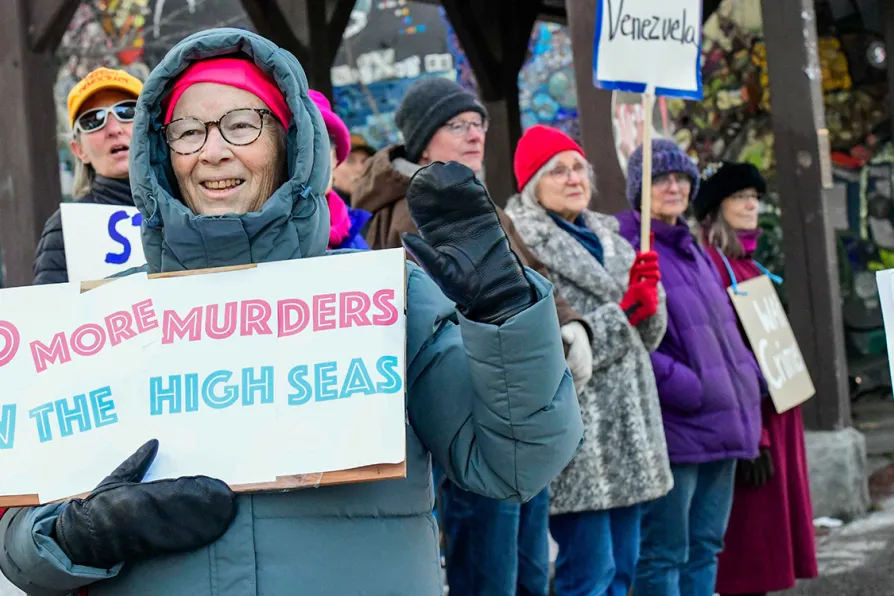 People take part in a national day of protest against US policy on Venezuela in Brattleboro, Vermont, , December 6, 2025





HOW likely is a US war on Venezuela? States across the region are alarmed one is imminent.
The huge military build-up in the Caribbean has been accompanied by murderous strikes on boats alleged — without evidence — to be smuggling drugs. Extrajudicial killings so brazen that members of the US Congress who have never batted an eyelid at drone assassinations in Africa and Asia are questioning who ordered what.
The US armada gathers as President Donald Trump calls for regime change. Administration insiders issue a steady stream of misinformation to confuse the press, alleging all kinds of behind-the-scenes deals designed to discredit Venezuelan President Nicolas Maduro.
Some argue that the forces assembled are designed to intimidate, not invade: 10,000 troops is a fraction of the 160,000 that invaded Iraq.
But the National Security Strategy published on Friday by the White House suggests we should be ready for the worst.
This thoroughly Trumpian document is a window on the administration’s thinking.
It reflects its domestic conservatism (calling for US households to consist of “strong, traditional families that raise healthy children”) and far-right conspiracy theories such as the Great Replacement Theory (immigration into Europe, we are told, means that “within a few decades at the latest, certain Nato members will become majority non-European”).
It is climate-denialist, listing the US’s energy needs as consisting of “oil, coal, gas and nuclear” and denouncing climate change as an “ideology.”
It does suggest that the US attempt to broker a peace in Ukraine is not merely a ruse: it rejects further Nato enlargement, criticises European states’ resistance to a deal and calls for “re-establishing strategic stability with Russia.”
Concern to “prevent unintended escalation or expansion of the [Ukraine] war” is linked to the oft-cited pivot to Asia: it stresses the importance of preventing Chinese reunification with Taiwan because of the island’s significance to US naval domination of the Pacific, calls on Indo-Pacific countries to provide the “US military greater access to their ports and other facilities” and dwells longer on how to maintain an edge over its “near peer” rival China than on any other theme.
But its top priority is to “reassert and enforce the Monroe Doctrine to restore American pre-eminence in the western hemisphere.”
It vows to “deny non-hemispheric competitors the ability… to own or control strategically vital assets in our hemisphere” — coded language for a determination to block co-operation between Latin American countries and China, particularly when it comes to infrastructure projects (“we should make every effort to push out foreign companies that build infrastructure in the region”). It boasts of restoring US “privileged access” to the Panama Canal.
The so-called “Trump corollary” to the Monroe Doctrine was announced on the 202nd anniversary of that doctrine on December 2.
Like the original Monroe doctrine, it is a prescription for US imperialist domination of the Americas in the guise of protecting the hemisphere from outside actors — then Europe, today China.
Governments outside Washington’s orbit are classified as potential threats to its access to natural resources, and its “enlist and expand” policy sets out plans to recruit US allies to help it police the region and convert non-allies into allies through “various means.”
This means hostility to alliances like the Brics, which brings together a Latin American giant (Brazil) with African and Eurasian powers, and it signals escalated regime change operations against countries asserting their independence from the US.
Venezuela is clearly first in line, but the sovereignty of every state in the region is under threat.
Mobilising maximum resistance to US aggression will involve building Britain’s active and effective solidarity campaigns — including those with Cuba, Venezuela and Nicaragua and Justice for Colombia.
Trump sees dominance in Latin America as key to continued US domination of the world. We all have a stake in preserving its freedom and independence.
