The UK Prime Minister may have the regal touch in northern England, but he’s been wrong-footed on the constitutional challenges posed by the Celtic Alliance of first ministers from Scotland, Wales and Northern Ireland, argues KENNY MacASKILL


 Latest editorial
Venezuela’s fight for sovereignty and independence
NEIRLAY ANDRADE, a member of the Communist Party of Venezuela’s political committee, outlines her party’s position on the crisis facing the country
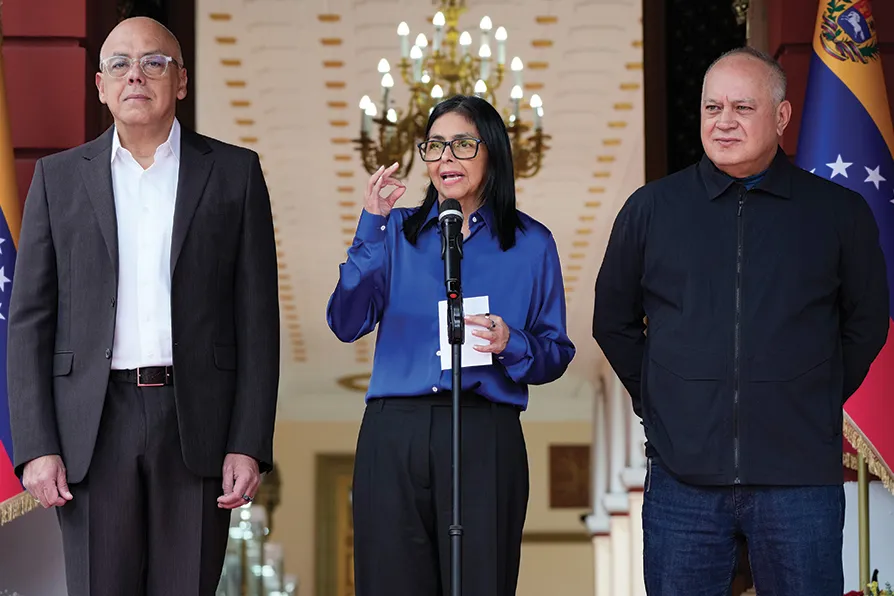
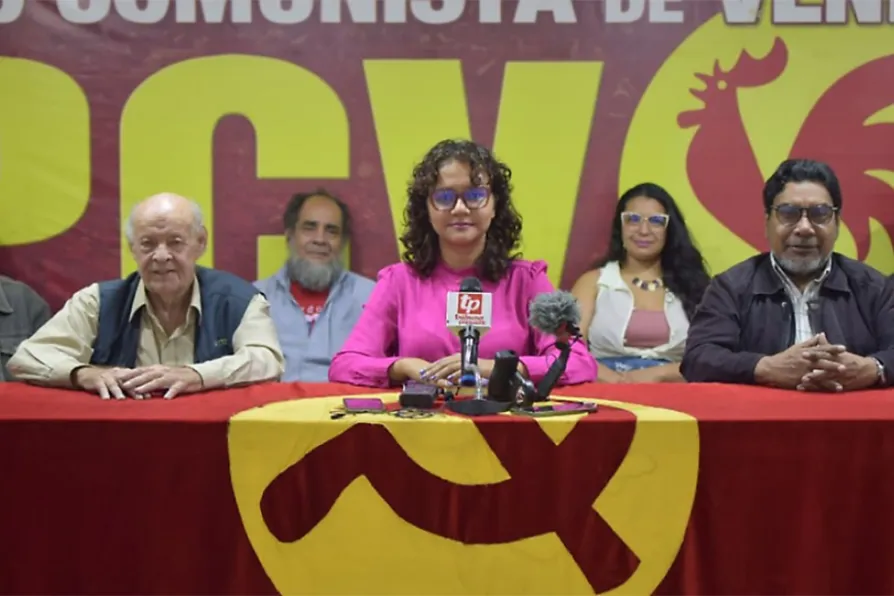 Neirlay Andrade (centre) with other senior PCV leaders at a press conference [Pic: PCV]
A look at Taylor Wimpey’s accounts shows why Labour’s market-led housing strategy won’t deliver more, cheaper homes, as promised, says SOLOMON HUGHES
DAVID HORSLEY remembers the remarkable life and death of US black revolutionary George Jackson, whose politically passionate prison letters were published as Soledad Brother
Cuban trade union federation CTC leader OSNAY MIGUEL COLINA speaks to Ben Chacko about life and work under a crippling US siege
A part of the British empire’s network of slavery, today the Caribbean island of Nevis faces a new form of exploitation in the form of crypto-colonialism, CLAUDIA WEBBE writes
Challenges from the unscrupulous misuse of AI to steal actors’ voice and physical likenesses is being met with a firm union response, writes LYNDA ROOKE





US IMPERIALISM is waging a political and military offensive in Latin America and the Caribbean aimed at securing full control of the region.
To this end, it invokes the so-called “Trump corollary” to the Monroe Doctrine in its struggle to contain the influence of China and Russia.
Under these pretexts and in violation of international law, beginning in August 2025, it deployed the so-called Operation Southern Spear in the waters of the Caribbean Sea and the Eastern Pacific, mobilising — under the command of the Southern Command — a military force of unprecedented magnitude in Latin America.
After months of extrajudicial killings in international waters — including the unpunished murder of Venezuelan, Colombian and Caribbean island civilians — and of detentions and assaults on ships carrying Venezuelan oil, it proceeded to attack Venezuela.
The US military deployment in the Caribbean and the aggression against Venezuela is part of a broader offensive against the peoples of Latin America and the Caribbean, aimed at thwarting their struggles for more just, democratic and sovereign societies.
In this context, Washington has intensified a plan to economically and energetically strangle revolutionary Cuba, accompanied by growing threats of military intervention, with the aim of provoking the collapse and defeat of the Cuban revolution.
At the same time, US imperialism has succeeded in installing governments aligned with its policy of domination in countries such as Argentina, Panama, Ecuador, Paraguay, the Dominican Republic, El Salvador, Chile, Bolivia, Costa Rica, Honduras, Colombia and Peru.
To this list must be added the current government of Venezuela, despite the deceptive rhetoric of the ruling elite.
In examining this new balance of political forces in Latin America, we communists must, from a class perspective, identify the role played by social-reformist movements, as well as their limitations, inconsistencies, and ambiguities.
US aggression
On January 3 of this year, the US carried out a military assault against Venezuela and kidnapped the de facto President of the Republic, Nicolas Maduro, and his wife, Cilia Flores, while indiscriminately murdering Venezuelan and Cuban personnel who were serving as presidential guards.
The Communist Party of Venezuela (PCV) immediately condemned this action as an act of cowardly imperialist aggression, completely contrary to international law.
Likewise, we denounce the absence of a military response by the Venezuelan state in defence of its sovereignty and territorial integrity, which were violated by the attack by US military forces and the subsequent daily presence of foreign officers and troops on our territory.
The Venezuelan people thus saw for themselves their vulnerability in the face of a foreign power’s ambitions and the state’s inability to guarantee sovereignty and national security.
The defiant rhetoric against imperialism and the promises to defend the homeland, “even with our lives, if necessary,” ultimately proved to be empty rhetoric from a leadership that, shamefully, places Venezuelan territory and its natural resources at the service of the interests of the tyrants of the North.
This confirms our long-standing accusations regarding the nature of the [ruling] United Socialist Party of Venezuela (PSUV).
The leadership’s sole interest is in retaining power at any cost: not only through the destruction of labour rights and the violation of democratic freedoms, but also by surrendering the country and thwarting the struggles waged for decades by the Venezuelan people — the true revolutionaries and patriots — to build a free and sovereign nation.
Immediately following the US military assault and Maduro’s abduction, the illegitimate exercise of political power continued through a “transitional” government headed by Delcy Rodriguez, who, along with Jorge Rodriguez and Diosdado Cabello, forms the so-called “triumvirate of indignity.”
This group has directed its administration toward surrendering the country and its strategic resources to serve the interests of US imperialism and Israeli zionism in their quest for continental and global domination, in open collusion with sectors of the bourgeois opposition.
Cynically, the corrupt and treacherous leadership of the PSUV seeks to justify its diplomatic understanding with the US government by appealing to a supposed pragmatism aimed at preserving the so-called “revolutionary” government.
However, the surrender of energy sovereignty to transnational corporations, the adoption of positions aligned with imperialist foreign policy and the presence of the CIA as well as US Marines on Venezuelan territory reveal conduct that is subordinate to interests foreign to those of the nation and far removed from any revolutionary principle.
Among the first measures adopted by the so-called “transitional government” was the complete halt of crude oil and fuel supplies to Cuba. Shortly thereafter, it pushed through a comprehensive reform of the Organic Law on Hydrocarbons that further cedes the oil industry to transnational corporations, continuing the special privileges granted by Maduro to Chevron.
Donald Trump has cynically admitted that the US has already more than recouped the cost of the military operation against Caracas through its control of Venezuelan oil, on top of which it has reaped a windfall of more than $13 billion (£9.7bn) in just six months.
In the face of this plunder, the triumvirate of the Rodriguez siblings and Diosdado Cabello remains silent and allows the country’s oil wealth to end up in the hands of imperialism, in a scenario where nearly 70 per cent of Venezuelan households live in poverty and one-third face extreme poverty.
The recent tragedy caused by the June 24 earthquakes laid bare the country’s institutional collapse and the absence of a government attuned to the people’s needs. At the same time, it confirmed the lack of autonomy among the ruling elite, which allowed the entry of US military forces and officials from the zionist state of Israel under the pretext of humanitarian aid.
Historic role
How could a sovereign nation, governed by a leadership that still proclaims itself “revolutionary” end up transformed into a neocolonial oil protectorate?
To understand this, it is necessary to consider the historical role assigned to Venezuela in the international division of labour: a strategic supplier of fossil fuels to the Western imperialist powers, particularly the United States.
The inter-imperialist dispute over control of Venezuela’s resources intensified due to the growing presence of Russian, Chinese, Turkish and Iranian capital. In this context and in the face of the military escalation in the Middle East, the Trump administration carried out its plan of aggression against Venezuela.
However, the events and the conduct of the Venezuelan civilian and military leadership indicate that this was not merely a military operation, but also a political manoeuvre aimed at subordinating the ruling elite to the interests of US imperialism.
This situation was exacerbated by the deep crisis of capitalist accumulation and the collapse of oil prices, to which Nicolas Maduro’s government responded with years of anti-worker, anti-popular and anti-democratic policies. The embezzlement of public funds, the transfer of enormous resources to the parasitic bourgeoisie and financial capital, and an economic policy favourable to big capital deepened inequality and fuelled opposition from broad sectors of the population.
At the same time, a labour policy was implemented aimed at eroding wages and dismantling the rights workers had won through decades of struggle.
Under the pretext of a false resistance to criminal imperialist sanctions, a policy of overexploitation of the workforce became widespread through the destruction of wages, the weakening of collective bargaining agreements, restrictions on the right to strike and freedom of association, and the judicial criminalisation of the workers’ struggle.
Added to this process was the offensive against democratic freedoms and political participation.
The PSUV leadership ordered a judicial assault on numerous parties. In the case of the PCV — this is about to mark its third anniversary — the judicial process violated the right to a defence and constitutional guarantees.
Ultimately, a court subordinate to political power handed over the PCV’s legal status to PSUV members. As a result, the Venezuelan working class was stripped of its primary instrument of political and electoral participation.
Despite this de facto outlawing, the PCV continues to fight. It demands the restoration of its legal status and its voter registration, and it stands ready to adopt whatever forms of struggle are necessary to defend the interests of the working class and the working people.
In light of this situation, the PCV, together with various political and social organisations, is moving forward with the development of a policy of popular and democratic unity to restore the constitution, defend national sovereignty, and confront plunder, authoritarianism, and foreign interference.
The goal is to unite a great national movement for the restoration of social rights and democratic freedoms, as well as for the sovereignty and independence of the homeland.
The aim is for the Venezuelan people to resume their historic struggle for emancipation and against all forms of foreign domination.
Neirlay Andrade is a member of the political committee of the Communist Party of Venezuela (PCV) and director of its newspaper Tribuna Popular. This an edited version of her contribution at the recent International Meeting of Communist and Workers Parties held in Cuba.

Similar stories
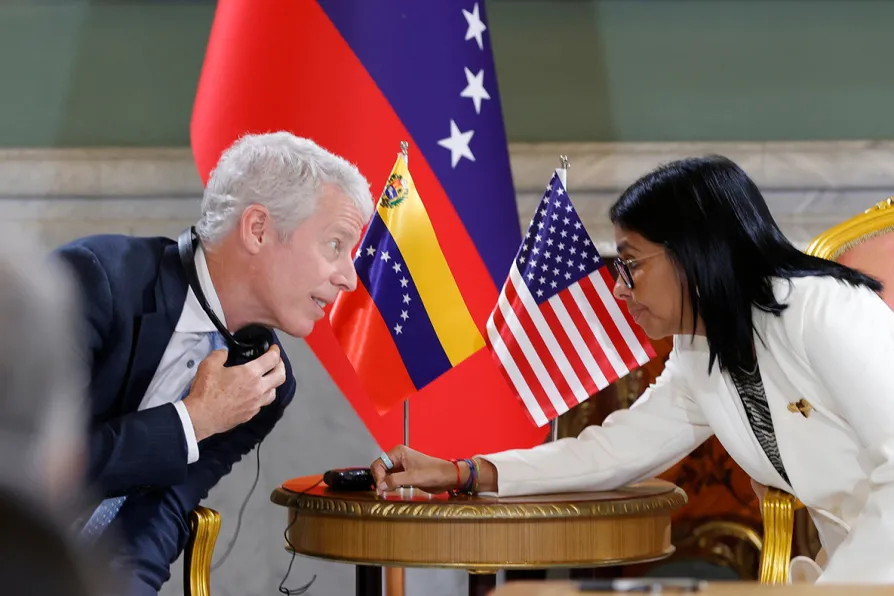
Whatever differences exist among international sympathisers of the Bolivarian revolution about its current trajectory, they should unite against the imperialist power that is the source of an enforced retreat, argues ROGER D HARRIS
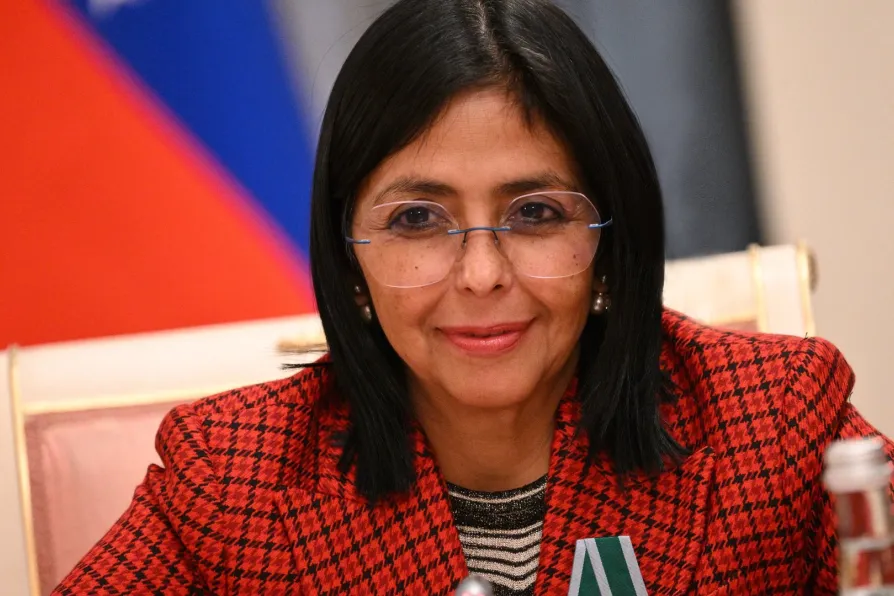
Concessions to Washington by the post-Maduro leadership in Caracas are designed to preserve the core of the Bolivarian Revolution not betray it, argue Roger D Harris, Francisco Dominguez and Mara Paez Victor. How the solidarity movement responds is critical
ISAAC SANEY points to the global stakes involved in defending the Cuban revolution against imperialism and calls for resistance
International solidarity can ensure that Trump and his machine cannot prevail without a level of political and economic cost that he will not want to pay, argues CLAUDIA WEBBE