In a season of Greek mythology NIAMH THORNTON looks at an intriguing relocation of Medea to contemporary Mexico


 Latest editorial

‘You will never know how we feel’
By chance, RENATA MEDEIROS MIRRA comes across a fine new two hander about the enduring legacy of the Miners' strike
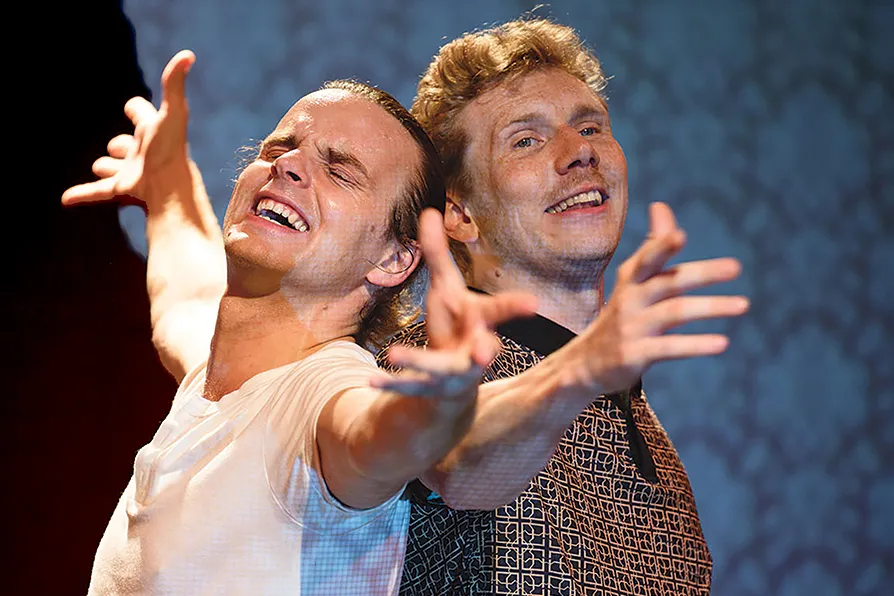 Sam Rees and Charlie Muskett in Cyn / Pic: Courtesy of Nawr ond Wedyn Theatre Company
Rescue care from the realm of sentimentality: what happens when we replace the vertical relationship between benefactor and victim with interdependence, collective organisation and struggle?
New releases by Interpol, Phoebe Bridgers, Lambchop
ANGUS REID urges us to understand the persecution of Jason Arday from a political and historical perspective, and to see the victim in human terms
Re-releases of the classics Gypsy Rhumba and Buena Vista Social Club, and a stunning album by Palestinian artist Faris Ishaq
Nothing, says ANDY HEDGECOCK, can rescue this undistinguished amalgam of ponderous melodrama and shallow philosophical speculation
JAMIE BRITTON invites readers to visit 3,500 locals as part of a marathon artistic pub crawl





Cyn
Stephenson Theatre @theSpace at Surgeons’ Hall, Edinburgh
⭑⭑⭑⭑☆
AT THE Edinburgh Festival Fringe, on my way to watch the acclaimed show The Horse Of Jenin by Alaa Shehada, among the many leaflets that landed on my hands there was one that called my attention: Cyn — Where Did The Heart Go.
On the back, it read “South Wales, 1995,” and referred to the closing of the Welsh mines. With only five minutes between the end of show I was about to watch and the start of this one, I put some faith in my ability to run and bought the ticket.
Sam Ree’s writing and acting were so immediately effective that, as soon as the room went silent and the action started, I was transported to a pub in the Welsh Valleys, despite the very simple set in a small intimate venue. The rest of the cast also did a good job and there was a palpably powerful energy sustained throughout the whole 50 minutes.
The play deals particularly well with the contradiction of what the mines represented to the Welsh communities, namely the exploitation and ruthless nature of the work, but also the income, pride and community connection built around it. It also deals very well with the transgenerational and long-lasting effects of class struggle in its most real manifestation — the violent repression of the miners’ strikes.
The use of song in the play is effective in remembering, in uniting, and in healing a wound that the audience is invited to feel. At one point, the main character says: “You will never know how we feel.” As someone who has not been directly part of that struggle, you know those words are true, that you’ll never know how it feels, and yet, alas, you are there, feeling it in that very moment. That is testament of good art.
The way the play brings Welsh culture to life, with kindness and self-awareness, and its portrait of the English as “the other who holds responsibility” but not necessarily as the enemy, also adds to its strengths.
For those of us who see the world through the lenses of class struggle, the idea that a well-intentioned boss could make a difference can come across as naive and potentially flawed in the otherwise brilliant text, but in the context of the play and the character’s journey that comment can also be forgiven.
Intense, beautiful and funny, this is a simple play by a talented writer, actor and singer who hopefully will gift us with more of his work in the future.
There were moments when Ree seemed to be the embodiment of the struggle that these communities endured, and still endure, and it is very inspiring to see young people actively keeping alive the collective memory of the miners’ strikes and those who were active agents in a fight that belongs to all the workers around the world.
The run has ended but further stagings are in the pipeline for this autumn. For details email sam@lonelyshepherd.info.

Similar stories
EWAN CAMERON trawls the Edinburgh fringe for new political drama

If you only see one show in Edinburgh, make it this one urges EWAN CAMERON

MARY CONWAY applauds the timely revival of Miller’s study of people fatally deformed by the economics of survival

MAYER WAKEFIELD has reservations about a two-handed theatrical homage to jazz’s most mercurial musician