Latest editorial
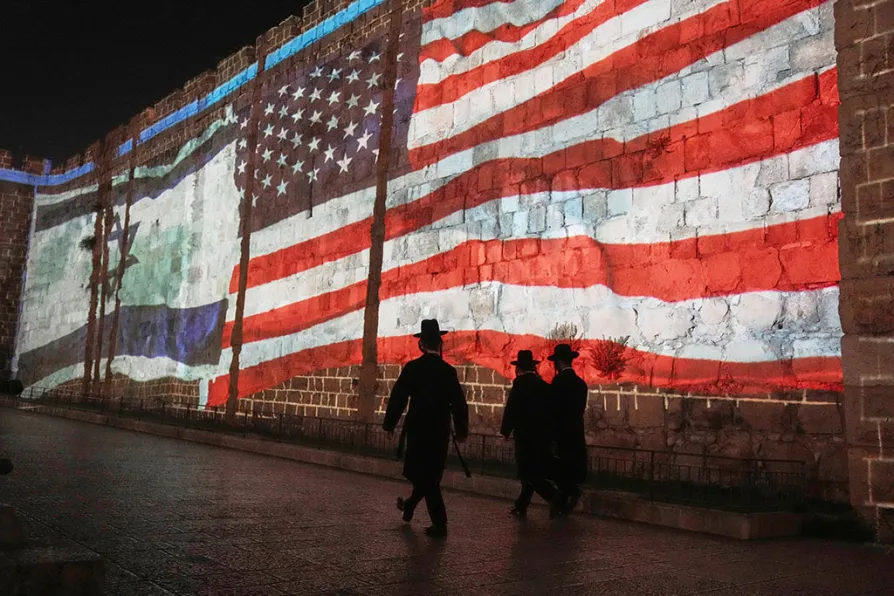 Partners in crime: The Israeli and US flags projected onto the wall of the Old City in Jerusalem






ACTIVISTS yesterday welcomed US President Donald Trump’s claims of an outline deal with Iran today — but warned there can be no lasting peace in the Middle East while the US military maintains such a huge presence there.
Mr Trump said today that he was holding off on a widely expected attack on Iran. Posting to social media, he claimed the emerging deal “would include the immediate, complete, and total opening of the Hormuz Strait, and an end to Iran’s nuclear threat.
“I have agreed, for the future benefit of the world and, likewise, the survival of a successful and prosperous Iran, to cancel the attack, subject to being able to rapidly make a deal,” President Trump said.
According to President Trump, Israel has agreed to join the US in the commitment to try to complete the agreement.
It is not the first time that Trump has issued apocalyptic warnings, only to subsequently insist that diplomacy was being given a chance.
But Iran has denied his claim that it asked the US to hold off on attacks, or that any agreement has been reached to reopen the Strait of Hormuz.
The Iranian Fars News quoted government sources in Tehran describing any such deal as “baseless.”
Iran’s Mehr news agency described President Trump’s claims as “nothing but a new lie.”
And the country’s acting Defence Minister Majid Ibn al-Reza said Tehran viewed every threat from its adversaries as “real and credible,” even if it formed part of psychological warfare.
“We will neither be caught off guard nor remain passive,” he added.
A source close to Iran’s nuclear negotiating team told Fars News that no such agreement exists, while a military source said the strait will remain restricted for as long as US hostile actions continue, with vessel transit limited to the designated route and subject to authorisation by the Navy of the Islamic Revolutionary Guard Corp.
Journalist and geopolitical analyst Pepe Escobar said the announcement by President Trump was more likely to be a result of other nations in the region understanding that Iran’s retaliation to the threatened massive US attack against Gulf energy and water infrastructure could have been devastating.
Mr Escobar said sources had revealed to him that Saudi Arabia and others in the region “refused to absorb the consequences of escalation,” and Crown Prince Mohammad bin Salman, the kingdom’s de facto ruler, had “personally asked President Trump to back off.”
Other sources have confirmed that prior to the announcement, the crown prince spoke with President Trump by phone.
The kingdom’s official SPA news agency reported that the crown prince had “emphasised the necessity of prioritising dialogue to reduce tensions and the importance of exerting all possible efforts to achieve a truce that paves the way for diplomatic solutions.”
On Saturday, the US State Department issued new security alerts for Americans in 10 countries in the region to exercise heightened caution due to the escalating tensions with Iran.
The warnings, which covered Bahrain, Israel, Iraq, Jordan, Kuwait, Lebanon, Oman, Qatar, Saudi Arabia and the United Arab Emirates, told US citizens to prepare for the possibility of flight cancellations, temporary airspace closures and other travel disruptions.
While welcoming the prospect for peace in the region, other activists remained sceptical of a lasting solution.
Communist Party of Britain international secretary Kevan Nelson said: “The world is weary of the brinkmanship and state terrorism that has typified the Trump regime’s murderous Operation Epic Fury.”
He slammed President Trump for his continuing “gangster diplomacy via social media.”
“A lasting peace in the Middle East will only be achieved when US military and naval forces withdraw from the region,” he added.
CND general secretary Sophie Bolt warned that the US president has a track record of breaking agreements.
She said he needed to stop sabotaging the “viable peace plan” of the Memorandum of Understanding agreed in June, “which offers a way to end this illegal and devastating war on Iran.”
Director of the Tricontinental Centre for Social Research Vijay Prashad told the Morning Star: “There can be no peace that does not settle the main issues. Otherwise it is merely a ceasefire that the US has routinely violated.”
Mr Prashad also believed that a ceasefire required “a withdrawal of the US firepower from the region, from the platforms that have struck Iran. That’s a start.”
Iranian-Swedish international relations analyst Trita Parsi told CNN that claims by President Trump “that he called off strikes because Iran ‘asked him to’ is highly questionable.”
He said: “It’s a narrative designed to give the impression that President Trump is in the driving seat in this conflict. It’s been clear for some time now: he isn’t.”
Iran had continued its attacks on US assets in the region on Saturday. Kuwait’s military said its forces responded to Iranian drone attacks.
The British Navy said on Saturday that a tanker was struck and a separate explosion hit close to a vessel in the Strait of Hormuz off the coast of Oman.
No casualties were reported in either incident, it said. The United Kingdom Maritime Trade Organisation said an unknown projectile hit the vessel on Friday 11 nautical miles north-east of Lima, Oman. The attack damaged the vessel’s engine room.
The group said that on Saturday a large splash and an explosion were reported close to another tanker while it was sailing 21 nautical miles north-west of Khasab city.
Iran has repeatedly attacked vessels attempting to transit through the Strait of Hormuz without its authorisation as part of its ongoing conflict with the US.
Washington and Tehran have engaged in escalating strikes and counter-strikes since a ceasefire in April aimed at pausing the war was broken by the US in June.
Since then, the US has blockaded Iranian ports and bombed Iranian sites, including civilian infrastructure.
In return Iran has escalated its targeting of US assets in countries across the Middle East and fired on shipping in the Strait of Hormuz.
The attacks have led to soaring oil prices across the world.
It is not only international pressure that the US president faces. According to the Pew research centre, around 60 per cent of Americans disapprove of the war with Iran and President Trump’s already sinking popularity has fallen even further.
Any escalation would almost certainly have resulted in an increase in oil prices, further squeezing US consumers.
With crucial US midterm elections looming, the president will know his international decisions could have serious domestic consequences.