

 Latest editorial

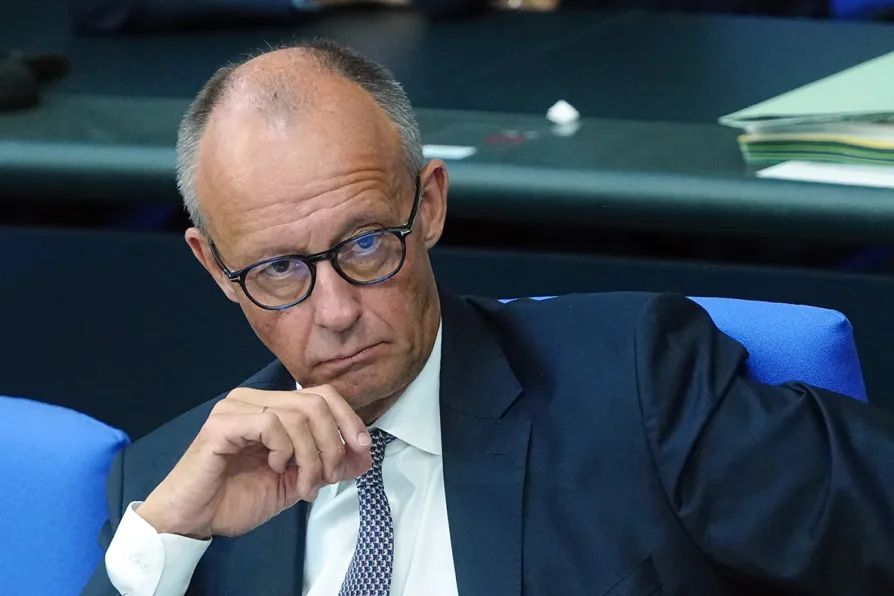 German Chancellor Friedrich Merz attends a meeting of the German federal parliament, Bundestag, at the Reichstag building in Berlin, Germany, September 8, 2026





GERMAN Chancellor Friedrich Merz refused to abandon unpopular economic policies yesterday after the far-right Alternative for Germany (AfD) party won a landslide victory in a regional election.
The anti-migration AfD fell three seats short of a majority in Sunday’s vote in the small eastern state of Saxony-Anhalt, leaving the party with a very good chance of forming the first far-right state government since the Nazi era.
Mr Merz said his conservative Christian Democratic Union (CDU) was “deeply shocked” by what he called “the most serious election defeat that the CDU has had for years, for decades,” but he stressed that “giving up is not an option for me.”
Having vowed to weaken AfD before he came to power last year, Mr Merz has instead has seen the party’s support increase.
The governing coalition of his Union bloc and the Social Democrats has struggled to persuade voters that it can get the country’s chronically sluggish economy moving by forcing through potentially painful measures, including an attack on pension rights.
Nonetheless, Mr Merz insisted yesterday that “we need fundamental reforms in Germany,” while acknowledging a need to “justify them, not just rationally but also emotionally.”
With the AfD branch in Saxony-Anhalt one of several considered a proven right-wing extremist group by Germany’s domestic intelligence agency, Mr Merz said he wanted to assure Germany’s allies that “our institutions are resilient and stable” and the country would stick to its values and constitution after the AfD win.
Other major parties have refused to co-operate with AfD, forming a so-called “firewall,” but Ulrich Siegmund, the AfD candidate for governor of Saxony-Anhalt, said his party would seek allies among other groups in the legislature and even individual legislators.
The left-wing Sahra Wagenknecht Alliance (BSW) has criticised the “firewall” against AfD and signalled that it could allow Mr Siegmund to become governor by abstaining in a potential third round of voting in the state legislature, in which a simple majority would suffice.
AfD and BSW share sympathy for Russia and oppose immigration but disagree on other issues.
A government excluding AfD would only be possible in the unlikely event that all the other parties in the legislature managed to work together.
Billionaire Elon Musk congratulated AfD on its election victory, as did the leaders of far-right parties in Spain and Portugal.
Germany faces a further two regional elections on September 20 — in Berlin and in Mecklenburg-Western Pomerania, another eastern state where AfD is strong.




NICK WRIGHT returns to Berlin and finds a city in darkness and political turmoil