Supporters from both sides prepare to stand together against season ticket threats and exploitation, writes JAMES NALTON


 Latest editorial
Football’s future is not for sale
Resistance grows as Fifa seeks to hand private investors a slice of the international game, writes JAMES NALTON
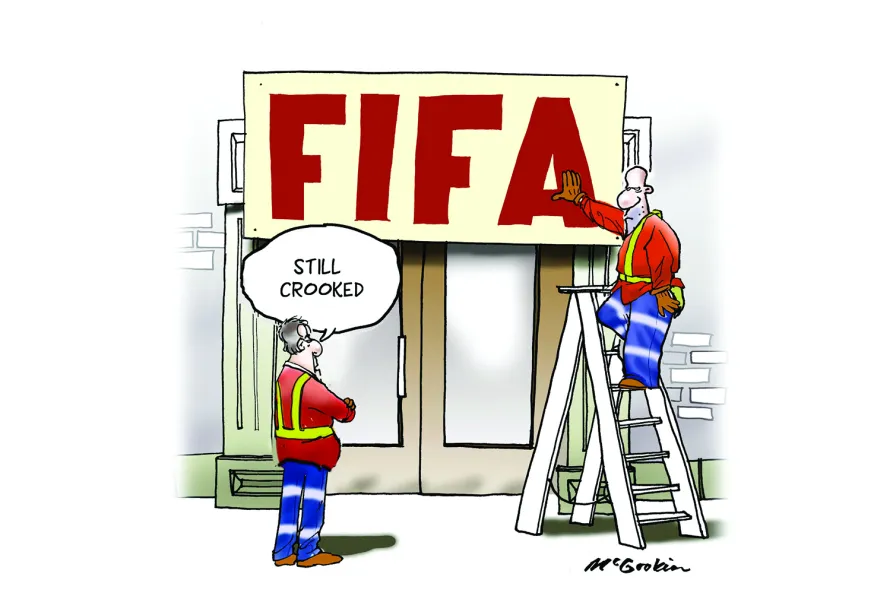 Cartoon: Malc McGookin

French federation withdraws support as pressure mounts on Fifa president





JUST when you think the culmination of the World Cup would mean at least a brief respite from the antics of Fifa president Gianni Infantino, a new development sheds some light on the reasons behind his and the governing body’s conduct around the 2026 tournament.
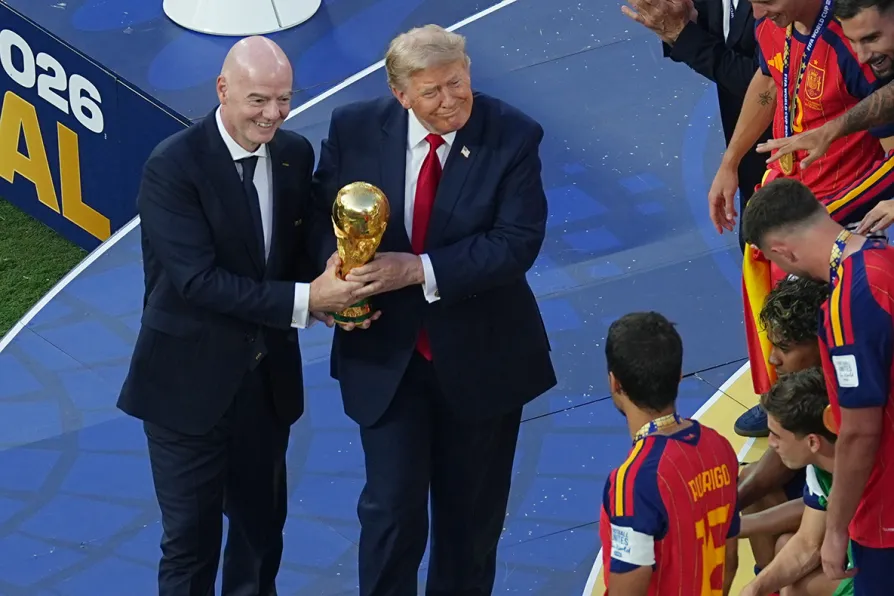
While previous international tournaments carried an obvious narrative of sportswashing, as host countries use the world’s biggest sporting events to improve their image on the global stage, the 2026 World Cup was unusual in that it highlighted many of the bad things about the US administration, which also made few attempts to hide them.
If anything, they doubled down and showed the world their unsuitability to host an event that requires the free movement into the host country of attendees from across the globe.
Sportswashing didn’t seem to apply here, but Fifa was still acting in a manner not befitting an organisation that should be the custodian of the global game.
This column covered this extensively in the months leading up to the World Cup, looking at how Fifa was using the ticket selling and reselling culture of the US to set extortionate prices and further profit from the reselling of tickets via its own official platform, and how, if it was a form of sportswashing, it was one being carried out by Fifa themselves in an attempt to normalise a particular brand of commercialisation of football.
An attempt to sportswash the commodification of football.
Fifa was selling everything it could, both digitally and physically, going as far as selling pieces of the grass pitch on which the World Cup final was played in New Jersey. At the 2026 World Cup, everything was for sale. As it turns out, as the endgame was revealed last week, so was international football itself.
Less than two weeks after the World Cup final, Fifa’s intentions became clear as reports in the Times and Financial Times revealed that the governing body would set up a subsidiary for the commercial and events portions of its activity, and sell minority stakes in the new subsidiary to private investors.
Fifa said this would lead to an influx of $20 million for each of its member associations for the period between 2027 and 2030, and increasing sums in two subsequent three-year periods.
The investment would be led by Joshua Kushner, the brother of Donald Trump’s son-in-law, Jared Kushner, who is married to Trump’s daughter Ivanka.
This sees another piece of the 2026 World Cup puzzle fall into place, and explains Infantino’s cosying up to Trump throughout the whole process, despite the obstacles the US administration created around the tournament. It also explains the blatant involvement of Trump in the suspension of a match ban for United States striker Folarin Balogun.
Unlike many of Fifa’s previous questionable proposals, this one has been met with a significant backlash, not just from the media, but from continental governing bodies and from many of Fifa’s member associations.
Uefa came out strongly against it, threatening to boycott future World Cups should this proposal go ahead. Many others followed suit, with member associations generally opposed, though some were clearly keeping their powder dry with fairly ambiguous statements, leaving it to the continental confederations to make the strongest shows of opposition.
Of course, Uefa will have its own interests at heart, and is powerful and rich enough to make a stand. It generates a lot of money for Fifa, and boasts many of the most high-profile football nations in world football. This shouldn’t mean it takes precedence over the rest of the globe, though, and one idea Fifa gets right, even if it appears to only use it as a tool to make its bad ideas seem more palatable, is that football’s riches need to be better shared out across the world.
Regardless of its own interests and power, and perhaps because of it, it is nevertheless important that a confederation as strong as Uefa made a stand as Fifa looked to effectively sell off the game to private equity, something that has already happened at the top level of the club game.
One of the most damning indictments of this move to sell off international football came on Friday when Carlos Cordeiro, a former banker who was one of Infantino’s senior advisers, and someone heavily involved in the relationship between Fifa and the White House during the 2026 World Cup process, resigned.
Cordeiro not only highlighted how this was bad for the game, but also that the deal, though it might look attractive on paper given the sums mentioned, was a bad one for Fifa’s member associations.
“Football has been central to my life, and after more than 35 years in banking, I understand both the value of this asset and the consequences of giving part of it away,” said Cordeiro.
“That is why this proposal should be rejected.
“Fifa already has access to extraordinary financial resources. The organisation sits on billions of dollars in reserves and no debt.
“The Fifa president himself has highlighted the $15 billion in revenue generated between 2022 and 2026.
“If member associations believe additional investment is needed to develop the game, Fifa already has the financial capacity to provide that support from its existing resources.
“Against that backdrop, selling a permanent stake in football’s most valuable asset to raise $4.2bn makes little sense. It is mortgaging football’s future without any compelling justification.”
Even the capitalists think it is a bad deal.
Taking a step back from the finer details of this latest saga reveals a significant moment in the future of international football. Though not without its economic issues, and certainly not without its political ones, international football as a wider entity is an area of the game relatively untouched by the blight of private equity that has invaded the game at the club level.
Rather than trying to sell the international game, an organisation like Fifa should be its custodian, and, as Cordeiro says, already has more than enough money to invest back into the game, most of which it sits on, unused.
This is money earned by the game and by those involved in it, from players to fans, from staff to volunteers. It should be invested in them and the areas where the game is played around the world, and not used to attract a small cabal of private equity investors.

Similar stories
A World Cup full of memorable moments was also marked by exclusion, exploitation and unprecedented political meddling, writes JAMES NALTON