Labour must deliver its manifesto promises in full and begin the bigger task of restoring workers’ collective power, says MATT WRACK


 Latest editorial
Let’s move from outsourcing by default to public service by design
The Labour government must deliver on its commitment to bring back privatised services into the public sector. This not only saves money but also creates accountability and generates wider social benefits, argues ANDY MCDONALD MP
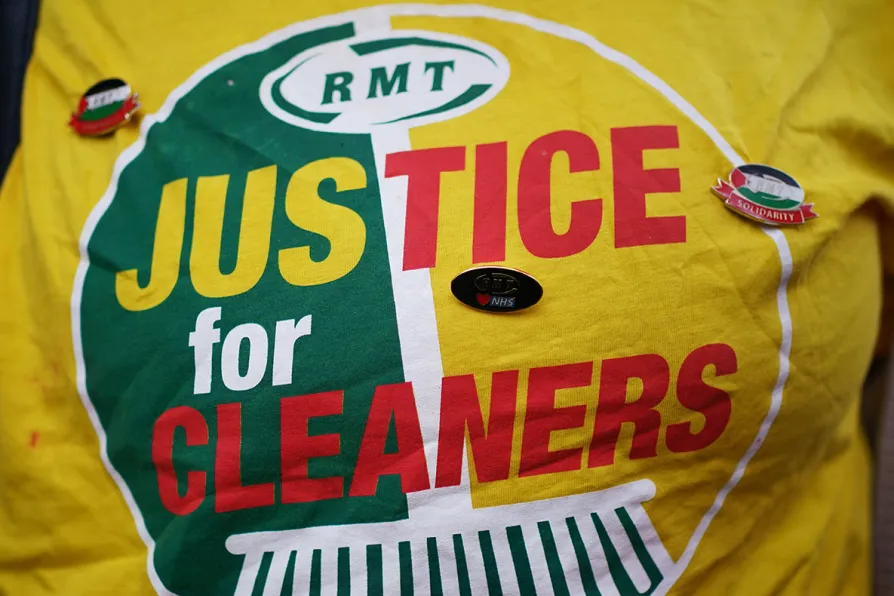 Railway cleaners stage a protest outside the Transport Department (DfT), London. Yui Mok/PA Archive/PA Images Date: 07-Dec-2022

This summer’s fire outbreaks highlighted once again the deadly cost of job, equipment and funding cuts to the fire service. Ten years after the Grenfell tragedy, serious lessons still need to be learned, says STEVE WRIGHT
Live music and musical education are both under attack and threaten to impoverish our culture. The Musicians’ Union seeks allies in the fightback, writes NAOMI POHL
The TUC fell for the illusion of a ‘Social Europe’ in 1988 and backed single-market membership. DOUG NICHOLLS argues that dramatic changes in the EU prove the need for an independent economic policy
As Cuba faces an unprecedented US energy siege and growing threats of military intervention, TUC Congress must stand unequivocally with Cuban workers and their right to determine their own future, writes STEVE GILLAN, POA general secretary and TUC president
By organising for boycotts, divestment and sanctions, trade unionists can turn solidarity into action, writes JESS BARNARD





LABOUR came into government promising the biggest wave of insourcing in a generation. Two years on, the first serious steps have been taken. This week’s TUC should ask how far the government is prepared to go.
Outsourcing is often presented as an inevitable feature of modern government. It is not. When a public body has the capacity to employ people directly and deliver a service itself, handing that work to a private contractor means public money is being used not only to provide the service, but to generate private profit.
It weakens accountability, fragments workforces and leaves the public sector dependent on private companies when things go wrong. Over time, public bodies can lose the skills and capacity to provide services themselves, while outsourced workers are often paid less and receive worse conditions than direct employees.
That is why Labour’s commitment before the 2024 election to deliver “the biggest wave of insourcing in a generation” mattered.
The government has begun to put that promise into practice. The Cabinet Office has challenged the culture of “outsourcing by default”, introducing a Public Interest Test and Insourcing Strategies so departments consider long-term value for money, service quality, resilience and wider social and economic objectives rather than simply the immediate price of a contract.
One of the clearest examples has been the campaign by PCS to bring facilities management in the Civil Service back into public hands.
For years, cleaning, security and other workplace services across government buildings have been delivered by private contractors. PCS has consistently argued that these are public services, carried out with public money, and that workers should not have to depend on a private company standing between them and the public employer.
The government’s decision to begin bringing cleaning and security services back in-house as contracts expire is therefore significant. It recognises that government should retain the capacity to deliver essential services itself — and demonstrates that it can lead by example.
PCS deserves real credit for keeping up the pressure.
The same is true of its campaign over Civil Service pension administration. The experience of MyCSP and the subsequent involvement of Capita has exposed the dangers of outsourcing an essential public function.
PCS has argued that taxpayers’ money should support public provision rather than private profit, and that accountability for Civil Service pensions should rest with the public institutions responsible for them.
There are now encouraging signs that ministers are listening.
On September 10, minister Sally Jameson said current service levels under the Capita contract were “completely unacceptable,” confirmed that the government was withholding payments and, crucially, said ministers were “looking closely at options for bringing the pension scheme in-house.” She also reaffirmed the government’s commitment to delivering “the biggest wave of insourcing in a generation”. I urge the government to take Civil Service pension management back in house.
The pressure from PCS has coincided with a growing parliamentary debate about what Labour’s insourcing agenda should mean in practice. MPs have pressed ministers to go further, while the government has developed the Public Interest Test to challenge the old presumption in favour of outsourcing.
The test currently applies to central government bodies, including departments, executive agencies and non-departmental public bodies, for relevant procurements and contract renewals over £1 million.
That is an important change in direction, but it should be the start of something bigger.
The Public Interest Test is not yet a requirement across the whole public sector. NHS trusts, councils and other public bodies are encouraged to consider its principles but are not subject to the same mandatory test.
That is the gap we should now close. Unison and the RMT have recently launched the Insource NOW! campaign, building on their consistent opposition to outsourcing.
So, if the government is opening the door to insourcing, it should not be limited to Whitehall.
The next stage should be to extend the Public Interest Test across the whole public sector — and it could start with the National Health Service and with Great British Railways.
In the NHS, there is growing anger against creeping privatisation. The government can start to turn the tide on that. Outsourced facilities management, cleaning, catering and security workers are not peripheral to patient care. Clean hospitals, properly maintained buildings, safe environments and reliable catering and security are essential to a functioning health service. These workers should be part of the public service they sustain.
The creation of Great British Railways offers another opportunity. We should not build a publicly owned railway around a two-tier workforce, where some workers are directly employed while others doing essential work on stations and trains remain employed by contractors.
Cleaning, catering, security, facilities management and other essential services should be brought into the publicly owned railway family.
This is not about pretending that every contract can or should be brought in-house overnight. It is about changing the starting point. Before outsourcing an essential public service, the question should be simple: is this genuinely better for taxpayers, workers and service users than direct public provision?
That should be the purpose of a proper Public Interest Test. It should demonstrate the benefits of insourcing.
The Labour government has made a significant start, beginning to rebuild public capacity after years in which the state was told its role was simply to commission and contract.
Now we need to go further and faster.
It has started in the Civil Service. It could include education, or local govermnent. But it could make its next move in hospitals and in railways. The government has started to end outsourcing by default. The task now is to make public provision the presumption.
Andy McDonald is MP for Middlesbrough and Thornaby East.

Similar stories
Public ownership of Great British Railways has enormous potential to improve our railway network, but that can’t happen unless jobs, employee rights and union recognition is at the heart of the transition, argues MARYAM ESLAMDOUST

PCS is demanding the long-overdue return of essential services to public ownership, explains FRAN HEATHCOTE

Despite promises of a new era of insourcing, billions of pounds of public contracts continue to flow to private firms. Unions are now calling for urgent action to bring services back in-house, says EDDIE DEMPSEY
Outsourcing is at the heart of inequality. Only collective unity in the trade union movement can topple the Establishment’s obsession with it, says SAM GURNEY