ROB WARZYNIAK wades knee deep through a pile of ‘dead canaries’ of Trumpist policies which exacerbated the horrors of US capitalism domestically


Even Tories are questioning their party’s future
Some thinkers and authors on the right are openly discussing the possibility that the historically successful party of the British ruling class may be exhausted, writes KEITH FLETT

 Conservative Party leader Kemi Badenoch and shadow chancellor Andrew Griffith during a visit to Global Technologies Racing in Fontwell, West Sussex. Friday September 4, 2026. Picture by: Gareth Fuller/PA Wire/PA Images

Without evidence or Nato consultations Berlin’s answer to the Leipzig incident is a rupture of relations. SEVIM DAGDELEN examines why
FRANCISCO DOMINGUEZ introduces the background to a conference on defending Latin America’s sovereignty
The glacier collapse in Nepal is yet another warning that a warming planet is making Himalayan disasters more frequent and destructive – but the countries facing the greatest risks are often those least responsible, says LI YANG
Nick Blair is set to benefit from a hugely lucrative contract to ‘virtually’ train the British army for its next war. Like father, like son, writes SOLOMON HUGHES
Even when tragedy strikes, Western media cannot resist the opportunity to turn it into a sordid propaganda opportunity, as the Nepal-China border tragedy shows, writes CARLOS MARTINEZ
Trade unions should be at the heart of the anti-racist push for reparations for the historic legacy and continuing impact of slavery, writes ROGER McKENZIE





MOST of the media in Britain is right-wing or very right-wing and so most news coverage focuses on what is happening inside the Labour Party — why it can’t resolve the problems of British capitalism and whether Reform might do better.
With Andy Burnham as prime minister, Labour now has a capable politician in charge but, as even he seems to realise, doing much to sort out anything is a struggle which will require a lot more than votes in Parliament.
This should, but often does not, raise the question of whether the historic party of British capital, the Tories, can help the bosses to achieve their agenda.
Kemi Badenoch recently reshuffled her shadow cabinet. With just over 100 MPs, choices are limited but she did manage to appoint Andrew Griffith as shadow chancellor, someone who was one of the main architects of Liz Truss’s 2022 mini-Budget.
Among those on the right who do think about these things, this has raised some history questions.
The Tory Party often claims to be the most successful electorally focused party in modern history. It has achieved that primarily by shapeshifting in the late 19th and early 20th centuries, reconfiguring membership with the Liberals over Ireland and free trade.
A little more recently, from 1931, it was able to draw in sections of Labour and Liberal support for a pro-boss agenda in the wake of the 1929 financial crash and, of course, from 2010-15 it allied with the Liberal Democrats to force through an austerity agenda.
Badenoch has been attempting her own shapeshifting by excluding those who back net zero and the European Convention on Human Rights from being Tory candidates. The problem here is that this narrows rather than increases Tory support.
As right-wing commentators have grasped this is a history of the present. Allistair Heath, the editor of the Sunday Telegraph, is usually given to hyperbolic end-of-the-world headlines. However, he did analyse recent local election results in a more restrained manner.
He noted that after a Reform councillor had resigned in Merseyside, Labour regained the seat. Labour also held another seat in Wandsworth in south London, despite door-knocking from Tory front benchers including Badenoch.
In Dover a three-way split between the Tories, Reform and Restore saw the Greens win a seat.
Heath argued: “While not all of the right’s woes can be attributed to division, a three-way split of the conservative electorate in the present moment would guarantee a left-wing victory at an early general election. A lot more unity is a necessary but not sufficient condition for a right-wing victory.”
In this history of the present, it is often mentioned that in Canada the conservative right split in a similar way to Britain, but when the two factions reunited it was the harder right forces that became dominant. It did not, however, win the Canadian Conservatives the 2025 election, which was won instead by Mark Carney’s Liberals.
Another figure on the political right, Anthony Seldon, has just published the latest in his series of books on recent prime ministers, this one covering Rishi Sunak’s 2022-24 premiership.
He frames the study on the question of whether the Tory Party is finished. Noting that the 2024 general election result was the worst in the Tories’ 190-year history, he writes: “Talk of the replacement of the party would have seemed delusional 10 years ago but is now a credible possibility.”
He continues: “Had things become so desperate by 2024 that the keys back to power had rusted away.”
He concludes that this is not inevitable, and rightly so, but in terms of media fixation on Nigel Farage and Labour, it’s an important history of the present. The split on the British right gives the left a chance to promote an alternative beyond Westminster politics.

Similar stories
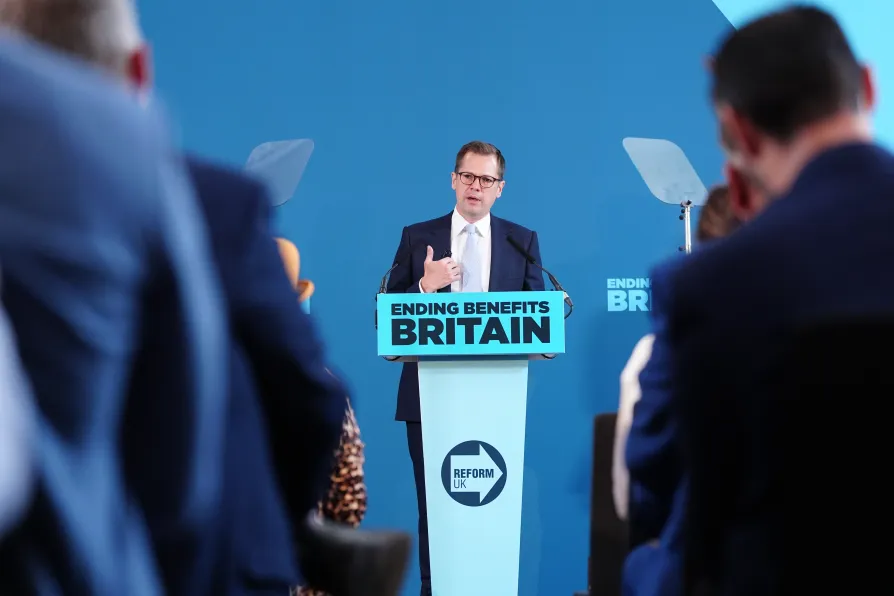

PM tells MPs he want welfare cuts and backs Nato demands for soaring military spending