ROB WARZYNIAK wades knee deep through a pile of ‘dead canaries’ of Trumpist policies which exacerbated the horrors of US capitalism domestically


Liverpool on guard against fascism, yesterday and today
Merseyside’s proud tradition of internationalism is being kept alive through events organised by trade unionists and allies in the region, writes ROBERT MACDONALD
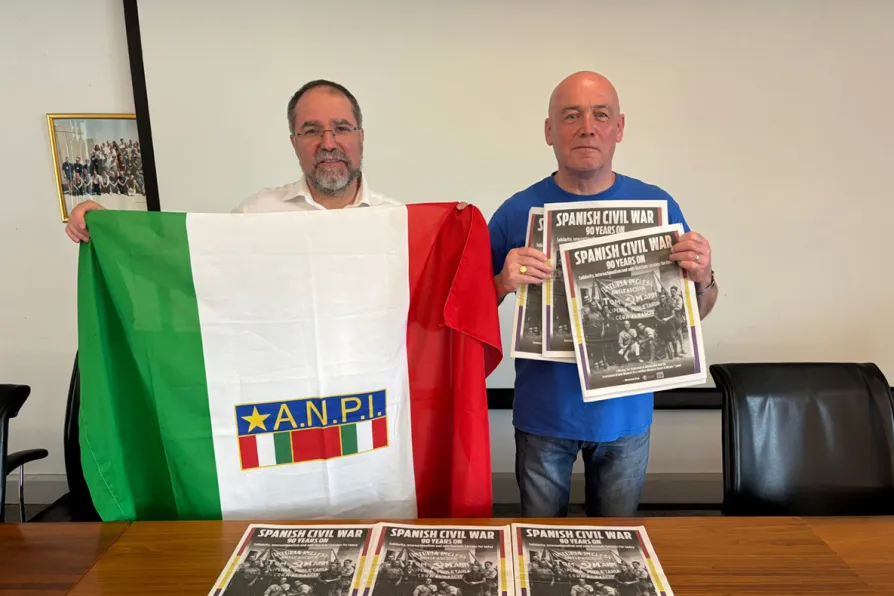
 Simone Rossi with ANPI Italian flag and Steve Farley with Morning Star supplements. Picture Robert MacDonald.
Without evidence or Nato consultations Berlin’s answer to the Leipzig incident is a rupture of relations. SEVIM DAGDELEN examines why
FRANCISCO DOMINGUEZ introduces the background to a conference on defending Latin America’s sovereignty
The glacier collapse in Nepal is yet another warning that a warming planet is making Himalayan disasters more frequent and destructive – but the countries facing the greatest risks are often those least responsible, says LI YANG
Nick Blair is set to benefit from a hugely lucrative contract to ‘virtually’ train the British army for its next war. Like father, like son, writes SOLOMON HUGHES
Even when tragedy strikes, Western media cannot resist the opportunity to turn it into a sordid propaganda opportunity, as the Nepal-China border tragedy shows, writes CARLOS MARTINEZ
Trade unions should be at the heart of the anti-racist push for reparations for the historic legacy and continuing impact of slavery, writes ROGER McKENZIE





HISTORIC struggles against fascism in Spain and Italy, along with the responses to global challenges today, were highlighted at two Liverpool events focusing on international solidarity and the Spanish civil war’s 90th anniversary.
Both events were organised by the North West Trade Union International Committee, a coalition of union members, with speakers from Britain, Spain, Italy and France.
For over 10 years, the committee has held activities in north-west England and educational visits to Spain, Italy and Ireland for union members. The latest talks were at Unite the Union’s Liverpool office and The Casa venue. The Morning Star’s Spanish civil war supplement was distributed to the audience at both events.
The first presentation was given by Tracy Delaney of Unison, Claire Moreau of the French CGT, Simone Rossi of the Italian partisans’ association ANPI; Kevan Nelson, former assistant general secretary of Unison; and Steve Farley, a PCS and committee member.
First, Tracy Delaney read a message from Spain’s CCOO workers’ commissions and the Atocha Foundation in Madrid, which commemorates labour-movement lawyers killed by neofascists in 1977, as Spain moved towards democracy after the end of Franco’s dictatorship.
Next year will be the 50th anniversary of the killings and the north-west trade union group plans to attend Madrid commemorations. Tracey said: “The Atocha commemorations keep alive the memory of those killed defending freedom, democracy and workers’ rights during a difficult time for Spain. They were killed for what they represented – working for trade union freedom and hopes of a better world.
“Today, we are witnessing the rise of populism, attacks on social rights and attempts to weaken unions. Furthermore, we live in an unstable international scene where, too often, force is put forward rather than dialogue.”
Simone Rossi, secretary of ANPI in Britain, said: “ANPI promotes awareness of history and wants to keep the values of the Italian partisans alive for young generations. Their values helped shape the post-war republic of Italy. Our work aims to ensure democracy is protected and people understand what is at stake with fascism. We also share common histories in fighting fascism across Europe, including Italians in the International Brigade in Spain and those who fought with the Allies in the second world war.”
He explained the rise of Italian fascism including violence against trade unionists. He said: “Unfortunately, many on the Italian left in the 1920s did not understand fascism. The left was unable to unite and responses were scattered. The left needs to avoid making the same mistakes today.”
However, he also highlighted Italian anti-fascism. He said: “The most effective resistance came from working-class organisations. Rome, Pisa and Parma were among the areas where the Italian Blackshirts retreated. But the skirmishes did not stop Mussolini taking power and anti-fascist organisations had to operate underground for years.”
But key industrial strikes against fascism arose during the second world war. In 1943, Turin workers, many from FIAT factories, took action five months before Mussolini was deposed. More strikes came in 1944 and 1945, leading up to a general uprising against Italian fascism and the Nazi German occupation of northern Italy.
Rossi also highlighted post-war Italian neofascism and right-wing populism in recent decades. But the Italian far right was not progressing in places where left-wing organisations stayed active and addressed issues like globalisation, such as in Bologna, he added. Lessons can be learned from this.
Today, ANPI has branches around the world, members of all nationalities and is committed to building bridges between anti-fascist organisations.
Women’s role
Claire Moreau of the French CGT spoke about greater recognition needed of women’s experiences in the Spanish civil war.
She said: “The International Brigade is perhaps the most important demonstration of international solidarity, with the working-class movement and the Comintern’s success in organising to fight for the Spanish Republic. Around 40,000 people went to Spain from countries including Algeria and Japan.
“But most were men and the labour movement then was shaped by gender roles, with only men being trained to use weapons in the International Brigade. We need to remember the women who stepped forward too. Many were active in healthcare but some served on the front line, although they were often sent back.
“Spanish republican women were among the primary victims of fascist terror including torture, rape, the theft of children and imprisonment. Even in the working-class movement, some history has been erased — so it is our duty to recognise them.”
Kevan Nelson firstly paid tribute to Colin Carr, a former Unite regional officer who played a key role in creating the North West Trade Union International Committee.
He said: “The political work of this committee began 10 years ago. It is a coalition of comrades from many unions who are committed to internationalism and working-class solidarity. It began around Spanish civil war activity but is not exclusively about that.
Battlefield tours
“In 2017, 120 comrades had a guided tour of the Jarama area near Madrid, the scene of a key civil war battle for British International Brigade volunteers. In 2018, 90 people visited the Ebro area, another important civil war location. In 2019, another Jarama trip was arranged but with more women and younger people.”
He highlighted Merseyside’s Jack Jones and Jack Coward, former leaders of the Transport & General Workers Union and National Union of Seamen respectively, who as young men fought in the Spanish civil war. Mr Nelson said: “We salute them and all the others who responded to the needs of Spain.”
In other activity, the north-west committee has organised Irish labour history visits to Belfast and Dublin, a Liverpool event about Latin America and the US, and a trip to Bologna with ANPI earlier this year, highlighting Italian partisans.
Moving to current affairs, Nelson spoke about Venezuela, Ukraine, Gaza, Iran and Cuba, the right’s push for more military spending and the consequences for civilians, industries, public needs and world peace.
But dangerous times require international solidarity, he added. Progressive movements had responded to this throughout history. In Liverpool, past examples included solidarity activity against Chilean dictator General Augusto Pinochet and apartheid South Africa. Trade unions and others must respond to today’s issues.
The second event was held at Liverpool’s Casa venue and combined politics with food and music. Speakers included Mark Hoskesson, a former Unite convener and Liverpool Trades Council secretary; Danny Payne, a committee member; and Helen Graham, a Spanish civil war historian and author.
Hoskesson recalled Spanish civil war projects including a plaque installed at Unite’s Liverpool office and an exhibition, “From The Mersey To The Ebro,” which Danny Payne developed for Liverpool’s City of Culture year and is now displayed at The Casa.
On overseas visits, Hoskesson emphasised. “These are not trade union ‘jaunts.’ The people who gave their lives in Spain were overwhelmingly working class and trade unionists. They were seamen, miners, dockers and fitters. Yes, there were a few middle-class poets and artists in Spain — but almost 80 per cent were manual workers or unemployed. The workers were the heroes of the Spanish civil war. Our message today is that workers’ solidarity is the ‘fist’ needed to smash fascism.”
Payne highlighted Liverpool politics in the early 20th Century, Merseyside people who went to Spain and the key influence of the Communist Party in recruitment to the International Brigade.
Lessons from history
Academic Helen Graham gave a detailed presentation on the Spanish civil war, highlighting 1930s geopolitics. Across Europe, right-wing forces were attacking the social gains made after World War I, the rise of socialism and the USSR.
The Spanish Republican government was faced by Franco also backed by fascist Italy and Nazi Germany — then the world’s only military-industrial complexes. If the Spanish government could have bought arms internationally, it could have perhaps prevented the coup, but it could not. Only later did arms come from the USSR when Madrid was at risk, she said.
Britain’s policy of “non-intervention” did not stop Hitler and Mussolini. Graham said British powers wanted Franco’s coup to succeed. Britain had significant links to Spanish business and tolerated rising fascism for years. Neville Chamberlain reportedly asked that Barcelona be bombed “discreetly” by Franco’s forces, she added. The British Establishment even considered visiting the Nazi Dachau concentration camp, she said, but this failed to materialise after Germany invaded Poland in 1939.
Importantly, she said more than half of all International Brigade volunteers were migrants or refugees from central Europe. But she added: “This is not echoed in English literature — but we need to be holistic. They were the beginnings of the European resistance.”

Similar stories