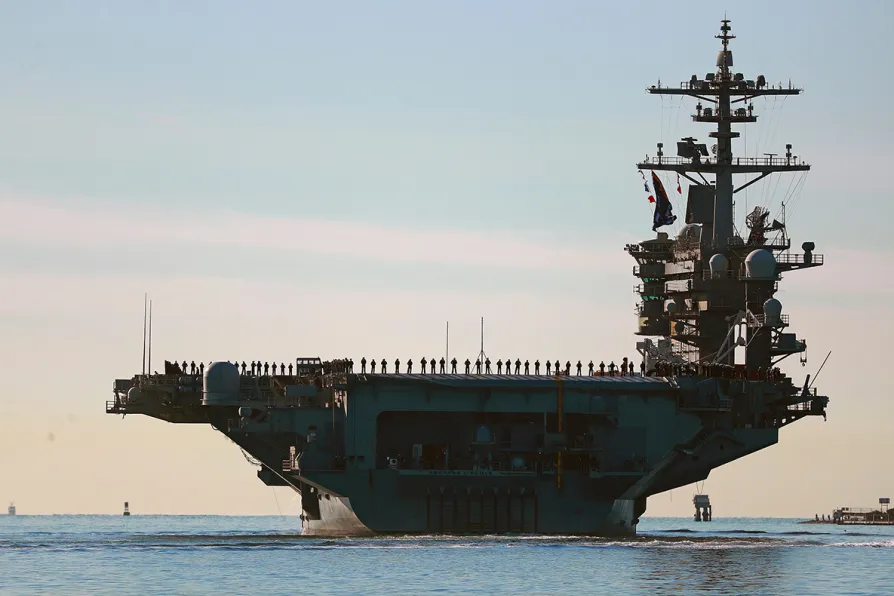
 Sailors and Marines line the deck of aircraft carrier USS Abraham Lincoln as it deploys from San Diego, January 3, 2021





THE United States is now threatening to maintain an indefinite naval blockade of Iran.
US Defence Secretary Pete Hegseth told reporters on Thursday that the US military could keep a naval presence in the region to enforce its blockade of Iran.
“Indefinitely the United States Navy can maintain a blockade like that because we’ll rotate ships in and out, as we have, and we’ll continue to,” he said.
The reference to rotating ships may refer to reports that sailors on the USS Abraham Lincoln, which has not made land in 250 days — a record for a modern aircraft carrier — have attempted to jump overboard while others report a “mental health crisis” on the ship because it has been on active duty for so long, a deployment linked to the Iran war.
After the US broke the memorandum of understanding agreed with Iran, Tehran has toughened up its control of the Strait of Hormuz, a key strategic waterway for the world’s economy.
The Iranians have attacked some vessels trying to transit the waterway, through which a fifth of the world’s oil and liquefied natural gas travelled before the war began in February.
Two vessels from the state-owned Abu Dhabi National Oil Company were attacked transiting the strait yesterday evening, UAE news agency WAM reported.
The United Arab Emirates government condemned it as an Iranian attack.
US President Donald Trump has bragged repeatedly that the US has “total control” over the strait.
The Iranians have said that those claims “do not change the reality. The Strait of Hormuz remains blocked and will not be reopened until Iran’s conditions are accepted.”
The demands include the removal of economic sanctions and the release of frozen Iranian assets.
The US previously said it would lift the Iranian blockade once Iran and Oman, which sit on either side of the strait, reach an agreement to restore commercial shipping.
The US president is under pressure at home to end a war that is deeply unpopular, with high fuel prices dragging down his approval ratings and potentially eroding his party’s control of Congress in midterm elections in November.
There is also increasing stress on the global economy.
On Wednesday, the International Energy Agency forecast that global oil supply would fall by around 4.3 million barrels per day, or around 4 per cent, this year.
Oil prices have been bouncing up and down depending on whether a full resumption of hostilities was on the cards.
There are allegations that President Trump has profited financially from the uncertainty.