
ROB WARZYNIAK wades knee deep through a pile of ‘dead canaries’ of Trumpist policies which exacerbated the horrors of US capitalism domestically


No easy exit from Ukraine debacle
Andy Burnham offers unconditional support for Zelensky but no solutions to the underlying conflict between the Nato/EU bloc and Russia, says NICK WRIGHT
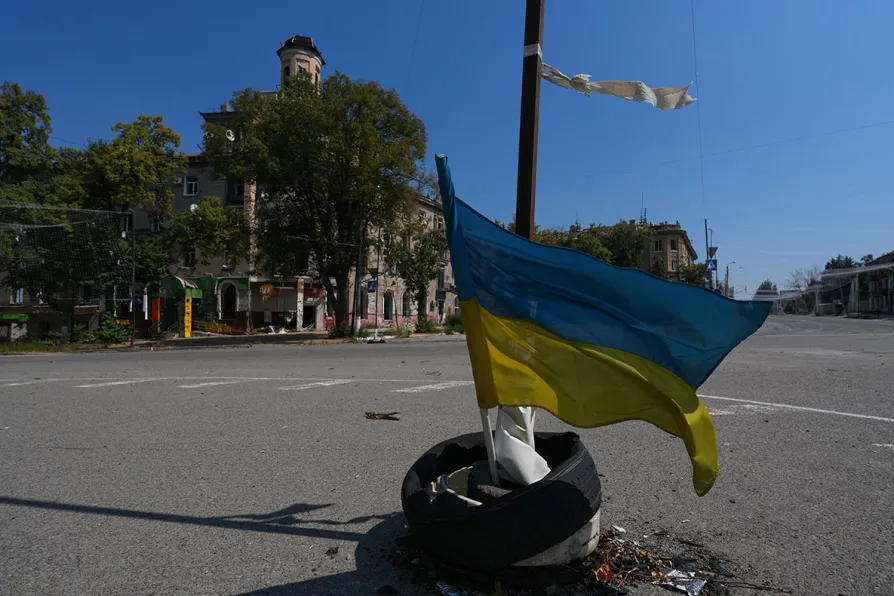
 A Ukrainian flag waves in the centre of the frontline town of Druzhkivka, Donetsk region, Ukraine, August 10, 2026
Without evidence or Nato consultations Berlin’s answer to the Leipzig incident is a rupture of relations. SEVIM DAGDELEN examines why
FRANCISCO DOMINGUEZ introduces the background to a conference on defending Latin America’s sovereignty
The glacier collapse in Nepal is yet another warning that a warming planet is making Himalayan disasters more frequent and destructive – but the countries facing the greatest risks are often those least responsible, says LI YANG
Nick Blair is set to benefit from a hugely lucrative contract to ‘virtually’ train the British army for its next war. Like father, like son, writes SOLOMON HUGHES
Even when tragedy strikes, Western media cannot resist the opportunity to turn it into a sordid propaganda opportunity, as the Nepal-China border tragedy shows, writes CARLOS MARTINEZ
Trade unions should be at the heart of the anti-racist push for reparations for the historic legacy and continuing impact of slavery, writes ROGER McKENZIE





ON HIS last day in office, prime minister Keir Starmer dropped in on Ukrainian leader Volodymyr Zelensky in Kiev to pledge another £255 million in funding. Starmer came away with Ukraine’s Order of Freedom to decorate his post-No 10 mantelpiece.
Last month, European Union (EU) states approved the Britain’s participation in the Ukraine support loan — this is the EU’s €90 billion (around £77bn) advance to fund Ukraine over this year and next.
Two thirds of the loan is for Ukraine to buy military resources and one third for direct economic and budgetary support.
Britain’s participation in the loan is part of the government’s policy of deepening integration with the European Union. Britain has underwritten a proportion of the costs of the loan and is now in a security and defence partnership with the EU, while being a substantial existing contributor to the overall financial and military support that underpins the Nato/EU proxy war.
The key provision of the agreement states: “This is an important step towards the participation of the UK allowing Ukraine to procure, under the Ukraine Support Loan, from a larger pool of defence manufacturers, ensuring they have the capabilities to withstand Russian aggression.”
These are codewords for a policy of preferment for European arms manufacturers keen to profit from taxpayer-funded military purchases.
Russia has now occupied almost all of the Russian provinces that the Soviet Union ceded to Ukraine in the early years after the October Revolution.
It has also strengthened its control over the Crimea, ceded to Ukraine in the 1950s, and now rendered more secure by the consolidation of the peninsula’s defences.
Odessa, a cosmopolitan but substantially Russian-speaking city, remains in Ukrainian hands. It also used to be a heavily Yiddish-speaking city until the Nazi occupation and Holocaust.
The city must be high on the list of territories Russia wants to see priced into a peace deal, even if Odessa is not gained by military means.
Much of the West’s media myth-making is grounded in the illusion that Ukraine holds the strategic initiative. Kiev’s shift to missile and drone attacks on Russian Federation regions within range of these weapons has achieved some propaganda successes in the West. However, it may also reinforce Russian civilians’ conviction that they really are at war rather than significantly alter the battlefield situation.
This may be, in a sense, some compensation for the failure of the British intelligence-inspired assault into the Russian territory of Kursk, which ended with a whimper. Nato military and intelligence officers who provided close support for the Ukrainian armed forces have in turn become targets for Russian missile and drone strikes.
There is a will among the leaders of some EU states and Britain to intensify military and logistical support for Ukraine’s military, although other EU states in the immediate vicinity of the conflict are markedly less enthusiastic.
Nato and EU military support for Ukraine is dependent on a media-induced notion that the strategic advantage now lies with Ukraine. The Ukrainian missile assault on Russian oil-refinery infrastructure has caused casualties as well as some disruption of supplies to the domestic economy but, like Napoleon, Hitler and the generals of the 14 armies which invaded post-revolutionary Russia, Ukraine’s military has discovered that Russia is a huge territory and most of it is beyond even the most sophisticated missiles that Nato and the EU are prepared to supply.
Meanwhile, Russia’s targeting of Ukrainian infrastructure has become more effective since Donald Trump’s Iranian adventure, which has so denuded the US stock of anti-missile defence systems that there is little left for Kiev to use to intercept Russian strikes.
The first exodus of refugees from Ukraine was, of course, the million plus people who, in 2014 and 2015, fled the assaults by Ukrainian special forces, as well as the Azov and Right Sector militias.
But the largest number of refugees — six million people — have left the country subsequently. Perhaps another third of the Ukrainian population has been displaced, firstly during the post-2014 civil strife and latterly by the Russian invasion.
The Ukrainian armed forces increasingly face a manpower crisis. In April this year, the Independent newspaper reported that Mykhailo Fedorov, Ukraine’s newly appointed defence minister, admitted that Ukraine has two million draft-dodgers and hundreds of thousands more who are absent without leave.
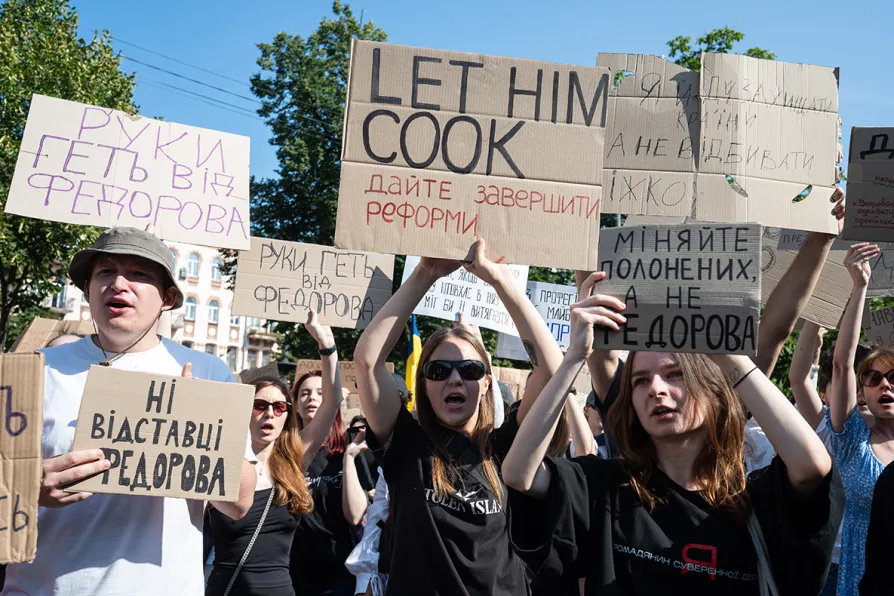
Last month, Zelensky dismissed Fedorov, provoking widespread public protests. Some sources suggest that Fedorov had been successful in implementing a more integrated military strategy and that he had also made some headway against widespread corruption. These demonstrations crossed over with protests aimed at preserving the independence of anti-corruption agencies threatened by Zelensky.
Fedorov, previously Ukraine’s minister of technological innovation, has a certain following among young professionals and remains uncontaminated by the pervasive culture of corruption that envelops Ukraine’s political and business elite.
The demonstrations which followed Fedorov’s dismissal are just one indication that civil society in Ukraine is becoming more influential. A strong desire for peace is emerging as a decisive factor.
A Lord Ashcroft poll has focused on this question and reports that just 16 per cent of Ukrainians say they believe they are currently winning the war. This is down from nearly half of those surveyed by the organisation a year into the conflict in 2023.
The report continues: “Even so, this is more than the proportion who think Russia has the upper hand. Though Russia has experienced net territorial losses over the last year, two thirds of Ukrainians think neither side currently has a clear advantage, a figure unchanged since my previous survey just over a year ago.
“In our five allied countries, majorities also agree that neither side is in an obviously stronger position. However, it is notable that in each case, the dissenting minority is more likely to think things are going Russia’s way than Ukraine’s.”
Ashcroft’s opinion surveys are valuable in this context precisely because he is so open about his support for the Nato/EU strategy.
On Crimea, an irredentist one third thought it possible to regain all the territory taken by the Russians and Ukraine should keep fighting until this was achieved. A roughly similar proportion thought this possible but the cost would be too high, with older age groups more invested in regaining the lost territories than younger people.
And nearly three-quarters of Ukrainians want to see direct negotiations between Ukraine and Russia.
The context for this now seemingly settled state of opinion is the changed battlefield conditions.
Large parts of Ukraine are open land dedicated to arable crops. Older military strategies, which relied on a combination of armour and air power to dominate the battlefield and allow ground forces to occupy territory, are now largely negated by the predominance of drone and missile technology, compelling infantry to evade surveillance and find secure cover.
The material factor that counts most against a political and diplomatic resolution of the conflict is, of course, the dependence of Zelensky’s regime on the support he receives from abroad, particularly from the European Union and most of its constituent states.
This aid is conditional. This is made explicit by the US Department of War’s position: “The United States ensures that every dollar of support to Ukraine serves a clear strategic purpose and advances America’s national security interests. While we continue working with allies to strengthen Ukraine’s sovereignty, Europe must take the lead in long-term security assistance. Support will be results-driven, accountable and part of a broader strategy for lasting peace.”
Thus European, specifically EU, aid to Ukraine’s war fighting capacity is consistent with US policy and is increasingly at odds with the direction of Ukrainian public opinion.
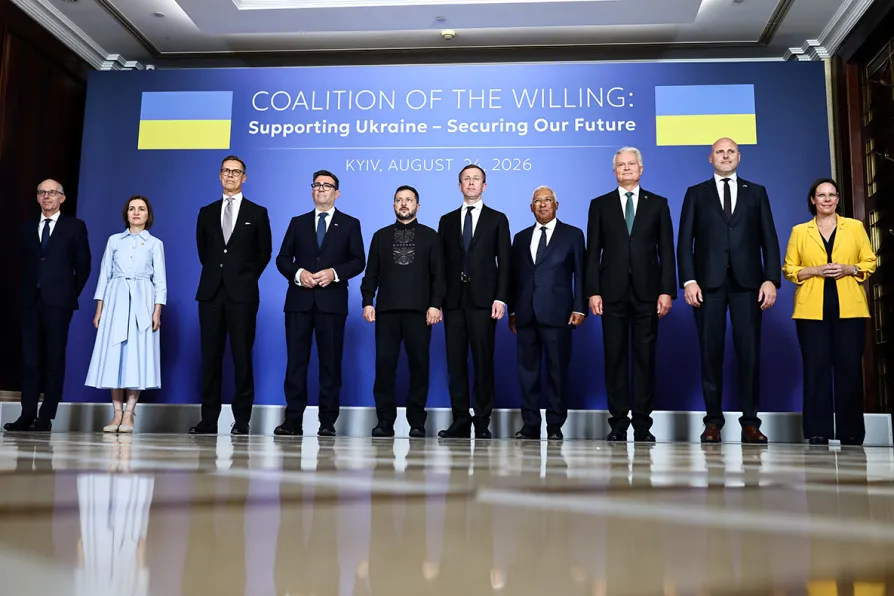
New British Prime Minister Andy Burnham has seamlessly picked up on Starmer’s discredited policy, telling his first international visitor, Zelensky, that Britain is “with Ukraine 100 per cent.”
Burnham also offered the intellectual property rights to allow Ukraine to manufacture and deploy the new “Stone Cloak” electronic-warfare system.
Just over half of British respondents backed military support for Ukraine, considerably more than among citizens of Nato countries nearer the front line. There is also greater scepticism about accepting more Ukrainian refugees, with particular resistance in Germany and Poland.
The same Ashcroft survey asked specifically whether respondents would support Starmer’s pet idea of sending British troops to Ukraine to join an international “peacekeeping” force in the event of a peace deal. The Russians regard this as a provocation. The survey found a majority in favour in Britain, and public opinion more supportive than opposed in France and the US, with majority opposition in Germany and Poland.
It’s clear that the peace movement in Britain has a major task ahead in acquainting people with the real-life consequences of the Nato/EU war strategy.

Similar stories
The defence secretary’s resignation reveals not a split over principle but a dispute over pace of military spending, as Britain’s political Establishment unites behind deeper Nato commitments, argues NICK WRIGHT