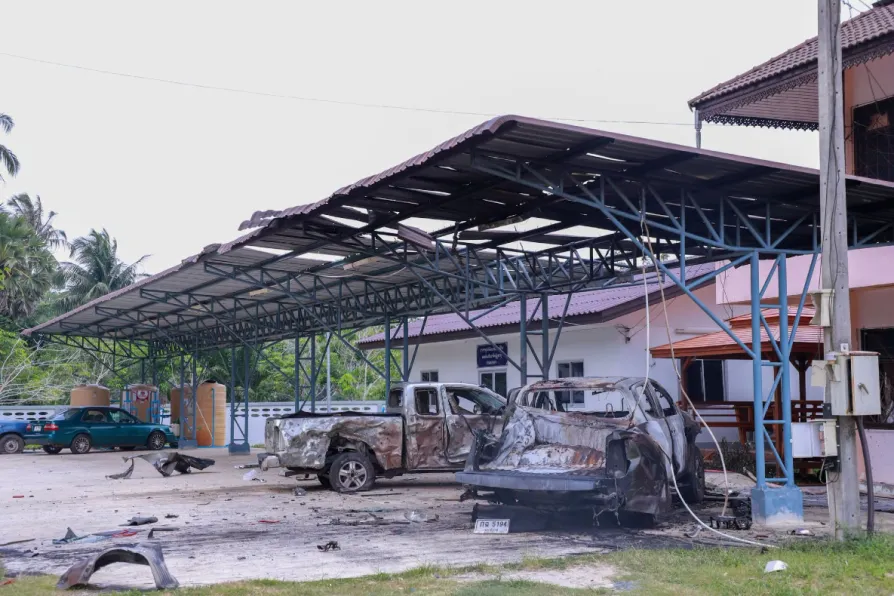
 Vehicles damaged by arson at a local government office in Sri Sakhon Subdistrict in Narathiwat province, Thailand, August 23, 2026





THAILAND’S Prime Minister Anutin Charnvirakul, already facing a flood crisis in the country’s north, held an urgent meeting on Sunday with high-level security officials in response to co-ordinated violence overnight in three southern provinces where a Muslim insurgency is active.
The meeting, held shortly before Anutin flew north to inspect the badly flooded province of Nan, followed 51 incidents on Saturday night in the southern-most provinces of Narathiwat, Pattani and Yala.
The attackers did not engage with military or police forces. Only three civilians were known to have been wounded and they were reported to be recovering on Sunday.
The violence primarily involved small bombs, arson and other forms of property damage. The highest-profile target was a 7-eleven convenience store in Pattani.
A bomb that damaged rail tracks in Narathiwat forced the suspension of local and long-haul services. It was not clear when they would be restored due to the uncertain security situation.
No group was immediately publicly blamed or claimed responsibility for the actions.
However, such attacks are generally believed to be carried out by the Barisan Revolusi Nasional Melayu Patani (BRN).
It is the major insurgent group in the south with the organisational means and support to stage such an action. It is also the group with which the Thai government has been holding on-again, off-again peace talks.
The three southernmost provinces are the only ones with Muslim majorities in predominantly Buddhist Thailand and the BRN has said that it is seeking self-rule for them.
Muslim residents have long complained of being treated like second-class citizens in Thailand and separatist movements have been periodically active for decades.
Insurgent violence escalated sharply in 2004 and was met with heavy-handed crackdowns, further fuelling discontent.
According to Deep South Watch, a think tank based at the Prince of Songkla University’s campus in Pattani, 7,837 people have died in the violence in the past 22 years.