Labour must deliver its manifesto promises in full and begin the bigger task of restoring workers’ collective power, says MATT WRACK


 Latest editorial
Burnham needs to deliver the goods on pledges for education funding
If Labour is genuinely committed to supporting working-class students it must act urgently to reverse the funding crisis affecting universities and colleges, JO GRADY tells Christophe Domec
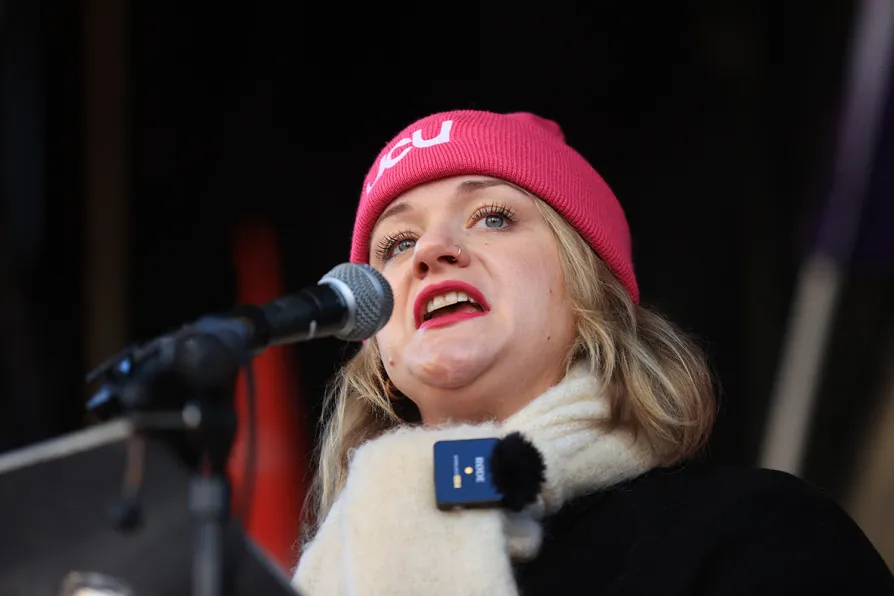 Jo Grady, general secretary UCU, addresses rally outside Belfast City Hall. Picture Liam McBurney/PA Archive/PA Images. January 18 2024

This summer’s fire outbreaks highlighted once again the deadly cost of job, equipment and funding cuts to the fire service. Ten years after the Grenfell tragedy, serious lessons still need to be learned, says STEVE WRIGHT
Live music and musical education are both under attack and threaten to impoverish our culture. The Musicians’ Union seeks allies in the fightback, writes NAOMI POHL
The TUC fell for the illusion of a ‘Social Europe’ in 1988 and backed single-market membership. DOUG NICHOLLS argues that dramatic changes in the EU prove the need for an independent economic policy
As Cuba faces an unprecedented US energy siege and growing threats of military intervention, TUC Congress must stand unequivocally with Cuban workers and their right to determine their own future, writes STEVE GILLAN, POA general secretary and TUC president
By organising for boycotts, divestment and sanctions, trade unionists can turn solidarity into action, writes JESS BARNARD





ANDY BURNHAM has spoken powerfully about how he, a “working-class lad” from north-west England, was able to study arts and humanities at Cambridge.
But, at the moment, opportunities like those once given to the new Prime Minister are under “total threat,” UCU general secretary Jo Grady told the Morning Star.
Speaking to the “daily miracle” ahead of the 158th annual TUC Congress, Grady says: “I want to make sure that every working-class child from the north-west or wherever can continue to do that.”
This year, the UCU will put forward a motion asking unions to recognise how deep the funding crisis is in colleges and universities in Britain.
“We’re looking at thousands of job losses in universities, arts and humanities attacked, courses closed. It’s a drastic restructuring of universities as we know it,” she explains.
“And that’s in addition to our college staff being really, really underpaid — about 9,000 less than people doing their comparative job in sixth forms.”
Universities are seeing “dozens of local disputes” at this very moment, she says, pointing to “really impressive and courageous local strikes” in places such as Exeter, where workers are fighting to protect entire departments and jobs.
“We are managing to save jobs or at least get the university to engage with us about how we might save money and protect courses and protect jobs, but it is obviously a real slog. The union’s been investing massive amounts of money into its fighting fund to ensure that members can stay in the fight and that we can protect as many jobs as possible.”
Grady acknowledges that there has been an important shift since Burnham took over from his predecessor, mainly in terms of his tenor.
He has spoken “very clearly and openly about the need for a proper safety net, whether that’s for homeless people, or whether that’s for social care,” and about the importance of post-16 education, even signalling he could move to “make it post-14 education, by bringing in a vocational focus right down into schools.”
Pointing to a real shift from Keir Starmer’s “really disappointing” tone, to one more “impressive” under Burnham, Grady says: “When you are in government, you have the ability to be more generous with your storytelling.
“You don’t have to make an outlandish statement to get journalists to listen to you.
“I was really impressed, for instance, when [Burnham] was speaking about care and he took real time to talk about the vast amounts of international staff that work in our care sector.
“You juxtapose that to when Keir [Starmer] did the Island of Strangers speech — which I know he stepped back from — but I think they’re really kind of crucial moments in how a leader tells stories and encourages the population to think about their own nation.”
For many progressives, these are welcome announcements. But the “proof is in the pudding,” Grady says, referring to Burnham and his Chancellor’s first Budget in autumn, set for October 28.
“What we need to see — and that is the crucial question — will [these words] be matched by money and investment when we get the Budget. They really, really need to address this huge crisis in our university sector and our college sector.
“Our Prime Minister wants to keep on telling us stories about how important it is that working-class children and marginalised people and children can grow up with imagination, to think and learn.
“Then they have to invest. And that investment cannot be predicated on increasing our investment in defence.”
At last year’s TUC Congress, unions backed a landmark motion moved by the UCU for “wages, not weapons,” reversing a previous policy which supported increases in defence spending.
These motions are linked, Grady explains, because “whilst we’re seeing universities moving to close departments and sack staff, the government announced a Defence Universities Alliance (DUA) involving 35 universities, the Ministry of Defence £182,000,000 in defence-related skills investment.”
“We don’t want the jobs that are saved in universities to purely be saved, because they’re being part of an investment in the war machine,” Grady says.
“We want priority investment in people, infrastructure, in services, in jobs — not the war machine. Our motion brought to the TUC last year talked about what building real security would look like.
“Throwing money into a black hole and calling it military Keynesianism doesn’t work. We do not want to see more military spending. And we particularly do not want to see it to the detriment of investment in our services and education.”
Referring to government plans to increase military spending to meet Nato targets, Grady says “these targets are essentially connected to what the US spends on its military.
“So, it’s not some sort of target driven by an assessment of what we need to be safe. It’s just about matching US spending.”
Referring to recent research produced by think-tank Common Wealth, suggested figures of 190,000 jobs created as a result of increased war spending are “pretty much all US jobs,” she says.
“Whether or not you think it will deliver security, it is not going to deliver this kind of jobs-based growth which is so often talked about.”
Building on a year of action against sector-wide cuts, the UCU is launching its “Education. It’s ours” campaign on September 22.
Grady says it will be based in “every branch of every university” in Britain, putting pressure on ministers and making a “huge case for why they need to invest properly in our education sector.”

Similar stories

DAVE WARD of the Communication Workers Union says unions must step up to meet the challenges of a transformed world of work

Faced with employer abuse and exploitation, low-paid overseas staff have been the backbone of Britain’s health and social care sectors. The Labour government must abandon plans to punish them with draconian visa restrictions, writes CLARE WILLIAMS, Unison national officer

In a wide-ranging interview, JEREMY CORBYN talks to Ben Chacko about the difficulties the new Prime Minister faces and why he sees no future in Labour