

 Latest editorial

As Naomi Osaka parades her latest line of flamboyant outfits in New York, LINDA PENTZ GUNTER wonders what the notoriously eccentric tennis designer would have made of it all
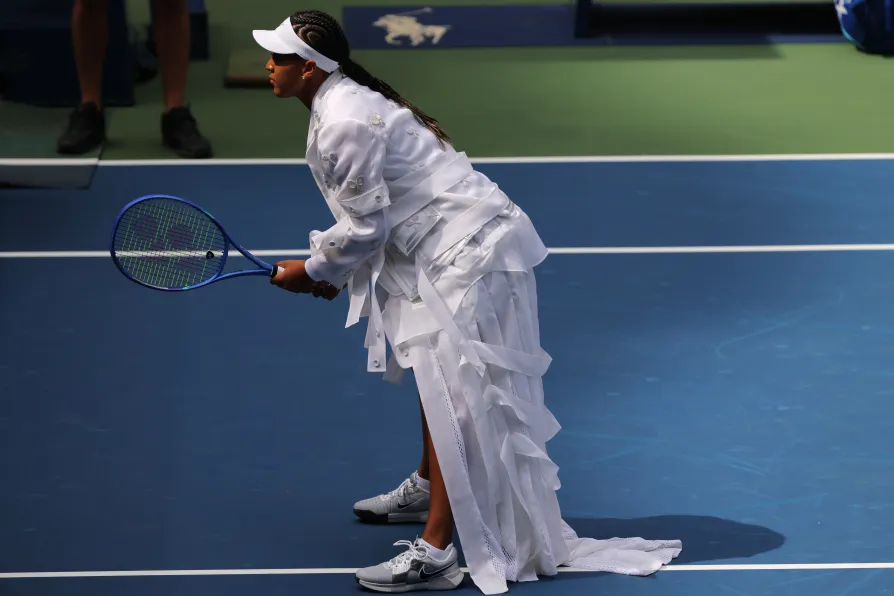 ONE OF A KIND: Naomi Osaka warms up ahead of her match against Katerina Siniakova during the US Open second-round






WATCHING Naomi Osaka’s ostentatious debut entrance onto the Arthur Ashe stadium on Monday night at the US Open Tennis Championships planted one obvious thought in my mind. What would Ted Tinling have thought?
Osaka, 28, is a Japanese American right-hander born to a Haitian-American father and a Japanese mother. She achieved the world’s number one ranking on the women’s tour in January 2019.
But recently, she has made more headlines for her jaw-dropping on-court outfits — often floor length, multi-layered, ruffled and highly original — lending a nod to her heritage or an influential icon.
Monday’s costume, which included a distressed white hoodie with newsprint headlines and photos tracking her career matched with a bouffant white tulle skirt, was a tribute to basketball great, Allen Iverson.
She’s also appeared in outfits inspired by the Japanese kimono, or adorned with giant bows, chiffon bustles and veiled hats. Naturally, she discards these outer layers for more traditional tennis garb once the match begins.
For her second round US Open match on Thursday, Osaka opted for a floor-length silvery beribboned coat.
Tinling, who started out as a tennis player himself in the 1920s and ’30s, became famous as the couturier to the tennis stars. Although it seems tame now, he caused a scandal in 1949 when American player Gussie Moran appeared on court at Wimbledon wearing his latest design — a shorter than usual skirt that revealed frilly knickers underneath.
The fallout was extraordinary. Tinling was banned from Wimbledon by the stuffy management at the All England Club for more than three decades. They accused him, among other things, of bringing “sin” onto Centre Court and of “drawing attention to the sexual area.” The press lapped it up. Moran came to be known as “Gorgeous Gussie.”
But Tinling kept the designs coming, and the opinions. He loved to deliver witty and often highly barbed one-liners and spared no one. He was the tennis tour’s Miriam Margolyes, not only not afraid to shock, but delighting in it. Everyone wanted to bask in his light, especially the media who lapped up his zingers.
Tinling was also not averse to making fashion statements of his own. At six feet seven inches tall, with a domed bald pate, Tinling was impossible to miss in a crowd, and that was just the way he liked it. I remember vividly accompanying him to an impromptu lunch at the Dallas Country Club prior to the women’s tournament there, at the invitation of the event’s director, Nancy Jeffett, whom Ted adored.
I was inappropriately dressed in purple brushed cotton overalls, having just arrived off the plane and obeyed Ted’s command to join him. Ted was also in purple, a three-piece suit which I am sure he considered entirely appropriate — along with white patent leather shoes and a giant diamond stud in his ear. The stares we got as we followed Nancy to our table were unforgettable.
Ted’s opinions were by no means restricted to tennis fashions. He loved Dallas — the place and the television series — and assured me at one of Jeffett’s many society parties that the two were exactly the same, “except the rocks in this room are real.” I never asked him if his own diamond was, but I imagine so.
True to his unfiltered style, he once proclaimed far too loudly as we took tea sometime in the 1980s at the Waldorf Astoria in New York, during the “Boy George” fashion era, that my dangly earrings were “so long they almost come down to your tits!”
Once in Dallas, when a night out involving too much tequila had me feeling green, I told Ted that my “official” story was I had contracted a bad cold. But at that morning’s sponsor brunch, the first thing he told anyone we met was “this is poor Linda. She has a dreadful hangover.” Around Ted there was no getting away with anything.
While he was a friend to the tennis stars, that did not automatically extend to their chosen partners. He was instantly suspicious of former Texas beauty queen Judy Nelson, who was the partner of Martina Navratilova from 1984-1991, referring to her caustically as “the other one” and never by name.
And maybe he was right. When the relationship ended, Nelson sued Navratilova for $7.5 million under palimony law. The case was settled out of court, reportedly for $3.5 million.
As two Brits in chosen exile in the US, we found much in common, including that we both travelled with our own English jam because the customary grape jelly served up in American hotels and coffee shops was entirely repulsive.
And then there were the surprises. Flamboyant as he was, I don’t recall Ted ever discussing his sexuality — although when you look up his bio, he is described as “openly gay”. But one day during the tournament in Philadelphia — his chosen hometown — he introduced a small gathering of mostly British tennis reporters to his “son.”
As he eventually explained it, the adult “son” before us was in fact the son of his batman during World War II, (during which he worked for British intelligence), who had died prematurely and to whom Ted said he owed a lot. The suggestion was that Ted had adopted him, but there is no verifiable evidence to support this and I don’t think any of us ever asked him about it again.
Ted died in 1990 in Cambridge, England. As planned, he donated all six feet seven inches of his body to science. Someone told me he had left written instructions for his entire funeral programme, but, again, nowhere is this verified.
Ted adored glamour. That perhaps accounts for his double-edged exasperation with the dazzlingly beautiful Argentine tennis champion, Gabriela Sabatini, about whom he commented, “she looks like Marilyn Monroe and walks like John Wayne.”
He would doubtless have been pleased to see Gabi, as everyone called her, walk across the stage at the 2026 International Tennis Hall of Fame ceremony last month looking agelessly radiant in a flowing floral skirt and with no hint of John Wayne about her. Ted himself was enshrined there in 1986, observing how nice it was to be installed in a museum “before you are stuffed.”
So I think Ted would have revelled in Osaka’s fashion audacity. He would have loved the extravagance of her showy get-ups and the risk-taking of walking onto the centre court at Roland Garros with a chiffon train dragging through the red clay. Or parading across the Rod Laver Arena in Melbourne almost hidden under a huge white hat and matching jagged umbrella with a long veil billowing behind her.
In the Tinling era, no two players ever wore the same outfit, in contrast to today’s sponsor-driven attire. When Tinling dressed former doubles champion Rosie Casals in velvet and sequins, she recalled that “When you put that on, you felt like a star.”
Osaka certainly looks like a star. Maybe she feels like one, too. Her mental fortitude has at times wavered — she has been openly outspoken about her battles with mental health, especially depression and anxiety, including in a July 2021 article she wrote for Time magazine entitled “It’s OK not to be OK.” Tellingly, in that same article she declared that “I am naturally introverted and do not court the spotlight.”
On the tennis court, confidence is everything. “Confidence is probably what makes the difference between a victory and a defeat,” Tinling observed of the sport. “If a woman feels that she is prettier or better dressed than her opponent, nothing can stop her.”
Ted’s views read a little old-fashioned today, but as we wait for Osaka’s next wild on-court ensemble, maybe he was onto something after all.
Linda Pentz is a writer living in Takoma Park, Maryland. She covered the professional tennis circuit from 1977-98.

Novak Djokovic could topple his own record 24 Grand Slam singles titles at the US Open, but the shadow of Rafael Nadal’s greatness still hovers over both the men’s and women’s draws, writes LINDA PENTZ GUNTER
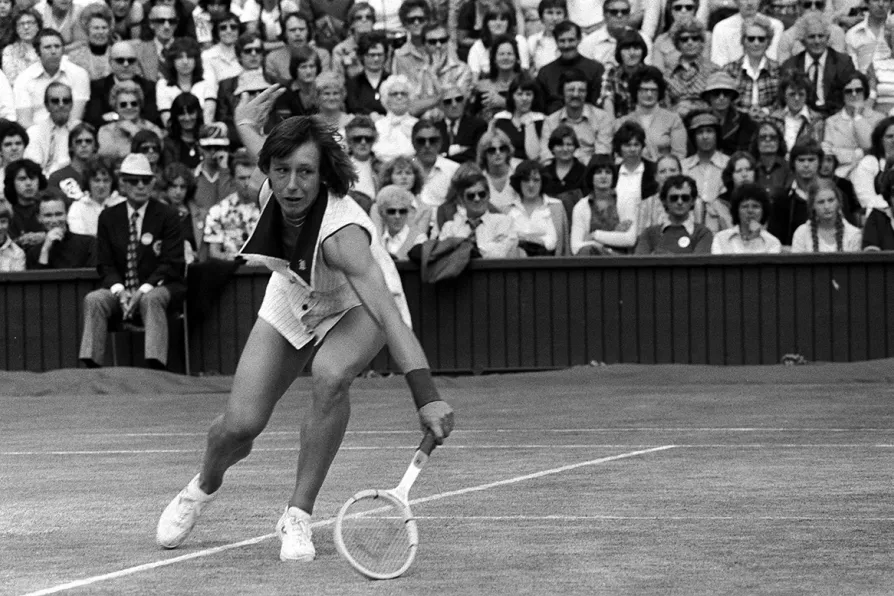
A new documentary recalls the unmatched rivalry between Chris Evert and Martina Navratilova, but it is also an honest and intimate look at their unlikely off-court friendship and shared battle with cancer, writes LINDA PENTZ GUNTER