Andy Burnham could learn a few lessons from a previous Labour government in the pre-privatisation era on how to tackle water shortages, writes KEITH FLETT


 Latest editorial

Scottish Labour’s race to the bottom with Farage
Having endured 14 years of Tory austerity followed by Starmerite cuts, young voters are desperate for change — but Anas Sarwar’s refusal to differentiate from Westminster means Scottish Labour risks electoral catastrophe, writes LAUREN HARPER
 Scottish Labour leader Anas Sarwar giving a speech at Pollokshaws Burgh Hall in Glasgow, to mark one year to go to the next Holyrood election on May 7 2026, May 7, 2025

North East Volunteers for Liberty plan to mark a double anniversary in October for local heroes who stood firm against tyranny, writes TONY FOX
India’s monsoon is running below normal overall, yet extreme rainfall has already caused deadly flooding in Kerala, explains LIGIN JOSEPH
Renewed illusions in social democratic reformism are sprouting as a result of Andy Burnham’s rhetoric, but material conditions are already intruding into the debate, argues NICK WRIGHT
The US is hell-bent on dismantling the International Criminal Court as part of its assault on global legal systems, but others also have valid reasons to seek its demise. BEN CHACKO provides the analysis





AS A YOUNG person, I have already lived through three recessions, 14 years of Tory austerity and now Starmerite austerity to boot.
“Generation Z” has known nothing but economic hardship and the decay of public services we all rely on. We haven’t inherited the opportunities of previous generations.
Instead, we’ve come of age through the aforementioned financial crises, dealt with our education budgets being slashed, NHS waiting lists stretching longer and longer, and rent devouring our incomes.
Is it really a mystery why young people, and indeed many others, are desperately seeking someone or something different in the face of this betrayal of all we were promised?
John Swinney’s calls for a “united front” against the common enemy of Reform only feeds into the image which Nigel Farage has spent over two decades perfecting: that he, an ex-London commodities trader, is somehow anti-Establishment. In truth, it is the failures of the SNP, the Tories and now the unwillingness of Keir Starmer and Anas Sarwar to offer a genuine alternative that have helped to create a perfect storm in which the far right can thrive.
Yet Farage never blames those with real power for the many issues facing the country. He directs the blame away from the elites and onto minorities. This is why he has been allowed to be so successful: he is the Establishment face of the anti-Establishment, the safe representative upon whom those disaffected by years of Establishment politics may pin their hopes that something finally changes.
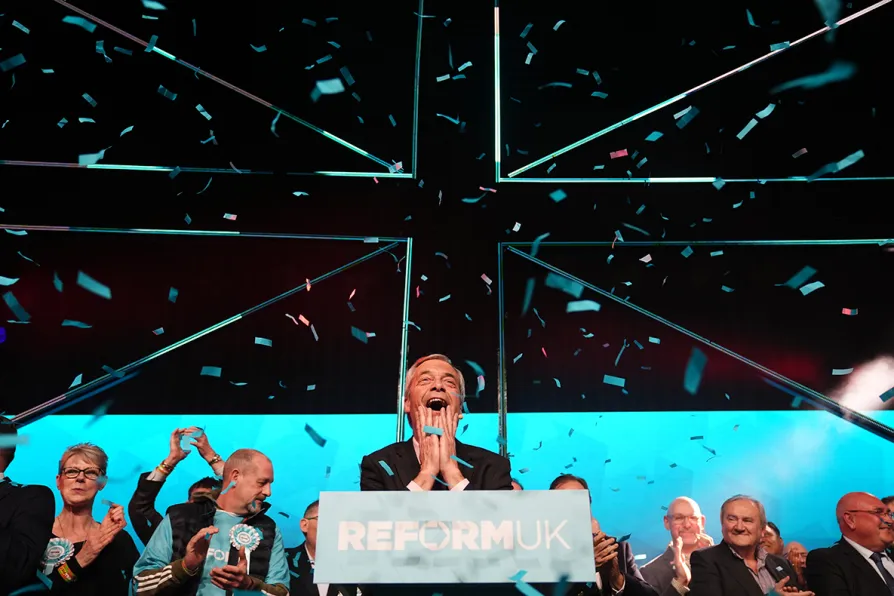
Unfortunately, we have passed the point of pointing and laughing at Farage whenever he claims to be the voice of the disaffected working class. After a string of council election wins in England, it now looks like his party could overtake Labour and become a serious force in Holyrood. Our politicians, who are only now realising the threat he poses, hold the blame for that. So, with the viability of his leadership being tested in a by-election in Hamilton, and Holyrood elections looming close behind, what should Anas Sarwar be doing to break the Farage factor?
The main problem he faces is his closeness to Starmer. His refusal to differentiate himself and Scottish Labour from the failing and unpopular Westminster government means he is being tarred with the same brush.
The first thing he should do is hold the Scottish Labour MPs to clear and distinct Scottish Labour policies. The two-child benefit cap is wildly unpopular in Scotland, so why did none of our Scottish Labour MPs vote to scrap it?
If Sarwar does not distance us from Starmer’s damaging policy decisions, Scottish Labour is doomed to suffer the same electoral catastrophe predicted for the Westminster government at the hands of Reform.
Sarwar must acknowledge that Starmer has committed economic and cultural vandalism on Scotland by refusing to nationalise the Grangemouth oil refinery. While hope may feel naive, strategic changes from Scottish Labour remain possible.
Ahead of the 2025 conference, young members passed a motion demanding the nationalisation of Grangemouth and apprenticeship opportunities for young people in the area, indicating left-wing ideas are still popular among young members.
If he promised to take serious, necessary action by nationalising key industries like Grangemouth, Sarwar would have the opportunity to prove Labour has what it takes to deal with rising poverty and unemployment.
How he funds this could also serve as a tool to employ in breaking the Reform wave that is threatening Scotland: a wealth tax. STUC research has shown that just a small 2 per cent wealth tax on Scotland’s 10 richest people could raise £459 million in revenue, enough to fund 10,000 public-sector workers.
If we were to use the powers of devolution properly, we could raise far more and create jobs, apprenticeships and a host of opportunities for young people. This, in turn, would stimulate the economy far more than cutting services, which are already at a breaking point.
Yet these things would require Sarwar and those in charge of Scottish Labour to admit that the shift to the right and the Starmer project had failed. Sarwar and Starmer are, of course, a part of the same Establishment which decided that Farage was the acceptable face of anti-Establishmentism.
So, where does that leave us? If Scottish Labour continues to march rightwards and meet Farage on his own terrain, we will be lucky to keep third place in Holyrood. But, if ordinary members and trade union affiliate members of Scottish Labour take up the fight, we can reclaim a party which was built for the working class — and truly fight the Establishment.

Similar stories

Treating the Clacton by-election as a joke risks reinforcing the Reform leader’s claim to be the victim of an out-of-touch Establishment, argues JOHN McINALLY


Young Communist League general secretary GEORGINA ANDREWS says the far right are filling a vacuum created by Labour’s abandonment of working-class interests — we have to give our class a better offer