

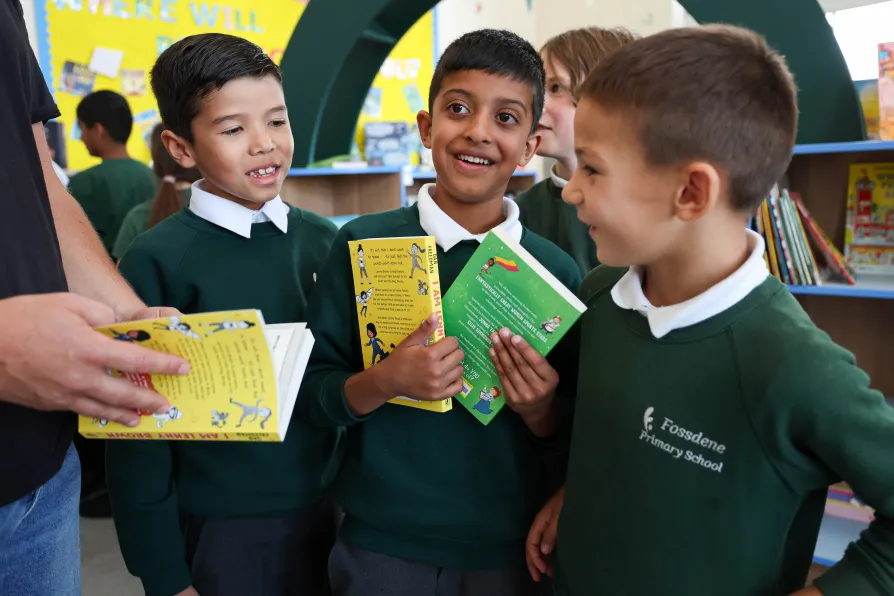
 ENRICHING: Children at Fossdene Primary School in Greenwich are welcomed back to primary school with a new library





SCHOOL libraries should be mandatory and every child in England should be issued with a library card from birth, said MPs on Friday after a probe into reading for pleasure.
The education committee said that it is “striking” that prisons are legally required to have libraries but schools are not.
MPs called them “powerful equalisers” and urged the Department for Education (DfE) to “extend its pledge to fund a library in every primary school to include every secondary school, and follow this up by placing school libraries on a statutory footing.”
Committee chair Helen Hayes called reading for pleasure a “miracle medicine.”
“We should be extremely concerned that so few children currently say they enjoy reading or regularly pick up a book,” she said.
“We know that children from disadvantaged backgrounds or those with additional needs are less likely to develop a love of reading, but access to literature should never be a luxury available only to the most prosperous families.”
National Education Union (NEU) general secretary Daniel Kebede said that the report “rightly identifies that competing curriculum demands are a major factor in the long-term decline in reading for pleasure among children, alongside rising poverty and lack of access to libraries.”
He called for increased school funding to deliver the “true potential of school libraries” and blamed the “current focus on reading proficiency over pleasure… [the] overloaded curriculum and heavy focus on assessment.”
The MPs also called for the government to restore funding for public libraries and to revise the school curriculum so it develops a love of reading.
GMB schools committee member Kehinde Akintunde said: “Easy access to books developed my passion for reading and led me to work as a sessional librarian.
“School libraries are so important, given the increase in the closure of local libraries and might be the first opportunity for a child to hold a physical book.
“The fact that prisons have libraries for rehabilitation of behaviour demonstrates the benefits of reading, therefore why should this not be encouraged from an early age?”
Children and young people’s enjoyment of reading rose for the first time in five years this year following a 20-year low last year, according to a National Literacy Trust survey.
Unison head of education Mike Short said: “Every child deserves access to a well-resourced, properly funded and staffed school library, wherever they live.
“Access to books improves literacy, supports learning and can inspire a lifelong love of reading.
“Community libraries, more widely, are a vital extension of the classroom. But years of austerity have hollowed out services to the extent that almost half the library staff in England have been cut since 2010, according to UNISON research.
“Investment’s needed in both school and community libraries so the availability of books isn’t just determined by income or postcode.”
The DfE welcomed the report and said it would reply to its recommendations.





Including races at Epsom and Doncaster