Councillor SAM WHEELER says there’s a tangible shift in mood on the left in the city whose mayor has recently become PM — but there’s no room for complacency



Reviving the fighting spirit of trade unionism
While recent trade union growth figures are welcome, in order to sustain and deepen this trend, we need a return class-conscious organising, argues NATHAN HENNEBRY
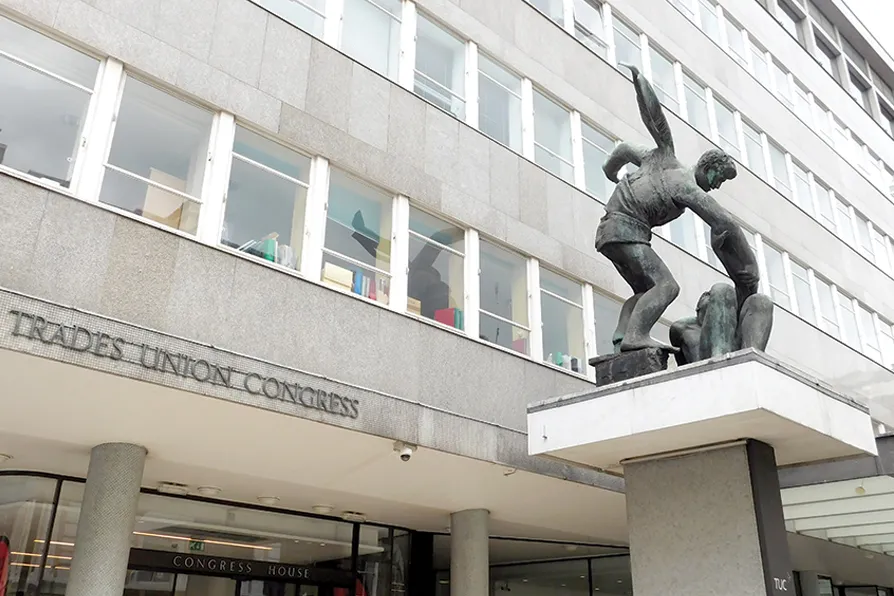
 MORE PEDESTAL THAN PRACTICE: The Spirit of Trade Unionism by the Norwich native Bernard Meadows adorns the entrance to the TUC HQ in London and was unveiled on March 27 1958 / Pic: Paul The Archivist/CC
Communist Party leaders Alex Gordon and Lorraine Douglas deliver vital medicines in trip to besieged socialist island
TUC Cymru is playing a leading role in tackling far-right ideas in the workplace, says LAURA DOEL
A New Delhi press conference in which Sheikh Hasina and her son implied the new order in Bangladesh is a security threat to India has sparked fears she is planning a comeback. SIAM SAROWER JAMIL reports on the fallout
Two months of student unrest have forced out India’s education minister and rattled the BJP regime. Could this be the beginning of the end for Modi, asks Communist Party of India (Marxist) general secretary MA BABY
MAT COWARD says the heatwave is a testing time for gardeners — but he has some tips





RECENTLY, the TUC announced that union membership had risen by 192,000 to 6.6 million in 2025.
This is of course cause for celebration as this recruitment reflects the hard work and graft put in by shop stewards across Britain. However, we are still a far cry from the levels of membership seen in 1979.
Despite growth, union membership, across the trade union movement, has creeped on a downward trend for the last four decades, standing at roughly 22 per cent of the workforce, with less than 50 per cent of public-sector workers and less than 12 per cent of private-sector workers in a union.
Younger workers are also less likely to join a union, and new research shows a similar trend with lower-paid workers.
The cause of this hasn’t just been the unbridled growth of the gig economy, outsourcing, agency work or the attitude of individualism. The decline in membership has also come as a result of our movement’s failure to adapt to the modern world and recover from deindustrialisation.
Members feel isolated from their union, ours included, and simply see it as a form of corporate insurance to take out against their employers — this dangerous attitude puts our union, and others across Britain, in the firing line of becoming irrelevant.
We can recruit as many members as we like, but retention is what matters most. When members are detached from the union, they do not engage with their branch. They do not toy with the idea of becoming a rep. They do not engage in any of the union’s democratic bodies.
The turnout for general secretary voting is a clear indicator of this — Unison’s recent general secretary election saw a 7 per cent turnout (98,251 votes cast from a possible 1,404,684). The UCU’s saw a 15.1 per cent turnout at its last leadership election, Unite 12 per cent and GMB 10.6 per cent.
Branch secretaries, shop stewards, and health & safety reps, are also becoming alienated from their unions, and many operate without guidance or coaching in how to build their branch and attract new members and engage older ones. Reps are stepping down, and the struggle to replace them with younger members continues to grow.
This, in turn, will leave union members defenceless and full-time officials overstretched.
The political question of the trade unions has also been brought into light. After over 13 years of fighting against Tory austerity, the unions have done little to put that same fight against Labour’s own austerity policies.
There has also been little fight from Labour-affiliated unions when it has come to addressing Labour dropping key manifesto pledges — most recently the abandonment of the equal living wage for employees of all ages.
The unwillingness to tackle the Labour government’s building of the new war economy, at the direct expense of workers in this country, is also resulting in the dulling of the trade union movement — instead of radical industrial action, we now have corporate compliance.
The lack of class-conscious trade union education plays a major role in this. By dulling the question of class, the powers that be have been able to dampen the flame of class consciousness in the unions.
On a positive note, the revitalisation of the GFTU has shown that class-conscious trade union education can be achieved.
Failing to develop members’ class consciousness will paralyse the union movement, and our class as a whole. It will see turnout and engagement drop to an even greater low, at a time where Britain’s youth continue to be lulled by the empty platitudes offered by right-wing populists and fascists.
Most importantly, it will leave a union movement where grassroots campaigning is stifled and challenges against the class traitors in the movement go unfought — leaving the door wide open for the most reactionary elements to sink their fangs into the ever trying but weakening gazelle of trade unionism in Britain.
The ideals of individualism didn’t die with Thatcher (sadly), instead, with the evolution and morphing of capital, these ideals have been repurposed and packaged for the modern age to disincentivise young workers from joining unions and shaping a future for them and their class.
So, it is not only a battle against the ruling class that our movement must win, but an internal battle to ensure a movement that is capable of waging class war. This starts in our workplaces, branches, regions, committees, and our Congress. For a class conscious trade union movement.
