
Washington’s inability to subjugate Iran is an example of how it is trying to preserve a regional order that no longer exists, argues RAMZY BAROUD


Remembering Victor Grossman – who never gave up hope for a socialist future
(March 1928 – December 2025)
Saluting an internationalist and a courageous and uncompromising seeker of the truth
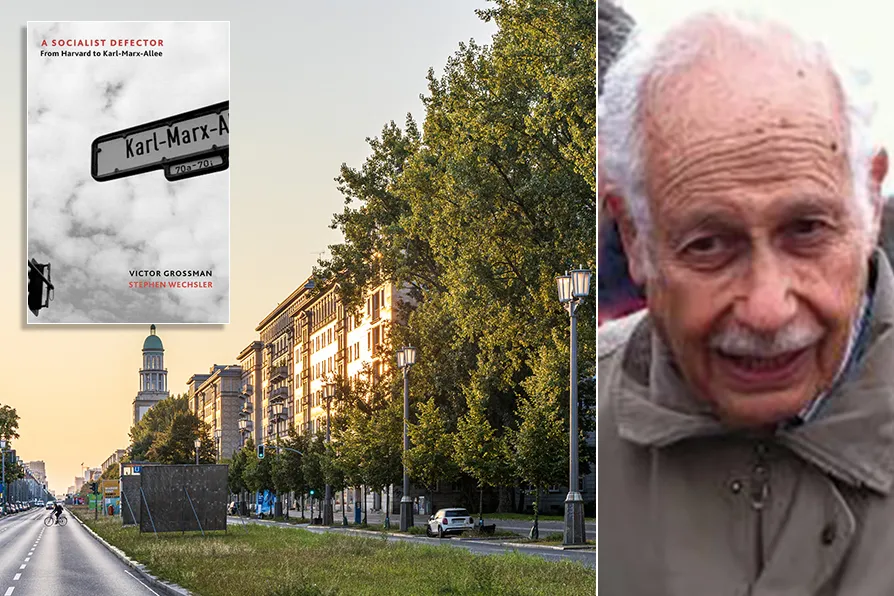
 (L to R) The Karl-Marx-Allee in the morning, September 2021; Victor Grossman while visiting Buchenwald in 2013 Pics (L to R): Matthias Sussen/CC; Ina Leukefeld/CC

US financial instability is exposing the limits of a dollar-dominated global economy — and giving the Global South a historic chance to build an alternative, says MURAD QURESHI
DOUG NICHOLLS says the parasitic finance markets must be challenged or another British government could be toppled
The late country singer’s Imagination Library has put hundreds of millions of books into children’s hands. We should build on that legacy by defending the libraries at the heart of our communities, says BRENDA AITCHISON
Deprivation is a fundamental factor in criminal behaviour that must be addressed but, KENNY MacASKILL argues, there needs to a major rethink in sentencing to tackle overcrowding
MML director MEIRIAN JUMP outlines the recently refreshed library’s busy autumn schedule that ranges from book sales, archival exploration, community work with online education and the ever popular site tours
TONY BURKE surveys the shifting political landscape and the challenges Labour needs to address if it is to prevail in the 2028 federal elections





VICTOR GROSSMAN, who regularly and incisively contributed to the Morning Star over many years, passed away on December 17 2025, at the age of 97.
His life was an extraordinary one — a life that spanned almost an entire century, encompassing nearly all the drama of the 20th century and reaching into the conflicts of our own time.
It was also the life of a man who never gave up hope for a socialist future.
Born in New York City in 1928 as Stephen Wechsler, his parents were an art dealer and librarian who had fled anti-semitic pogroms in the Russian empire.
Grossman’s political consciousness developed early on. The images of the Great Depression (1929-39), the struggle of the Spanish Republic (1931-39), the horrors of rising fascism, and the heroic and immeasurably costly resistance of the Soviet Union to the invasion by Hitler’s Germany and the latter’s eventual defeat (1941-45).
While at Harvard, he helped organise a Communist Party USA branch there, became active in the anti-racism movement, and experienced the highest point of the progressive movement in the United States around Henry Wallace — Franklin D Roosevelt’s vice-president’s — presidential campaign in 1948 which ended in bitter defeat to Harry S Truman.
His experiences as a labourer in Buffalo and the violent riots at the Robeson concert in Peekskill in 1949 made apparent to him the ferocity of the class struggle and the dread of emerging McCarthyism in his homeland.
In 1951, while stationed in Bavaria as a soldier in the US army, he found himself in a hopeless situation due to the McCarran Act — officially the Internal Security Act of 1950 — which, at the height of the cold war, criminalised members of left-wing organisations as “foreign agents.”
Fear of a long prison sentence for perjury drove him to take a dramatic step and flee across the border into Austria and swim across the Danube near Linz into the Soviet occupation zone.
This act officially made him a deserter and a political refugee. And as he later said, it was the most important day in his life.
In the German Democratic Republic (GDR) where he settled, Stephen Wechsler received a new name and found a new homeland.
He learned German, studied journalism in Leipzig, and found the love of his life, his wife Renate Kschiner, while studying at Karl Marx University. The two married in 1955 and raised two sons, Thomas and Timothy.
As a journalist at Radio Berlin International and at John Peet’s Democratic German Report, he became a chronicler of the GDR for an English-speaking audience, always striving to present a positive yet nuanced picture.
As a freelance lecturer who spoke about the United States with humour and without cliches, he enjoyed a certain licence and became a well-known, if not always uncontroversial, contemporary witness.
He valued and defended the GDR, its social achievements: the elimination of poverty and homelessness, and the guarantee of free education, healthcare and affordable housing.
Yet he experienced a painful shock when the revelations about the crimes under Stalin were revealed in 1956. The overwhelming dominance of Western consumer culture and media was a disappointment.
After the flourishing 1960s and 1970s, he witnessed the GDR decline, paralysed by ageing, reality-detached leadership and pressure to maintain the status quo from the USSR.
The fall of the Wall in 1989 then filled him with deep bitterness over the “rapid, total colonisation” of the country and the loss of its social ideals and structures.
After 1990, he was able to travel to the US again. He was taken by the vitality and diversity of New York, but the poverty, extreme commercialisation and the immeasurable gap between rich and poor confirmed his sharpest critiques of capitalism.
Although naturally fond his old homeland and New York, he always looked forward to returning to the more modest, familiar surroundings of his other home on Berlin’s Karl Marx Allee.
Until the very end, Grossman remained keenly alert to political developments in Germany and internationally. In his final new year’s greetings for 2025, he identified three of the horsemen of apocalypse of our time as social inequality, ecological catastrophe, and the looming danger of nuclear war.
He blamed an insatiable global financial oligarchy, naming its unscrupulous representatives — from Musk to the arms corporations — outright.
His hope rested on the struggles of workers, the courage of protesting students, and the possibility that majorities might rise up against oppression and for peace.
Grossman, who was a member of Die Linke, was shaped by a deep conviction, a courageous escape, the search for belonging in a foreign land, loyal criticism of that land, and an unextinguished longing for a world more just for humanity.
The memoir A Socialist Defector: From Harvard to Karl-Marx-Allee by Victor Grossman (2019) is available online and through bookshops.
