Andy Burnham could learn a few lessons from a previous Labour government in the pre-privatisation era on how to tackle water shortages, writes KEITH FLETT


 Latest editorial

Not all invasions are equal: the revolting hypocrisy surrounding Venezuela
When Russia invaded Ukraine in 2022, Western outrage was absolute. Yet today, the tone is markedly more subdued regarding US aggression against Venezuela. The manner in which the media and politicians frame this invasion exposes a profound ideological double standard, writes MARC VANDEPITTE
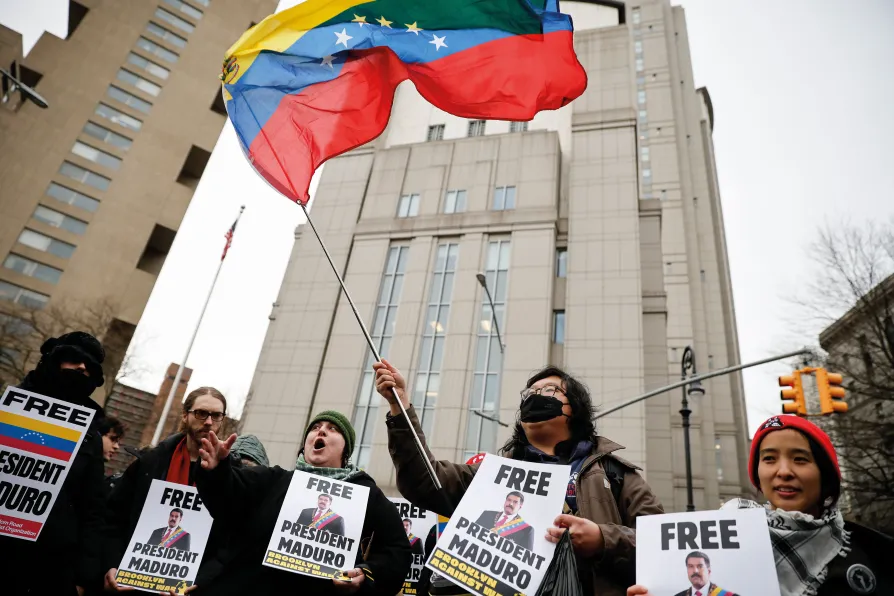 OUTRAGE: Protesters hold signs calling for the release of Venezuelan President Nicolas Maduro outside Manhattan Federal Court before his arraignment in New York, on Monday January 5
North East Volunteers for Liberty plan to mark a double anniversary in October for local heroes who stood firm against tyranny, writes TONY FOX
India’s monsoon is running below normal overall, yet extreme rainfall has already caused deadly flooding in Kerala, explains LIGIN JOSEPH
Renewed illusions in social democratic reformism are sprouting as a result of Andy Burnham’s rhetoric, but material conditions are already intruding into the debate, argues NICK WRIGHT
The US is hell-bent on dismantling the International Criminal Court as part of its assault on global legal systems, but others also have valid reasons to seek its demise. BEN CHACKO provides the analysis





AT TWO O’CLOCK in the morning on January 3, the residents of Caracas were jolted awake by the scream of fighter jets and the thud of missile strikes. Strategic sites, including the Fuerte Tiuna military base and La Carlota airport, were bombed mercilessly.
Large swathes of the city were immediately plunged into darkness as power failed, while thick plumes of smoke blackened the horizon.
As panicked families fled into the streets, news began to surface via social media: elite US units had carried out a brutal operation.
President Nicolas Maduro and his wife, Cilia Flores, had been abducted by US commandos and spirited away to the United States.
It was an unprecedented violation of the sovereignty of an independent state.
Donald Trump claimed victory via his platform, Truth Social. Saying that they had “successfully carried out a large scale strike against Venezuela and its leader,” he announced that the US would temporarily take over the country’s administration. The event inevitably evokes the dark era when Washington deposed or kidnapped Latin American leaders at will.
The Devil v the businessman
The contrast with the coverage of the 2022 invasion of Ukraine could not be more stark. At that time, Vladimir Putin was portrayed in every newspaper and news broadcast as the “devil incarnate.” The focus was entirely on his personality, his alleged madness, and his malevolent intentions.
The aggressor was given a face that the world was instructed to hate.
Today, with Trump, the media employs a completely different approach. There is hardly any moral condemnation of Trump as a war criminal. Instead, he is presented as a leader who — while admittedly brutal — is “pragmatic” and “restoring order.”
The aggression is described in almost clinical terms, stripped of the emotional weight that characterised the Russian invasion.
Where Putin was cast as an existential threat to humanity, Trump is treated as a head of state simply making a “bold” foreign policy choice. This personification of evil on one hand, and the normalisation of aggression on the other, manipulates public opinion in an extremely calculated way.
Double standards: democracy as an excuse
The treatment of the targeted leaders also reveals a shocking selectivity. During the invasion of Ukraine, Volodymyr Zelensky was immediately crowned the ultimate champion of democracy. Pre-war criticisms of his policies were airbrushed from the Western press as if they had never existed.
It became taboo to mention the banning of opposition parties or the relentless war in the Donbass, which claimed 14,000 lives between 2014 and 2022. The tragedy in Odessa, where some 40 trade unionists were burned alive, did not fit the heroic narrative and was subsequently filtered out of the coverage.
In Venezuela’s case, the opposite is happening. Media attention is focused almost exclusively on how “evil” Maduro supposedly is.
Every report on the US invasion is accompanied by a litany of his alleged failures. The narrative relies entirely on interpretations and exaggerations regarding the lack of democracy under his rule.
The White House attempts to justify the abduction by linking Maduro to drug cartels. However, this argument holds no water: the primary cocaine routes run through Colombia and Ecuador. Yet the media frequently “forgets“ to mention this, thereby legitimising military aggression in the eyes of the public.
Imperialism or geopolitics?
When Russian troops crossed the border with Ukraine, all Western commentators spoke of Russian imperialism. It was a flagrant “violation of international law and the sovereignty of a country.”
Those terms were justified, but today they prove to be virtually unfindable in analyses of the US attack on Caracas.
The brutal US invasion is being trivialised as a logical consequence of power politics. “That’s simply what great powers do,” is the cynical refrain on television talk shows.
On the evening news in my country (Belgium), this violent military incursion was described as a “rollercoaster of events organised by the US.” While 40 people were killed in cold blood to facilitate the kidnapping of a head of state, the news spoke of “the most bizarre 24 hours of [Maduro]’s life.” The anchor delivered the report as if summarising a scene from a thriller.
Violating international law is apparently of little consequence when the orders come from Washington. The “rules-based order” has proven to be a paper tiger. This is the essence of the double standard: when a non-Western country invades another, it is a crime against humanity; when the United States does the same — including the abduction of a head of state –—it is framed as an “intervention” or a “transition to democracy.” Language itself has become a weapon.
A crushing responsibility
Through this euphemistic framing and the constant demonisation of Maduro, a brutal military aggression is being de facto legitimised.
Following the double standards applied to Ukraine and Gaza, the West is losing its last shred of credibility with the global South. The “rules-based order” is being definitively unmasked as a selective instrument of power.
But there is more at stake. With this attack, Trump is testing the limits of his imperial ambitions. Because of Europe’s appallingly weak stance, Washington has received the signal that it can act with total impunity. Europe’s responsibility in this matter is crushing.
When the situation inevitably escalates — and the Panama Canal or Greenland are next in line — let no-one later claim: “Wir hebben es niet gewusst.”
