
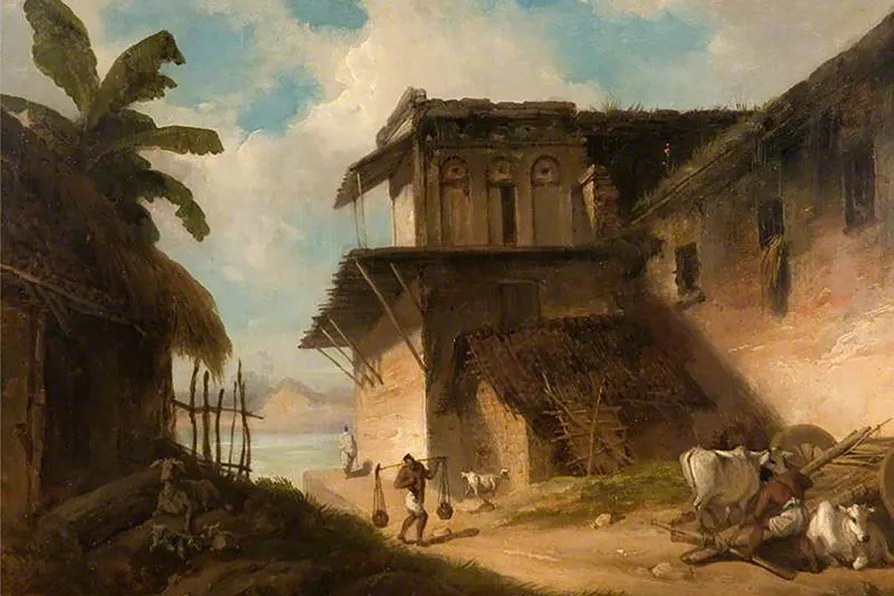
APURBA CHATTERJEE explains how British artists in India used the “picturesque” to reshape colonial landscapes and celebrate imperial power


A modest proposal: tax the super-rich
MARTIN GRAHAM welcomes a statistical analysis of how much tax the super-rich pay, and foresees that the demand will flush out their agents
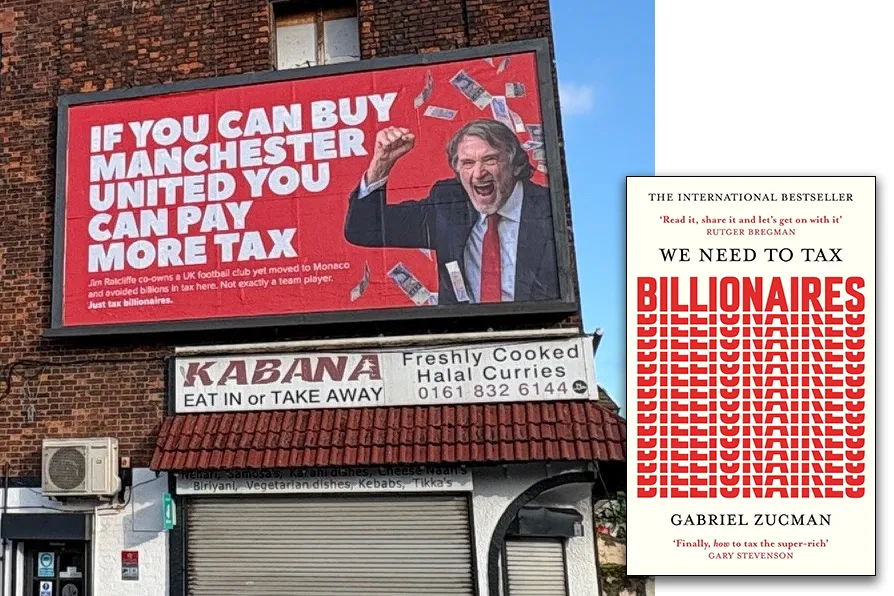
 SAYING IT STRAIGHT: A billboard showing the co-owner of Manchester United, Sir Jim Ratcliffe at Cheetham Hill, Manchester by campaign group Everyone Hates Elon, November 2025
PAUL DONOVAN welcomes a revival of Reginald Rose’s classic play that reminds us of the fundamental need for trials with juries
SIMON PARSONS applauds an exceptional performance of Wesker’s little-known play, by the same actor for whom it was written 45 years ago
ANDY HEDGECOCK and MARIA DUARTE review Late Fame, The Death of Robin Hood, Leviticus, and Gail Daughtry and the Celebrity Sex Pass
ANGUS REID recommends a uniquely accomplished documentary collage that contemplates our relation to the natural world
GORDON PARSONS enjoys Kant’s ‘mind-boggling’ theory of human reality: that we create the reality we experience





We Need To Tax Billionaires
Gabriel Zucman, Basic Books, £9.99
GABRIEL ZUCMAN, professor of Economics at the Paris School of Economics, employs a novel way of assessing how much tax the super-rich pay. Instead of looking at nominal rates or estimates of the income the super-rich choose to disclose, he has analysed National Income data (essentially, the total wages and profits) across socio-economic groups and compared it with estimates of how much tax of every type (direct and indirect) these groups pay.
Using French data, corroborated by a number of other studies (but none yet, regrettably, for Britain), he finds that the super-rich pay negligible amounts of tax relative to their income which he assumes, on average (somewhat conservatively in my view) to be around 5 per cent per annum on their wealth.
The wealth of the super-rich, he points out, can be estimated more reliably than their income. He therefore proposes an annual wealth tax on citizens of 2 per cent per annum on their wealth in excess of $100 million, wherever it is located. This would, he calculates, bring the effective rate of tax across all taxes paid by the super-rich close to the 45 per cent rate paid by the bottom half of the French income distribution — that part of the population that he identifies with the working class. In this way he claims the super-rich pay will pay their “fair share” of tax.
The super-rich currently pay only negligible amounts of tax relative to their income because they consume relatively little of their income, thus escaping consumption taxes like VAT; and they avoid paying much income tax or corporation tax by channelling their income through holding companies and trusts while limiting the dividends such companies pay.
The super-rich don’t, of course, pay inheritance tax and their assets are not sequestrated by local authorities to pay for their social care in old age.
Zucman is no Marxist. He sees tax avoidance by the super-rich as an “anomaly” — a breach of the fundamental principle of “equality under the law.” It can therefore be fixed by amending the law.
In an earlier book, The Hidden Wealth of Nations (Chicago University Press, 2015), he called for the closing down of tax havens as another way of removing this “anomaly.” He now offers the proposed 2 per cent tax on extreme wealth, wherever it is located, as the solution. It is intended to cut through their tax avoidance strategies. To achieve this, it must, however, be levied on citizens and tax all their wealth, wherever it is located. The problem of the super-rich relinquishing citizenship and acquiring a new one (remember Rubert Murdoch) is not convincingly addressed.
Zucman acknowledges that previous attempts at taxing wealth, for example by France in 1981, have been “abject failures.” He attributes this to the exemptions and allowances that accompanied those attempts. What he fails to recognise, however, is the sheer political power of the super-rich and their ability to influence and control governments and their tax policy, even (especially?) those elected on a social democratic platform. It’s difficult to see a 2 per cent tax on global wealth being implemented before this political power — which permeates governments, political parties, the House of Lords, the media, think tanks and our entire social infrastructure — is curtailed.
Marx would have it that the super-rich are to be expropriated, not taxed; but until then a 2 per cent wealth tax on the super-rich, if it could be achieved, is not to be dismissed.
Read this brief book only 65 A6 pages with a further 12 pages of notes — and draw on its arguments to lobby government and political parties for such a tax. This would at least provoke the agents of the super-rich to reveal themselves by their predictably hysterical response to this modest proposal.
