

 Latest editorial

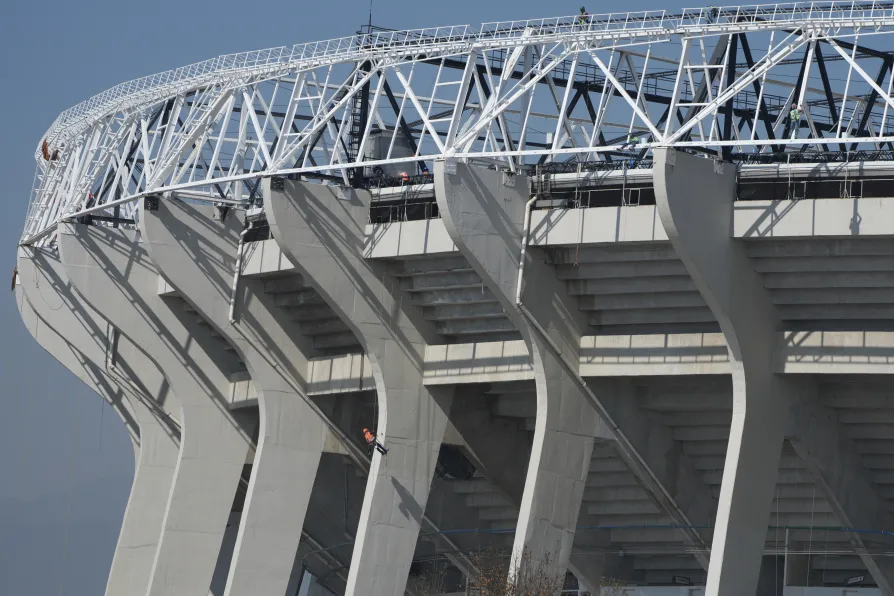 A worker paints a column of the Azteca Stadium 100 days before the opening ceremony of the 2026 FIFA soccer World Cup in Mexico City, March 3, 2026





THE 2026 World Cup kicks off this week, not in the United States, but in Mexico, at the footballing shrine that is the Estadio Azteca, Mexico City, host of finals in 1970 and 1986.
It means the southernmost country in North America is hosting the World Cup for a record third time, and though, like Canada, its pre-World Cup hype has been overshadowed by the at times overbearing and often controversial involvement of Fifa’s favourite co-host, the United States, it could end up being the best footballing experience of the three.
There is likely to be a much different feel to the games hosted in Mexico than those north of the border. Though Fifa has gradually made its tournaments more generic, less a reflection of the host country(ies) and more a reflection of Fifa branding, a flavour of the respective host cities will still be evident to viewers and, especially, to visitors.
As a result, Mexico could emerge as an almost separate part of this World Cup, given how much it differs in terms of its football culture from the USA and Canada.
The scenes in Mexico might be more familiar to those who follow the sport in Europe and South America, as elements of Mexican soccer culture have been borrowed by other leagues around the world, and a Latin American football flavour will be embedded in these matches regardless of who is playing.
In the United States and Canada, soccer competes with the American and Canadian versions of football and other sports, but in Mexico, association football is by far the most prominent and popular sport.
While there will still be a sense of novelty to games in the United States, and the biggest impact from hosting could be seen in Canada, it is in Mexico where this tournament will feel most at home. Not least because the country has hosted the World Cup twice previously, but also because of the history of the sport there, the age and tradition of its big clubs, and the lore (not always positive!) of its national team.
The domestic league, Liga MX, is the most-watched football competition in North America, as it also draws large viewing figures on Spanish-language TV channels in the United States. The Mexican national team themselves draw large crowds north of the border, even for games against the US, which is something that could prove useful if they progress to the knockout stages.
With all this in mind, it could also be argued that Mexico are one of the biggest underachievers in international football. As a football-mad nation with a population of over 100 million, putting it in the top 10 globally, it’s surprising that they have not been more of a force at World Cups.
The furthest El Tri (as the Mexico national team are known due to their tricolor flag) have gone in a World Cup is the quarter-finals, doing so on both of the previous occasions they hosted it, in 1970 and 1986.
Outside of those home tournaments, their World Cup performances have regularly ended in the first knockout round. Between USA 1994 and Russia 2018, Mexico exited at the last 16 stage on seven consecutive occasions. At the previous tournament, in Qatar, they at least avoided a repeat of their perennial last-16 failure by going out in the group stage.
This inability to make the next step and reach the quarter-finals is almost considered a curse, with the idea of reaching el quinto partido — the fifth game — becoming an additional psychological obstacle in itself, adding extra pressure to reach that stage.
The reasons why are regularly pondered, and as is often the case with these things, some are considered to be structural and economic. There is also the idea that there is a lack of competition on the international stage at the regional Concacaf level, where Mexico have won six of the last nine Gold Cups (the region’s equivalent to the Euros or Copa America). It’s why Mexico have previously pushed to be included in South American tournaments such as the Copa America at national team level and the Copa Libertadores at club level.
It’s not as if the likes of Brazil and Argentina have conventionally strong domestic leagues to rival Europe’s best, either, but they are still considered giants of the sport at international level. These South American nations produce top players for the “best leagues in the world,” while similar-level players from Mexico are few and far between.
Only five players in Mexico’s 26-man World Cup squad play in Europe’s top five leagues, including Fulham’s 35-year-old striker, Raul Jimenez. Despite this apparent lack of star power, expectations will still be high, but their group is no walk in the park.
Mexico open the tournament on Thursday evening against another former host, South Africa, which kicks off at 1pm local time, 8pm British time.
They are joined in Group A by the Czech Republic and South Korea. Coming out on top against such sides will not be an easy task for the hosts, though they have looked a more solid outfit since the return of 67-year-old manager Javier Aguirre for a third spell in charge.
If the group proves to be tough, they could soon cede home advantage, which is only guaranteed in the early knockout rounds if they top the group. If they qualify in second or third place, the rest of their campaign will be played in the United States.
One unusual positive might be that in this tournament, bumped up to 48 teams, el quinto partido will be the last 16, not the quarter-finals, so this refreshed format, back at the scene of previous progress to the quarter-finals, could remove that mental block of the fifth game and propel an unfancied Mexico further than many expect … if they successfully navigate that tricky group.
The country will be involved until the last 16 regardless, as a game in that round will be played at the Azteca, but its role as a host ends there, with all games from the quarter-finals onwards being hosted by the US.
On this occasion, Mexico will be hoping to reach the sixth game to ensure their welcome presence as co-hosts remains, and no-one turns a match played in the United States into a home game like Mexico do.
