
PETER MASON applauds the revival, 39 years later with the same team and cast, of Manfred Karge’s version of Brecht’s 100-year-old play, Mann Ist Mann

LGSM - the musical
PAUL DONOVAN applauds this joyous retelling of the story of the idealistic young communist Mark Ashton and his legendary solidarity with the striking miners
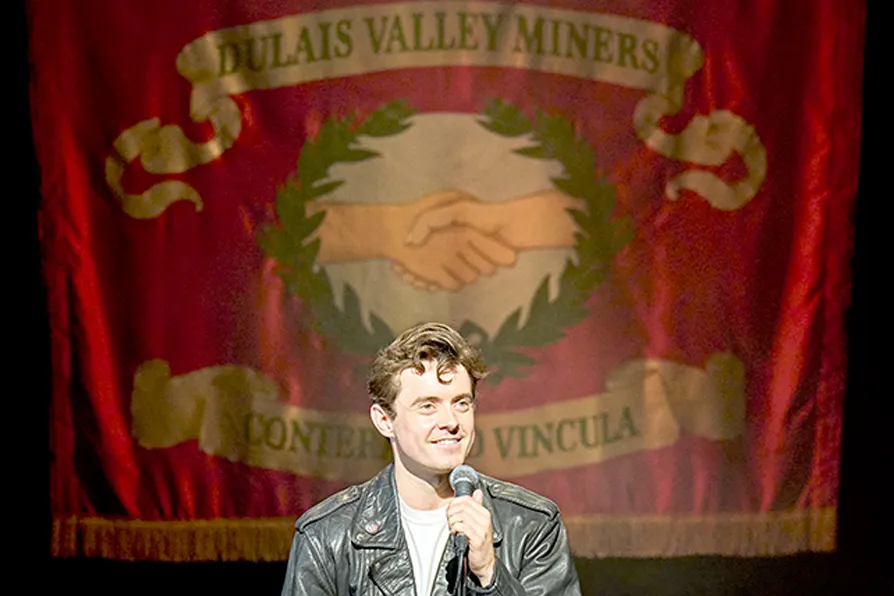
 COMMON STRUGGLE: Jhon Lumsden as YCL General Secretary Mark Ashton, co-founder of LGSM [Pic: Manuel Harlan]
New releases from Biita Houdei, The Mary Wallopers, and The Tubs
New releases from Biita Houdei, The Mary Wallopers, and The Tubs
MAYER WAKEFIELD applauds a fearless attempt to bring to the stage the 1984 toxic gas disaster in Bhopal, India
ALEX HALL applauds the account of a dogged, traumatic and punishing campaign for justice that has lasted from 1998 to the present day
NICK WRIGHT laments the political bias of an epic attempt to tell the history of the liberation of France from the Nazis, that excludes both the decisive contribution of the Soviet Red Army, and of the French communist party itself





Pride
National Theatre, London
⭑⭑⭑⭑☆
A RIP-ROARING retelling of the story of the 1980s miners strike and the support of a group of LGBT activists really comes to life in this musical adaptation.
Solidarity is the enduring theme of this stage version of Pride, brilliantly directed by Matthew Warchus.
This musical version will always be compared to the classic 2014 film of the same name but the comparison can only go so far. It is, though, in the main favourable. This is not surprising given that Warchus and Stephen Beresford, director and writer respectively of the film, replicate their roles here for the stage, this time in collaboration with musicians Christopher Nightingale, Josh Cohen and DJ Walde.
The story centres around young idealistic Northern Irish communist, Mark Ashton, general secretary of the YCL, who quickly sees the similarities in the struggle of the miners — in their battle against the Thatcher government — with that of the LGBT community. Both communities are vilified and hated. Ashton sees commonality in their causes and so a bond begins to form. Lesbians and Gays Support the Miners (LGSM) is created.
The founding group head off to meet the miners in their Welsh village. Some tensions ensue but the bond of solidarity starts to develop. Fund-raising activities begin, including the December 1984 Pits and Perverts event, which included Bronski Beat. The divisions and bigotry become apparent in the individual stories of the characters, as well as some of the interactions between communities.
This production has great energy, helped by Bunny Christie’s simple set. Though basic, the rapid changes operate seamlessly, going from an LGBT bookshop in London to a miners’ club in Wales, to the Pits and Perverts gig and marches.
There are some outstanding performances from Jhon Lumsden (Mark), Courtney Stapleton (Steph) and Samuel Barnett (Jonathon).
Warchus effectively uses the music to bring out the main features of the story. Outstanding among the songs are a rendition of Bread and Roses involving most of the cast, which brings the first half to a close. Also, Jonathon’s telling of his story, including the Aids diagnosis, happens in joyous life-fulfilling fashion. Disappointingly, though, Billy Bragg’s Power to the Union, that so memorably ends the film, is not included.
In fact, if there is a criticism, it is that the miners’ strike narrative gets somewhat diluted in the second half. While early on the focus is very much on supporting the strike, later there is more focus on specific LGBT issues. The threat of AIDS hanging over the community is well covered in the story of Jonathon and ultimately the tragic loss of Mark, aged 26.
The difficulties of coming out at that time are well illustrated in the story of Bromley (Lewis Cornay), who has another belting song of defiance.
Overall, this is an excellent production, with great energy, it brings forth laughter and tears. The humour runs through the production, punctuating a story that is really all about solidarity and the unity of different struggles. Something vital in the 1980s and maybe even more so today as similar divisions and hatreds threaten to fracture society.
Runs till September 12. Box Office: 020 3989 5455, nationaltheatre.org.uk
