Supporters from both sides prepare to stand together against season ticket threats and exploitation, writes JAMES NALTON


 Latest editorial
Israel claims children’s football pitch is a security threat
Palestinian children could be denied the simple right to play a game of football, writes LINDA PENTZ GUNTER
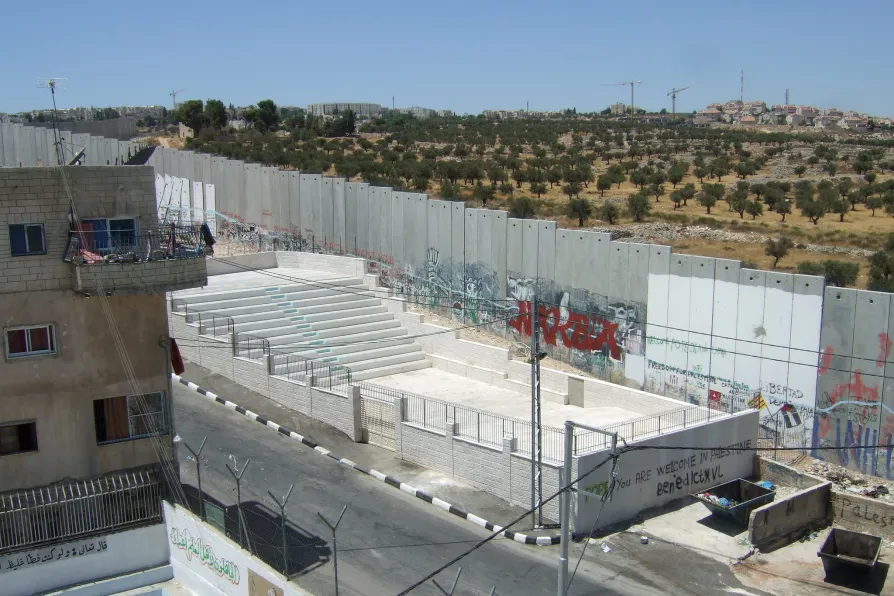 The wall seen from Aida refugee camp, Bethlehem. Photo: Paolo Cuttitta / Creative Commons

French federation withdraws support as pressure mounts on Fifa president





ON ANY given day, a group of Palestinian children can be found kicking a football around on a patch of bright green artificial turf, a small oasis of respite from the daily hardships of life in the Aida refugee camp not far from Bethlehem.
Beneath the grim shadow of the towering concrete wall that seals them off from the rest of the West Bank, the children train hard and dream big, enjoying their time together in one of the few safe spaces they know. But now, even this simple pleasure could be stolen from them.
The pitch, built in 2021, provides a modicum of joy and respite for children struggling to survive in the densely packed camp, to which their families had fled during the Nakba of 1948.
More than 7,000 people are crowded into the camp, one of the smallest in the West Bank, hemmed in by the wall that Israel constructed in the early 2000s. With its cramped housing and narrow alleyways, there is nowhere else in the camp for children to play. The Aida Youth Centre’s football academy has filled that void, attracting children from other nearby camps as well.
But on December 31, the 500 children, some of whom dare to dream of playing for Palestine or even a Premier League club, were confronted with a new, if familiar nightmare: the arrival of bulldozers.
Posted on the entrance gates was a notice from Israeli authorities telling the Centre that its football pitch was illegal, a “security threat” located too close to the wall and built, Israeli authorities claimed, without a permit. That accusation has been vigorously denied by local officials including the mayor of Bethlehem.
But Israeli authorities insisted that either the club demolished the pitch themselves within seven days of the notice or Israel would do it for them, then hand them the bill.
Middle East Eye describes the Aida camp as “surrounded by checkpoints, Israeli military bases and settlements — with seven military watchtowers overlooking the camp.” The place is “frequently raided by Israeli forces and was once described as the most tear-gassed place in the world,” the news outlet says.
And yet somehow, a little green patch of astroturf is a security threat to the nuclear state of Israel?
The directors of the youth centre appealed to Fifa and Uefa, sending a personal letter to Fifa president, Gianni Infantino. That letter, seen by Middle East Eye, begged Fifa and Infantino to intervene. “The pitch is in constant use,” MEE reported the letter as saying. “It is a rare place of hope and joy for children who endure hardship.”
There was no reply, but the bulldozers didn’t move in, either. The children clung onto hope. “If this field is demolished it will shatter my dreams and the dreams of my friends who play sports,” said one of the young footballers, Taym Al-Masaeed, in a video put out by the Aida centre in a social media campaign aimed at garnering international opposition to the demolition.
“There’s no other place to play except this field,” Al-Masaeed said.
Three young girls who trained at the Aida camp have already realised those dreams, competing at the international level with the Palestinian women’s national team in the West Asia Football Federation’s under-14 girls’ championship last December.
Others are still waiting. “Without this field, I wouldn’t have had this chance,” 18-year-old trainee goalkeeper Abdallah al-Ansurer told AL Monitor. “If it didn’t exist, we’d be playing in the streets — or not playing at all.”
The centre also ran a worldwide fundraising appeal asking people to do ten consecutive kick-ups without letting the ball touch the ground or make a donation. One of the local Aida camp talents, Mariam Amira, demonstrated the skill. Instagram then quickly filled up with comical videos from citizens around the world struggling to get past two or three kicks.
Even American children’s educator and YouTube star, Ms Rachel joined in the appeal to support a petition started by the children themselves. “The kids are absolutely devastated,” Ms Rachel said. “This soccer field means so much to them. It’s one of the only places where they can just be kids,” she said. “It is so cruel to demolish this field.”
Then, on January 20, there was finally a glimmer of good news. “Fifa and Uefa have intervened and applied pressure on Israel,” Aida Youth Centre’s sports director, Mohammed Abu Srour, told me. He had not been directly informed of the reprieve, he said, but had read it in the Israeli newspaper, Haaretz.
“However, neither Aida Youth Centre nor its lawyers have received any official written confirmation from Fifa, Uefa, the court or the Israeli military that the demolition order has been legally cancelled,” Abu Srour cautioned. He and others had been trying for weeks to get the international football bodies to act. “The situation remains uncertain,” he said.
Abu Srour would like to see Fifa and Uefa apply added pressure by suspending Israel “from participating in any tournament or competition until they stop violating human rights and targeting Palestinian athletes and the sports facilities,” he said.
In November, Fifa had itself announced plans to build two mini-pitches in the West Bank in partnership with the Swiss government that would represent “a message of solidarity and a belief in football’s ability to bring communities together even in the most challenging contexts,” Infantino said at the time.
Why then, would Fifa not strongly oppose the demolition of a West Bank football pitch already in existence for six years and serving hundreds of Palestinian children?
“The demolition can only be stopped by the Israeli occupation,” Abu Srour told me. This would happen “through a formal legal cancellation of the demolition order, communicated in writing to the lawyers representing the Aida Camp. While international pressure is crucial, only an official court or military decision delivered through legal channels can guarantee the pitch’s protection.”
Meanwhile, violence by the Israeli state against Palestinians in the West Bank continues to escalate. According to the Times of Israel, “Israel accelerated demolitions in Palestinian refugee camps in early 2025, leading to the displacement of 32,000 residents of camps in the central and northern West Bank.” The paper also cited Human Rights Watch calling the demolitions “a war crime.”
As Abu Srour pointed out in an interview with MME, amidst all the violence and destruction and now growing fears that Israel is about to fully annex the West Bank, “even the simplest right to play football is being taken away.”
Linda Pentz Gunter is a writer based in Takoma Park, Maryland. Her book, No to Nuclear: How Nuclear Power Destroys Lives, Derails Climate Progress And Provokes War, will be published by Pluto Press in March.
