
Tackling climate change is not just an urgent environmental necessity but provides an opportunity for economic restructuring in the interests of the Welsh people


How Greek International Brigaders forged a lifelong anti-fascist legacy
Barred from returning home, a group of Greek Brigaders came to Britain and founded the League for Democracy in Greece – a movement that carried the flame of anti-fascist resistance from the 1930s through the cold war and beyond. ALI BASSAM ZAHID tells the story
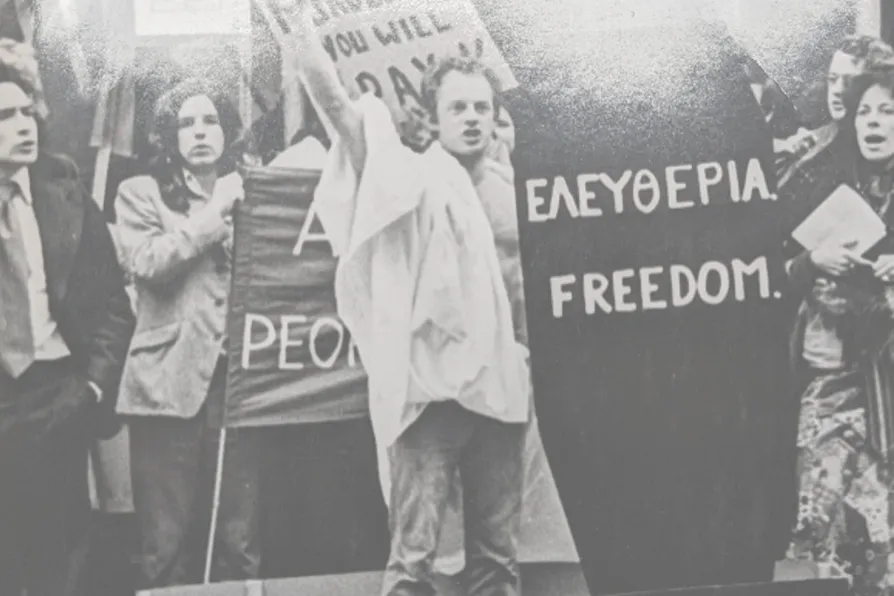
 Photo: Author supplied
A spate of bomb recoveries across Dhaka raise questions whether extremism is making a comeback, says SIAM SAROWER JAMIL
Poverty, refugee displacement, child labour and militia violence are exacerbating the challenge of health workers to limit this deadly contagious disease. CONSTANT SAME BAGALWA and MARK BANCHEREAU report
CLAUDIA WEBBE speaks out against the lethal mechanics of Britain’s culture-war press
Powerful agribusiness interests are trying to overturn efforts by the Lula government to protect the environment and indigenous peoples of the Amazon region, writes GABRIELA SA PESSOA
Trade unions and community groups are mobilising to push back against Trump’s racist raids after new revelations of spying on legal protesters. MARK GRUENBERG reports from the US state of Minnesota
The best wildfire service may begin with the community, argues KOMAL RAJ ARYAL





BETWEEN October 30 and 31, the Universitat de Barcelona hosted a conference on the research and memory of the International Brigades.
What fate had in store for the Brigades after the Spanish civil war (1936-39) has aroused extensive debate among scholars and enthusiasts alike.
Some 400 of the total number of men and women to volunteer in the Brigades were Greeks; however, for those hailing from the mainland, the dictator Ioannis Metaxas prohibited their return.
When the Brigades were withdrawn officially withdrawn from Spain in 1938, many Greek anti-fascists therefore settled in the United States or Britain. And among those who sailed to Britain, some played a key role in what later became known as the League for Democracy in Greece.
At the moment Greek anti-fascists disembarked on British soil, they congregated in port cities like Cardiff and Liverpool where, witnessing first hand the deplorable working conditions on the shopfloor, they fronted picket lines and helped trade unions organise industrial action.
Nothing illustrates this better than an incident in 1940, when they helped organise a strike that so impressed the Communist Party of Great Britain that it agreed to facilitate the formation of the Union of the Greek Seamen (hereafter FGMU).
With its headquarters in Cardiff, the FGMU was central to campaigns to raise public awareness about the wartime resistance to the Nazi occupation of Greece. Around the same time a unity committee was also formed to combat the news blackout caused by the occupation of Greece.
Much of the initiative and financial support for this came from the FGMU, however, under conditions of news censorship the future founders of the League for Democracy in Greece, Diana Pym and Marion Sarafis, admitted that the committee could only reach a restricted and specialist section of opinion.
British policy-makers were at pains to prevent the wartime resistance from being in a position to challenge them for political power come liberation. In the spring of 1944, prime minister Winston Churchill prohibited all favourable mention of the resistance on the BBC; to which the FGMU responded by announcing a number of protests across Britain.
Yet to channel this popular anger into something more insurgent than the FGMU, the League for Democracy in Greece was created.
Things drastically changed for the league when Labour won the general election on July 25 1945. As well as gaining 80 Labour MP signatories, 220 organisations signed on — with local branches opening up in London, Cardiff, Birmingham, Manchester, Edinburgh and north Staffordshire.
These branches were duly supplied with pamphlets and other forms of print material highlighting the gravitas of the situation in Greece.
Although the Greek civil war ended in 1949, the league did not cease operations. Throughout the cold war, the league continued to campaign for the release of political prisoners.
Then, in 1967, a group of army officers staged a coup to topple the Greek government, to which the league stepped in and became central in campaigns to challenge the British government to act. Owing to their relentless work, the British government faced extensive criticism, both from or within its own ranks and among the public.
What started out as a genuine desire to organise Greeks in Britain, therefore, morphed into an emblem of continuity — tethering the Spanish civil war to WWII, the Greek civil war and the cold war; through a legacy of anti-fascist struggle forged by individuals baptised during the war in Spain.
Ali Bassam Zahid is a second year PhD researcher at the University of Leeds. This work was supported by the Arts & Humanities Research Council through the White Rose College of the Arts & Humanities.

Similar stories
![Richard Baxell speaking at the Marx Memorial Library in London [Pic: Karl Weiss]](https://msd11.gn.apc.org/sites/default/files/styles/desktop/public/2026-07/RichardBaxell22Jul23.jpeg.webp?itok=HCh8iPRb)
Driven by anti-fascism and anger at Britain’s policy of non-intervention, thousands volunteered to fight in the Spanish civil war. Historian RICHARD BAXELL reflects on their sacrifices and enduring significance
![Harry Pollitt (right) with International Brigade volunteer David Guest, who was killed at the Ebro in July 1938 [Pic: Marx Memorial Library]](https://msd11.gn.apc.org/sites/default/files/styles/desktop/public/2026-07/a-2_a_50b_Harry%20Pollitt_David_Guest.jpg.webp?itok=Ag0u-8n5)
ALEX GORDON applauds the leading role played by Harry Pollitt and the Communist Party in the fight against fascism in Spain and salutes the memory of the International Brigades
CJ ATKINS commemorates one of the most dramatic moments in working-class history
Spanish dictator Francisco Franco died 50 years ago today November 20. JIM JUMP looks back at his blood-soaked rule and toxic legacy on Spain today