
APURBA CHATTERJEE explains how British artists in India used the “picturesque” to reshape colonial landscapes and celebrate imperial power


Frida Kahlo: what’s there to see
If you can see past the relentless commodification you will be rewarded by enormously powerful work, suggests JENNY MITCHELL
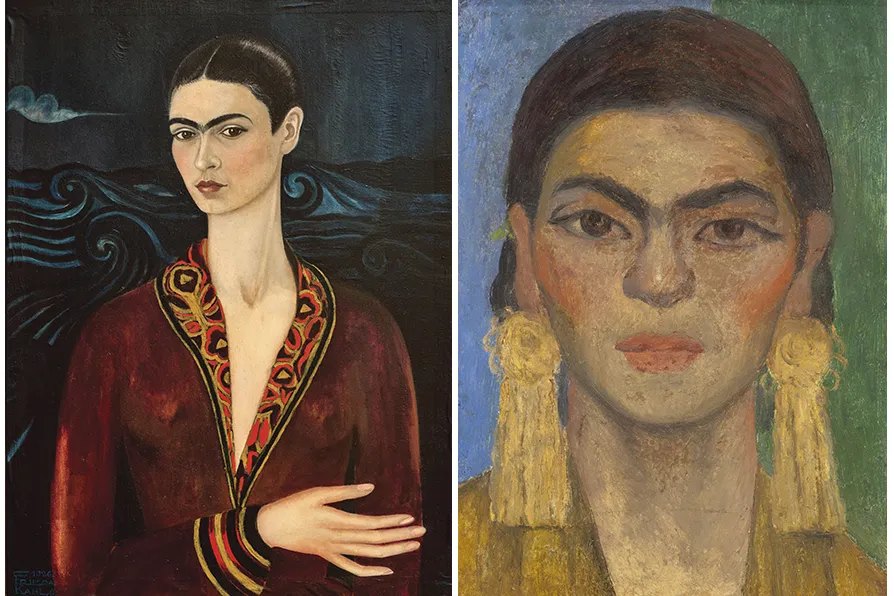
 (L) Frida Kahlo, Self-Portrait (With Velvet Dress) 1926; (R) Diego Rivera, Portrait of Frida Kahlo c.1935. [Pics: Courtesy of Tate Gallery/Private Collection; Los Angeles County Museum of Art]
PAUL DONOVAN welcomes a revival of Reginald Rose’s classic play that reminds us of the fundamental need for trials with juries
SIMON PARSONS applauds an exceptional performance of Wesker’s little-known play, by the same actor for whom it was written 45 years ago
ANDY HEDGECOCK and MARIA DUARTE review Late Fame, The Death of Robin Hood, Leviticus, and Gail Daughtry and the Celebrity Sex Pass
ANGUS REID recommends a uniquely accomplished documentary collage that contemplates our relation to the natural world
GORDON PARSONS enjoys Kant’s ‘mind-boggling’ theory of human reality: that we create the reality we experience





Frida: The making of an icon
Tate Modern, London
⭑⭑⭑⭑⭑
IT’S impossible to envy anyone who goes to see the first Frida Kahlo UK exhibition in over 20 years, not because the show isn’t amazing in many ways (it is). But if the unusually crowded press preview is anything to go by, visitors will struggle to actually see the work. Box office records have already been broken, and at the preview there was a palpable sense of excitement, with people dressed up like Kahlo as if to prove her status as an “icon.”
The story of her dreadful accident at the age of 18, and the wholesale commodification of her image since her early death, aged 47 in 1954, makes her an artist who inspires a great deal of reverence.
It’s clear the exhibition also wants to emphasis her commercial importance with one whole room dedicated to objects, from socks to rubber ducks, that bear her image. The main sponsor of the show is Bank of America who apparently want to make art “accessible,” all of which begs the question: What would Kahlo say? It’s clear from her work that she was an artist who spoke of (female) power, resistance and huge pride in her Mexican culture, rather than money-making endeavours.
Although her image is familiar, it’s still possible to be surprised by her self-presentation and rare talent. At the start of the exhibition are two photographs taken by her German-born father when she was 18, only a few months after the accident. It’s interesting that there are no images of her before this. Do the curators, on some level, see the accident as her defining or most important “achievement”?
In the first photograph, her signature direct gaze is already established, in contrast to the way she is dressed in the clothes of a demure, middle-class young woman. In the second photograph, she stands with her siblings and cousins, but is dressed in one of her father’s suits. What exactly is happening here? Who decided she should wear men’s clothing, and would it be a challenging image even now? Is this an icon being constructed or revealed?
There is another shock with the pencil drawing by Kahlo entitled El Accidente (1926). It depicts the bus and tram that collided, causing her to be impaled. The image of a bandaged woman floats at the bottom of the page, bodies lying everywhere. There’s also a disembodied portrait of Kahlo’s face as if, so soon after the accident, she is able to be an objective viewer. She looks out as well as in, so unflinchingly it creates deep emotion in the viewer.
It is a crude image, despite its power, and stands in contrast to Self-portrait In A Velvet Dress (1926), painted as a gift to a boyfriend who was going away.
This first self-portrait is very skilled, showing her as she always means to be seen — stern, strong, with a striking and uncompromising gaze. In the background there appears to be a tumultuous sea, perhaps to symbolise her boyfriend’s journey, but also speaking of her inner turmoil and the journeys she is about to make as an artist. The positioning of her hand and the lush quality of the clothes suggests her performative style, and an artistic connection to the great “masters” like Botticelli. The fact that she is a woman of colour, something that is not emphasised in the exhibition, makes her confidence even more striking.
In 1929, Kahlo married the Mexican muralist Diego Rivera, and this union offers several images that complicate the way she can be viewed. It is surprising to see her described on contemporaneous exhibition programmes as Mrs Riviere when she has now completely eclipsed him in terms of fame.
In his drawing of her, Nude With Beads (1930), she is reduced to a crude, adolescent image of available female sexuality. She even wears high heels and stockings, a soft pornographic cliche that is very far from the traditional Tehuana dress she wore as a symbol of pride in the indigenous Mexican culture of her mother.
Kahlo’s hands are occupied in this nude painting, fastening beads behind her neck so that she could not even resist if the viewer were to reach towards her. She has been stripped of her signature direct gaze, looking down in a way that could be demur or ashamed. This superficial image might go some way to explaining why she made herself the constant subject of her own work. Was this the only way to be seen as anything more than an object?
There are several other powerful paintings by Kahlo but these are overwhelmed to some extent by the work of artists she has since inspired, including a photograph of Tracy Emin dressed as Kahlo, lying on a bed. This can be called homage or appropriation, made even more uncomfortable because it references Kahlo’s disability. Would a contemporary male artist dress up as Pablo Picasso? What does that give to the work and what would Kahlo think?
During the curator’s talk at the preview, she was described as “the girl who refuses to go away.” Would Picasso be described as a “boy”?
If the viewer can see past the crowds and the commodification that lies at the heart of the exhibition, they will be rewarded by enormously powerful work.
Frida: The making of an icon runs until January 3 2027. For tickets and more information see: tate.org.uk
