

 Latest editorial

The climate debate has focused on tournaments and fan travel, but the sport’s relationship with fossil fuels stretches back to the Industrial Revolution
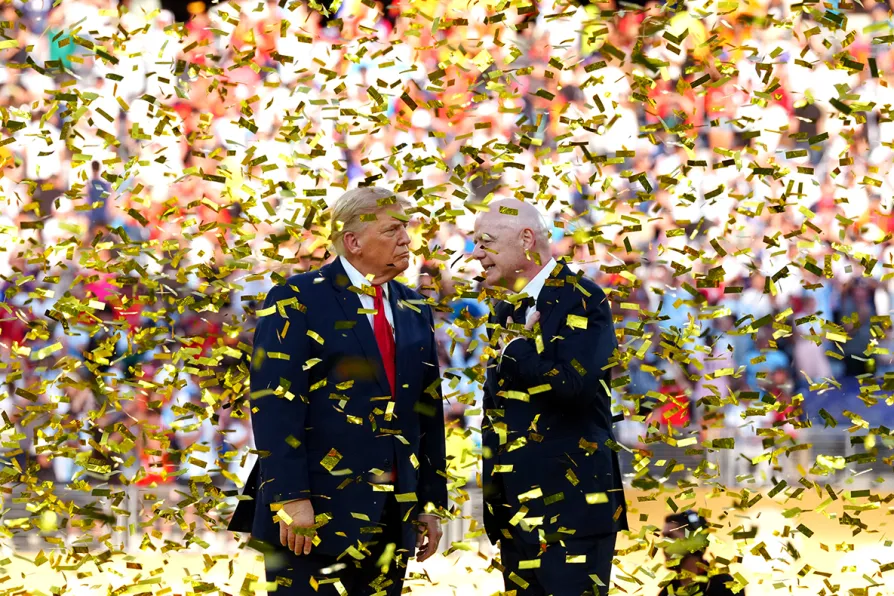 US President Donald Trump alongside Fifa President Gianni Infantino following the Fifa World Cup 2026 final at the New York-New Jersey Stadium, July 19, 2026

Snippets of news from the sporting world with JAMIE J





NO SOONER was a ball kicked in the 2026 Fifa World Cup than many observers began to highlight the numerous controversies blighting the event. Whether it be ticket prices, US immigration policies or the treatment of the Iranian team, with a participating nation at war with the host country, what happened off the pitch was just as important as what happened on it.
Few issues garnered as much attention as the climate impact of the event. Estimates of the tournament put the total emissions at around 9 million tons of CO2, of which 7.7 million tons are linked to the air transport of fans and teams.
Measuring events in this way represents a growing interest in the climate impact of football. This interest has been largely driven by the previous 2022 World Cup hosted by Qatar and the wider purchasing of football clubs across Europe by many states associated with fossil fuel production.
In our recent report, we argue this focus reflects an important aspect of football’s climate politics but ignores the historical carbon intensity of football.
Football’s climate impact has not simply been made recently; it long predates the recent World Cup. Nor did it begin with the influx of capital from the Middle East. The 2026 World Cup reminds us that these narratives are inherently Western-centric or Islamophobic if they ignore the role of North America and Europe. Although the emissions output of the World Cup is important, it has, in our view, again inaccurately laid the blame on fan travel. Moreover, unlike the focus on Qatar, the fossil fuel production of the US or Canada is rarely mentioned, nor are Donald Trump’s two withdrawals from the Paris Agreement.
Attributing football’s impact to this relatively recent trend more fundamentally ignores the fact that the sport came from many of the fossil fuel industries that arose across Europe during the Industrial Revolution. As highlighted by Andreas Malm’s idea of fossil capital, the Industrial Revolution marks the point at which the global economy became dependent upon fossil fuels. The same is true for football.
Think of any club across Europe. In their early days, they are very likely to have emerged from factory workers and new polluting industries that built the modern working-class. Take, for example, one of Britain’s biggest clubs, Manchester United. Not only did the club emerge from a city built upon the cotton industry, a sector that remains a prominent source of emissions, but the club was founded by workers from the Lancashire and Yorkshire Railway Company, when it began as Newton Heath FC.
New Premier League champions Arsenal similarly emerged from, and owe their very name to the Royal Arsenal armament factory in Woolwich, London, where again, the workers who established the club manufactured weapons and ammunition for the British Armed Forces. Only now are the profound emissions associated within ammunition being calculated.
This pattern is common among so many famous clubs around the world. Everton and Liverpool emerged from the maritime industry, fuelled by the fossil fuels it exported across the world, just as Sheffield United and Sheffield Wednesday arose from the workers producing steel that remains a stubborn sector to decarbonise. Aston Villa and Birmingham City were founded at the time the city refined its expertise in steam engines.
Beyond England, the same pattern can be seen across Europe. German club VfL Wolfsburg, located in the city of Wolfsburg, was founded in 1938 to essentially serve as the site of car production for Volkswagen, just as Juventus FC has remained tied to the Agnelli family who own Fiat.
Even today, European clubs are owned by those contributing to Donald Trump’s electoral campaign in full knowledge of the president’s aggressive climate denial and obstruction. Equally, Manchester United owner Jim Ratcliffe has been a prominent critic of Britain’s Net Zero targets.
At the same time, changes are happening. Unlike Fifa, Uefa has begun to act on the issue. For the 2026-27 season, clubs need to have a sustainability manager and strategy in place to take part in European competitions. Uefa has also set a €25 carbon price per tonne of CO2.
That the 2026 World Cup would be the most polluting in history was almost certain. And yet, football retains unparalleled cultural influence to instigate change, should it seek to do so. The biggest question remains: how to make Fifa act?
This article was written by James Jackson, Mark Doidge, Oscar Berglund, Jennifer Amann and Samuel Toscano.


JAMES NALTON argues that Curtis Jones’s departure leaves Liverpool facing a stark local void as the club’s roots are increasingly swallowed by football’s globalised model
Resistance grows as Fifa seeks to hand private investors a slice of the international game, writes JAMES NALTON

The World Cup, Olympics and rise of sports betting reveal how the playing field is increasingly shaped by power and inequality, writes DENNIS BROE

Council of Europe says Fifa must help to protect 2030 tournament