
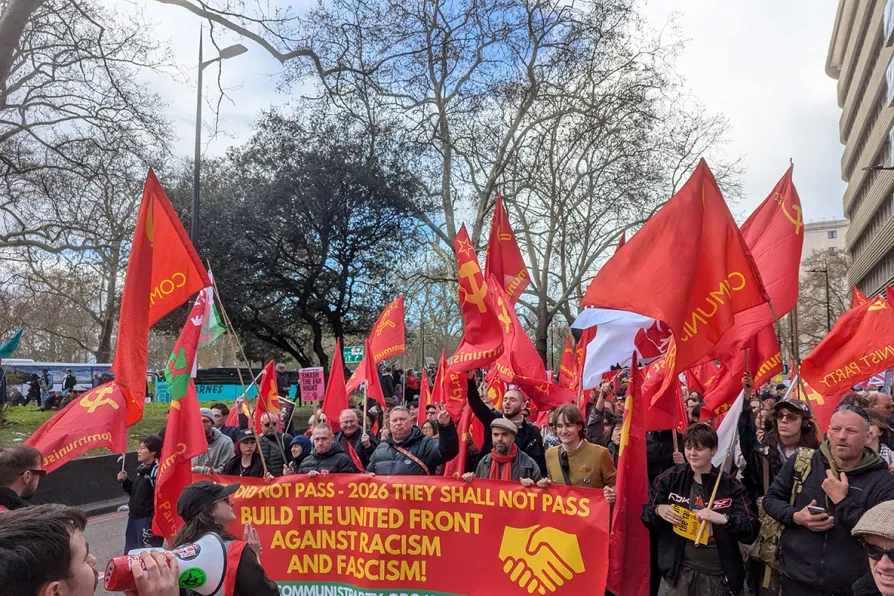
Working people across Britain are fighting back against austerity, war, repression and exploitation. The challenge now is to unite those struggles, says Communist Party of Britain assistant general secretary JOHNNIE HUNTER

Escaping Franco’s bombs: the story of the Basque children
The evacuation of thousands of Basque children became a landmark act of compassion during the Spanish civil war, write SIMON MARTINEZ and MANUEL MORENO

 Relaxing at the camp outside Southampton [Pic: Marx Memorial Library]
Train drivers’ union Aslef general secretary DAVE CALFE speaks to Ben Chacko about his hopes that Burnham’s devolution agenda will include the importance of the railway
DIANE ABBOTT provides an analysis of the reasons for EU and British voters’ dramatic swing to the right
Some of the review’s proposals could make the benefits system less cruel and dehumanising. But its vague plans for services and non-cash support revive the threat that disabled people will lose control over the money we need to survive, writes DYLAN MURPHY
Believe it or not, there was a time when the US government built beautiful homes for working‑class Americans to deal with a housing shortage, writes ERAN BEN-JOSEPH
MAT COWARD has heaps of good advice on recycling garden and household waste over the winter





NEARLY 4,000 children and 250 supporting adults were evacuated from the Basque city of Bilbao on May 21 1937, arriving in Southampton two days later.
They travelled across a stormy Bay of Biscay on the steamship Habana, a ship with capacity for 900 passengers. The Royal Navy, which was patrolling Spain’s northern coastline, made sure Franco’s warships didn’t interfere.
The story of the Basque children in Britain was one of the main strands of a broader Aid Spain movement and the response of ordinary people to the war in northern Spain.
Aid Spain activists raised money not only for the Basque Children’s Committee but also for medical aid, a Milk for Spain appeal and a fund for dependants of the International Brigades. Exceptionally generous were the South Wales Miners’ Federation and the AEU engineering union.
In Bilbao, as in Valencia and Barcelona, populations were added to by waves of women, children and the elderly retreating before the threat of violence from the Franco and Italian armies.
Madrid came under attack from the air, as did the Basque Country. Durango, Eibar and then Guernica on April 26 1937 were bombed by the Franco-supporting air forces of Italy and Hitler’s Condor Legion.
George Steer famously reported the destruction of Guernica: “I have visited the town and the whole of it was a terrible sight, flaming from end to end … the raid on Guernica is unparalleled in military history. Guernica was not a military objective.”
Franco’s objective in the north of Spain had already been made clear in a broadcast to the Basques by General Emilio Mola. He spelt out how he was going to crush resistance by targeting Bilbao and its province: I have decided to terminate rapidly the war in the north. I shall raze Vizcaya to the ground, beginning with the industries of war. I have the means to do so.”
The attack on Guernica’s civilian population on a quiet market day significantly increased the campaign led by the Joint Campaign for Spanish Relief and its offshoot, the Basque Children’s Committee.
In April former Labour MP Leah Manning, a former president of the national Union of Teachers, was in Bilbao meeting with the Basque government. She was assisted by Ralph Stevenson, the sympathetic British consul, and doctors Richard Ellis and Audrey Russell. The expedicion a Inglaterra (expedition to England) was under way.
On the evening of May 20 the children were assembled at Bilbao’s main railway station. From there they were taken by train, 600 at a time, to the port of Santurce, where they embarked on the Habana.
Awaiting the children in England was a tented town in fields at North Stoneham, outside Southampton, which was wholly funded by donations to the Basque Children’s Committee and erected by volunteers. In line with British government instructions, not a penny of public money was to be spent on the children.
The children settled into the routines of their new temporary home. They made the best of the English food — and liked the locally baked white bread.
However, overflying planes from the nearby Eastleigh airfield were stopped when the children complained they thought they were going to be bombed.
Soon groups of children started to leave the camp and went to homes dotted around the country. Eventually 90 such colonias were established, from Montrose to Margate and from Caerleon to Cambridge.
Some of the first groups went to Worthing, where local volunteers took responsibility for their food and lodging. Other groups went to the Isle of Wight, to be looked after by the Sisters of Nazareth, and to Shornells in south-east London, where they were welcomed by the Royal Arsenal Co-operative Society. By September 19 the last of the children had left the camp at North Stoneham.
In their temporary homes the children were in mixed age and mixed gender groups. The Spanish supporting adults went with them and maintained the children’s education. Cleaning, cooking and laundry were shared by the children, and the older children helped look after the younger ones.
The fall of Bilbao and the Basque Country in the summer of 1937 saw the start of the process of returning the children to their families. This carried on for many years. Some were repatriated to Spain, while others were reunited with their exiled families across the globe from France to Argentina.
Two hundred and fifty of the children remained in Britain for the rest of their lives, as did most of the adults who accompanied them from Spain.
Simon Martinez and Manuel Moreno are activists in the Basque Children of ’37 Association.

Similar stories
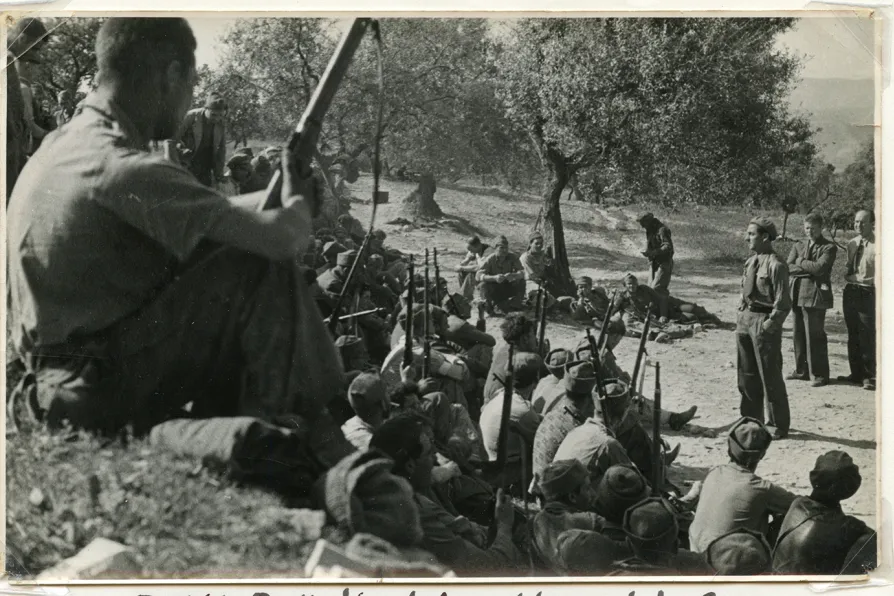
Thousands of remarkable Britons left ordinary lives behind to join the struggle against Franco. Here is a snapshot of those who answered the call
![Richard Baxell speaking at the Marx Memorial Library in London [Pic: Karl Weiss]](https://msd11.gn.apc.org/sites/default/files/styles/desktop/public/2026-07/RichardBaxell22Jul23.jpeg.webp?itok=HCh8iPRb)
Driven by anti-fascism and anger at Britain’s policy of non-intervention, thousands volunteered to fight in the Spanish civil war. Historian RICHARD BAXELL reflects on their sacrifices and enduring significance
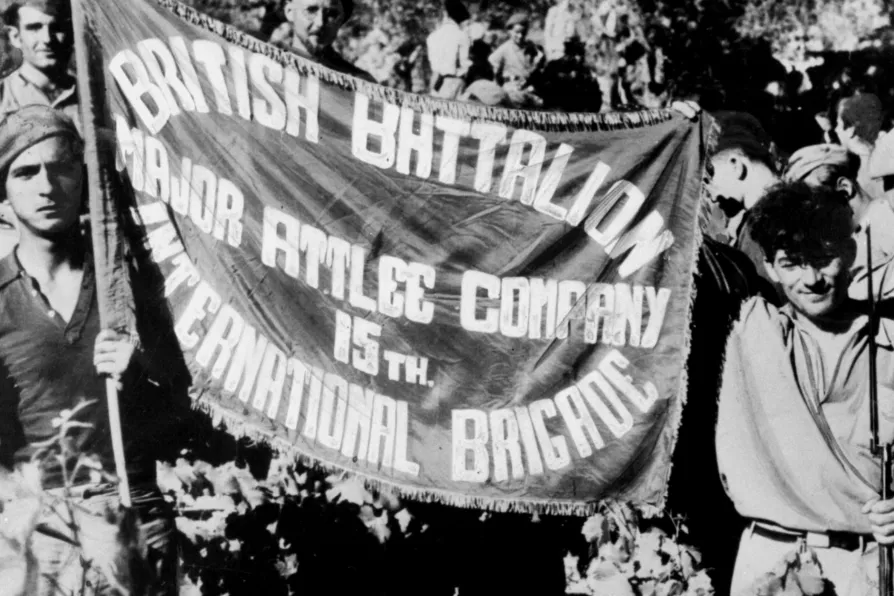
MAXINE PEAKE says the warnings of the International Brigades ring true today
![Harry Pollitt (right) with International Brigade volunteer David Guest, who was killed at the Ebro in July 1938 [Pic: Marx Memorial Library]](https://msd11.gn.apc.org/sites/default/files/styles/desktop/public/2026-07/a-2_a_50b_Harry%20Pollitt_David_Guest.jpg.webp?itok=Ag0u-8n5)
ALEX GORDON applauds the leading role played by Harry Pollitt and the Communist Party in the fight against fascism in Spain and salutes the memory of the International Brigades