APURBA CHATTERJEE explains how British artists in India used the “picturesque” to reshape colonial landscapes and celebrate imperial power


 Latest editorial

Deconstructing a period postcard
SUSAN DARLINGTON is fascinated by an exhibition that explores a colonial display to reveal the overlooked histories of migration and protest that continue to shape Bradford today
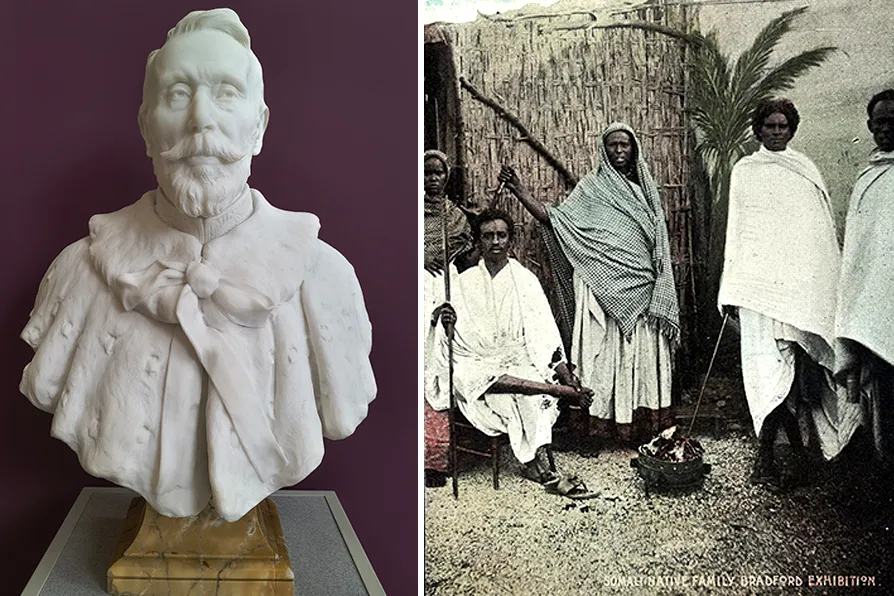 OTHERING: (L) Lord Mashmam, Samuel Cunliffe Lister by Edward Drury, 1904; (R) The Somali village in Lister Park, a form of colonial display that emerged in the late 19th century [Pics: Bradford Museums and Galleries]
PAUL DONOVAN welcomes a revival of Reginald Rose’s classic play that reminds us of the fundamental need for trials with juries
SIMON PARSONS applauds an exceptional performance of Wesker’s little-known play, by the same actor for whom it was written 45 years ago
ANDY HEDGECOCK and MARIA DUARTE review Late Fame, The Death of Robin Hood, Leviticus, and Gail Daughtry and the Celebrity Sex Pass
ANGUS REID recommends a uniquely accomplished documentary collage that contemplates our relation to the natural world
GORDON PARSONS enjoys Kant’s ‘mind-boggling’ theory of human reality: that we create the reality we experience





A Somali Village in Lister Park: Weaving Together Industry, Culture and Empire
Cartwright Hall Art Gallery, Bradford
★★★★☆
AT first glance, the young black woman on the colourised postcard appears to be posing naturally: head cocked slightly self-consciously, beads around her neck, and a brightly coloured skirt falling in folds to her ankles. Look more closely, though, and the backdrop begins to feel staged. The painted foliage reveals she’s standing in the “Somali Village” — the most popular attraction at Bradford’s Great Exhibition of 1904.
The ambitious event, which attracted over two million visitors across six months, celebrated the industry and innovation that had made the city the “wool capital of the world.” New technologies were showcased alongside fairground rides and musical entertainment. Yet it was also deeply shaped by the British empire. This was exemplified by the “living ethnographic display” of 57 Muslim men, women and children.
The touring group lived in a purpose-built “model village” in Lister Park, where they demonstrated daily activities such as cooking, prayer, weaving and mock battles. Although promoted as educational, the display encouraged spectators to contrast supposedly “primitive” cultures with advanced industry.
The Edwardian racial hierarchies that shaped how the village was originally presented are revisited in A Somali Village in Lister Park: Weaving Together Industry, Culture and Empire.
Supported by Arts Council England, Fozia Bora (University of Leeds), Somali Village, Culture House, Koor Archives, Everyday Muslim, and the Universities of Bradford and Leeds, the exhibition brings together widely sold postcards, commemorative exhibition memorabilia and contemporary Somali crafts.
One of the first objects that visitors encounter is a marble bust of Lord Masham, better known as Samuel Cunliffe Lister. The local industrialist and inventor not only gave Lister Park his name, he also funded the construction of Cartwright Hall Art Gallery within its grounds.
The bust is a reminder of how Lister used his wealth to shape how the city’s industrial history was recorded. It’s also one of many items through which Cartwright Hall expanded its collection between 1906-28, using profits from the exhibition, including those generated by the Somali Village.
Lister reappears in several souvenir postcards, most uncomfortably in a group of formally dressed white dignitaries looking down at Somalis as they cook. Widely circulated during the exhibition, the photograph helped to reinforce the racialised “othering” of the troupe. The accompanying panel encourages visitors to consider what’s happening in the image. It’s hard not to think of scientists peering through a microscope at a curious specimen.
That sense of scrutiny extends to a display of contemporary crafts the troupe might have produced. Shown alongside a replica booklet is an intricately decorated animal hide shield (gaashaan). The original text explains that it could be “easily pierced by a pistol bullet,” a chilling reminder of the colonial violence of the Anglo-Somali war.
The curation makes for uncomfortable viewing but in seeking to decolonise the village, the curators turn the white gaze back on itself to restore agency to the troupe. As guest curator Abira Hussein notes: “This exhibition invites us to think differently about the Somali Village in Bradford by centring the people who lived there. Moving beyond the spectacle of empire, it draws attention to their labour and social worlds, and to how they responded to being staged for public display.”
Image
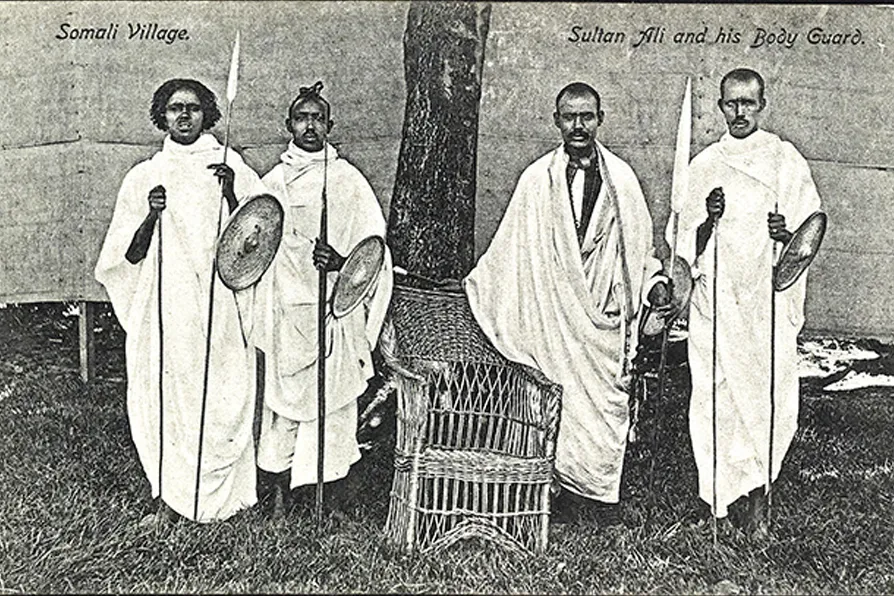
There’s certainly evidence the individuals were more than passive exhibits. Led by the polyglot Sultan Ali al-Urfa, they described themselves as Arwo, a Somali term for people of the market. They negotiated wages of £7-12 for six months of work (less than the average mill worker), sold handicrafts such as pottery and fabrics to visitors, and expected payment for photographs. In an image showing an informal interaction between troupe members, one woman pulls her headscarf across her face, quietly asserting her right to privacy.
There’s also evidence of cultures meeting and reshaping one another. In one photo, a group of Somalis are engrossed in a game of cards. A popular Western pastime, it suggests a form of cultural exchange within the empire. Also on display is a colourful Venetian trade bead (awaleh), excavated near the village entrance in 2025, which reminds visitors that the troupe were part of global trade networks (before arriving in Bradford, they’d already performed in France and continued to tour Europe and North America over the next decade).
The exhibition draws a line from the troupe to modern migration and the labour movement. Members of the village were free to leave, as one individual did, and at the end of the tour they picketed outside Bradford City Hall over a broken contract. A parallel is drawn between their protest and a strike by women millworkers in Manningham in 1890-91 — the severe looking dispute committee is pictured — which contributed to the formation of the city’s Independent Labour Party.
It concludes by acknowledging the overlooked histories that helped to shape the city, from the German mill merchants to the Pakistani mill workers who arrived in the 1900s. That wider story is illustrated with images of Braford’s first ever Asian Mela in 1989, and a striking photo from Sarah Maple’s 2024 “Mother Tongue” series (“Plait Performance,” in which the artist wears traditional Punjabi attire and a 10-metre-long plait).
What emerges from the exhibition is more than a critique of how the Somali Village was staged. It offers a fuller recognition of the people within it and the histories of migration and belonging that still shape the city.
Exhibition runs until November 1. For more information see: bradfordmuseums.org.
