

 Latest editorial

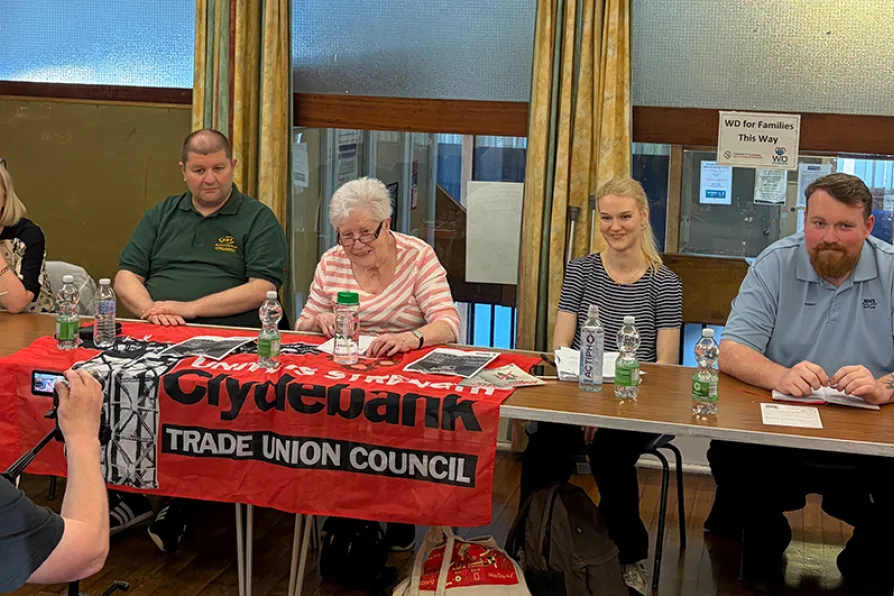






“HEALTHCARE and welfare, not warfare” was the demand heard at a public meeting called by Clydebank Trade Union Council (CTUC) on Tuesday night.
Soaring temperatures on the Clyde did little to stifle discussion as locals heard speeches from EIS general secretary Andrea Bradley, RMT Scotland officer Gordon Martin, trades council rep to the STUC general council Drew Gilchrist, and Stop the War Scotland secretary Sophie Johnson.
Referring to a motion passed at STUC Congress calling to roll back increases in defence spending, after a “comradely” debate with delegates representing arms industry workers, Mr Gilchrist said: “The SNP plans to cut 0.5 per cent of the public service workforce that’s already 10 per cent lower than it was 15 years ago.
“We are seeing an increase in wealth disparity and poverty and a decrease in our public services, but the British government wants to utilise weapons manufacture as an economic stimulus, despite the fact that it produces just one per cent of overall GDP and those areas around the UK where weapons are manufactured are some of the poorest.
“Most of the profit it produces is sent to the United States.”
Outlining the key role of trades councils in building an alternative, he added: “These motions and analysis come from into the movement from trades councils because they act as a conduit, as a connecting point between political, social, and industrial struggles the working class face.
“They could only come from that space.
“It brings us into contradiction sometimes with our own unions, but it allows us to force the conversation to be had, to allow us to bring these militant ideas to what can sometimes be a very stagnant debate.”
