
ROB WARZYNIAK wades knee deep through a pile of ‘dead canaries’ of Trumpist policies which exacerbated the horrors of US capitalism domestically


Centralise, outsource and automate
STEPHEN LOW looks at the SNP plans for public services
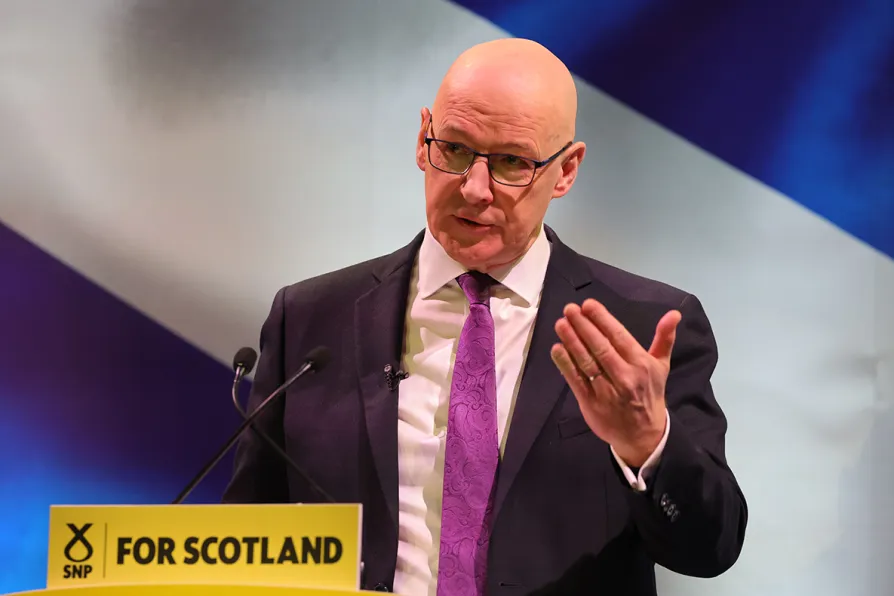
 First Minister of Scotland John Swinney delivers a keynote speech at Oran Mor, in Glasgow, as he launches the SNP's 2026 Scottish Parliament election campaign and outlines the opportunity for a fresh start with independence, January 5, 2026

Without evidence or Nato consultations Berlin’s answer to the Leipzig incident is a rupture of relations. SEVIM DAGDELEN examines why
FRANCISCO DOMINGUEZ introduces the background to a conference on defending Latin America’s sovereignty
The glacier collapse in Nepal is yet another warning that a warming planet is making Himalayan disasters more frequent and destructive – but the countries facing the greatest risks are often those least responsible, says LI YANG
Nick Blair is set to benefit from a hugely lucrative contract to ‘virtually’ train the British army for its next war. Like father, like son, writes SOLOMON HUGHES
Even when tragedy strikes, Western media cannot resist the opportunity to turn it into a sordid propaganda opportunity, as the Nepal-China border tragedy shows, writes CARLOS MARTINEZ
Trade unions should be at the heart of the anti-racist push for reparations for the historic legacy and continuing impact of slavery, writes ROGER McKENZIE





IN mid-October the Scottish government hosted an event in Strathclyde University. Its title, “The Public Service Reform Operational Summit,” could scarcely be more bland.
The intentions however could scarcely be more alarming, as an agenda of outsourcing, automation and offshoring was outlined.
This was an all-day session with an invite list consisting of every chief executive in Scotland’s public sector. From Architecture and Design Scotland to Zero Waste Scotland and everyone in between, including all the health board and council chief executives.
The aim was to develop ideas to progress the SNP government’s “public services reform strategy.”
This was announced in June and had a fairly clear attitude to staffing in public services. The short-term target for the strategy is saving £200 million a year for the next five years.
This is to be accomplished by a variety of mechanisms, principal among them reducing the workforce. The reform strategy makes a clear, and inaccurate division of staff into “front line” and hence essential and “the rest” — ripe for removal.
The strategy document itself talks of “reprofiling.” Helpfully it is explained elsewhere what they mean by this — a half per cent reduction target in every year or a total of some 27,000 jobs over the five-year period.
Another proposal is “Realising the potential of the third sector” — enhancing the role of the third sector as a “key delivery partner” with greater involvement in designing services. Or, to put it another way, outsourcing from the public sector.
Public bodies will be encouraged to develop shared services via AI, with a definite preference for all-Scotland solutions rather than local flexibility or autonomy in order to “simplify the delivery landscape.”
The Reform Strategy document is incidentally a rich source of joy for devotees of management-speak, consisting as it does of four “Pillars,” three “Foundations” and 18 “Workstreams.” Like much management-speak, the titles often contradict the content.
For example, local authorities, despite various blandishments, are to be undermined still further. Scottish government is looking to strengthen the Community Asset Transfer process on the one hand, and give more power to regional economic quangos on the other.
“Boring title — terrifying content” is something of a theme with the Scottish government. The Public Services Reform Strategy came as part of a package alongside the not exactly thrilling-sounding “Medium-Term Financial Strategy” and “Fiscal Sustainability Delivery Plan” — together they deliver a package of aims and targets.
Why are they doing this? They are going to need the money. There is a massive gap developing between the amount of money they want to spend and the amount of money they expect to be getting from taxes‚ nearly £5 billion a year by 2029-30.
The Scottish government’s intention gap is to be closed via greater efficiencies in public spending, and creating economic growth, rather than adopting the wealth-taxing ideas that trade unions have been urging.
This hardly instils confidence. If the Scottish government had a big red button in Bute House marked “Economic Growth” they would have pushed it by now. So if they carry on with their declared policies (one of which is that 51 per cent of Scottish income tax payers are paying less than in England and Wales) cutting the cost of public services takes on even more of a priority.
Which brings us back to the summit. Before the assembled chief executives went into workshops, Public Finance Minister Ivan McKee told the them he was wanting them to “commit to concrete actions.”
A look at the briefings prepared for those workshops (obtained through freedom of information requests, incidentally) makes for cheerless reading.
To deliver the announced targets to reduce the workforce the civil servants urged managers to look at “severance schemes to support workforce restructuring” these will deliver an “agile and efficient” public sector.
Centralisation or as it was put “removing duplication was a key theme. The presumption is that services only remain with bodies “where there is clear evidence to do so” and simplifying a “crowded delivery landscape.”
The Scottish government made it very clear where they see the real savings coming from though. Through BPO and GBS.
BPO stands for “business process outsourcing,” a method of subcontracting various business–related operations to third-party vendors. It’s noted with a tone of regret that “there may be logical, and regulatory/public policy requirements that prevent entities taking shared services on a full ‘BPO’ basis.”
“Global business services” do what it says on the tin. These are systems that control the delivery of business support functions to the core business through multiple service delivery models on a global basis. This is where it is believed by the SNP administration “the highest returns can be realised for Scotland.”
The mechanism for these is mainly to be artificial intelligence — or, as the official documentation puts it, “scaling intelligent automation” — ie relying on AI to design and deliver services.
Participants at the summit were asked “to identify opportunities to pilot AI technologies in public-sector processes.” If this happens it represents a significant transfer of not just resources and but also of control and ownership from the public to the private sector.
It’s easy to see that this strategy will deliver contracts for tech businesses. Seeing how fewer staff, centralisation and automated systems will provide better public services? That’s much more difficult.
