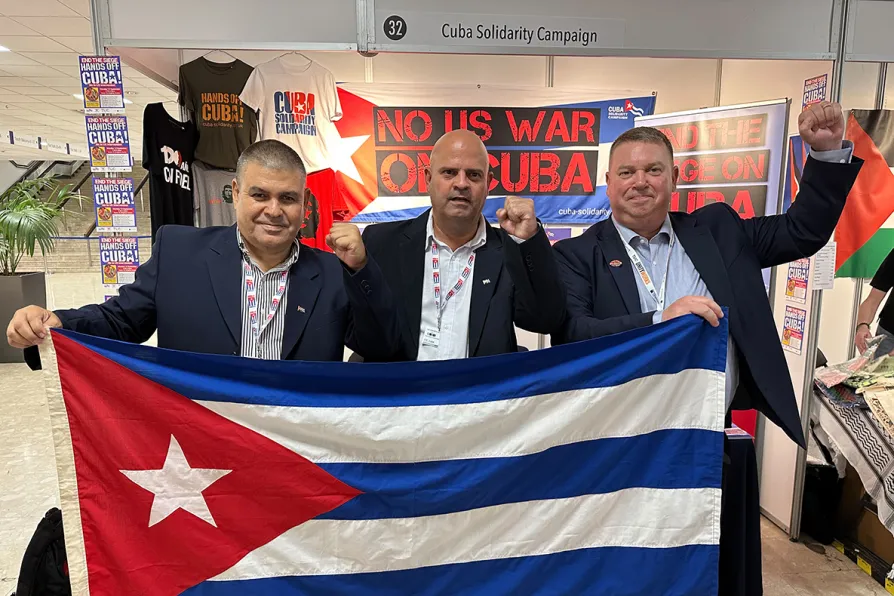
Cuban trade union federation CTC leader OSNAY MIGUEL COLINA speaks to Ben Chacko about life and work under a crippling US siege


 Latest editorial
Capitalism’s general crisis is back with a vengeance
ROBERT GRIFFITHS delivered the main political report to the Communist Party's executive committee meeting last weekend. Here is the first of two articles based on his address
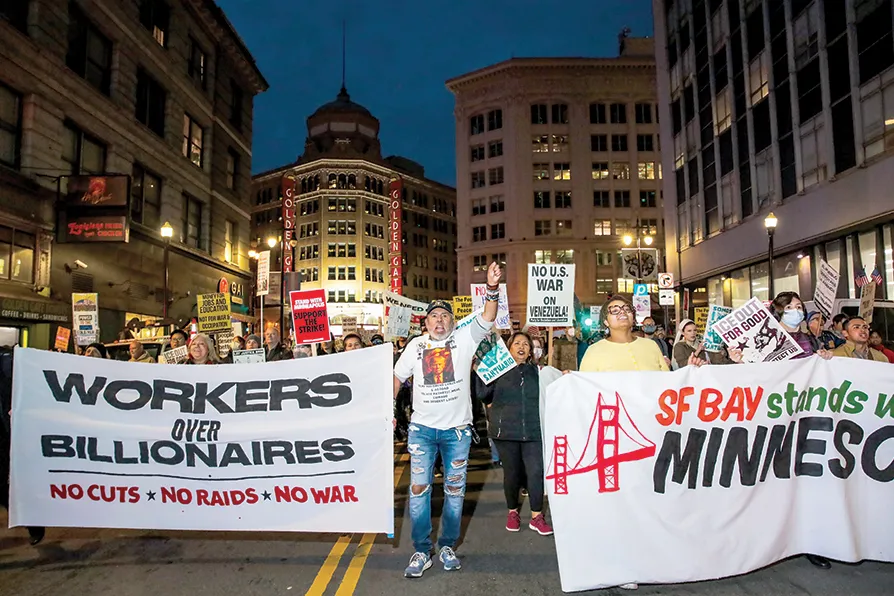 RESIST, RESIST, RESIST: Jim Martinez, center, and Jamila Rice, right in yellow, of Bay Resistance, at the San Francisco Free America Walkout, an anti-ICE protest on Tuesday, January 20 / Pic:Yalonda M. James/San Francisco Chronicle via AP
A part of the British empire’s network of slavery, today the Caribbean island of Nevis faces a new form of exploitation in the form of crypto-colonialism, CLAUDIA WEBBE writes
A new book by Victoria Holmes illuminates the many hidden histories of the oppression experienced by Gypsy/Roma/Traveller community, writes ROGER McKENZIE
Even the oligarchs of the artificial intelligence industries are warning that their creations have the capacity for the ultimate destruction of the planet and its population. ANDREW MURRAY suggests that there might just be other solutions
The Labour government must deliver on its commitment to bring back privatised services into the public sector. This not only saves money but also creates accountability and generates wider social benefits, argues ANDY MCDONALD MP
Public ownership of Great British Railways has enormous potential to improve our railway network, but that can’t happen unless jobs, employee rights and union recognition is at the heart of the transition, argues MARYAM ESLAMDOUST
Challenges from the unscrupulous misuse of AI to steal actors’ voice and physical likenesses is being met with a firm union response, writes LYNDA ROOKE





WHY are we experiencing a period of such crisis in international relations in Britain, Europe, the Americas and across the world?
So many responses to this question fail to locate it in what the international communist movement has long called the “general crisis of capitalism.”
At its base, capitalism cannot resolve the cyclical and structural crises that produce instability, shocks, slowdowns, recessions and slumps. As a system of class exploitation reinforced by oppression, it generates inequality and social crisis which, likewise, cannot be fully and permanently abolished without abolishing capitalism itself.
The march of the monopoly corporations to dominate economic and political life in the main capitalist economies, and the use of state power to promote their interests internationally, began in the late 19th century.
Colonial and post-colonial profits, post-war reconstruction and ideological warfare have sustained capitalist supremacy since, although capital’s turn to fascism for protection in the 1920s and 1930s almost proved suicidal.
Collapse and counter-revolution in the Soviet Union and the socialist countries of central and eastern Europe opened up new areas for capitalist exploitation and profiteering in the 1990s and early decades of the 21st century.
Neoliberalism’s privatisation and deregulation drive across both western and eastern Europe, together with the consequent “financialisation” of the US, British and French economies, turbo-charged the financial markets in the 1990s — and helped cause the great crash and recession of 2008-12.
Although an extraordinary combination of economic and political factors helped conceal its continuing existence, capitalism’s general crisis never went away. Now it is back with a vengeance economically, socially and politically.
According to OECD (Organisation for Economic Co-operation and Development), IMF and World Bank forecasts, the global capitalist economy is sluggish, its growth held back by the over-accumulation of capital that cannot find profitable investment in producing the goods and services society needs.
Narrow, short-term and profit-driven self-interest decides what is produced, when, where, by whom, and for whom.
In capitalist economies, most investment and production is not planned across the whole economy, let alone to meet society’s immediate and longer-term needs.
The exception, of course, is People’s China.
Now we see the world’s most powerful economy and state being ruled by a deeply reactionary, anti-democratic and ruthless cabal of gangster-capitalists, fronted by a capricious crook in the White House.
But there is logic and method to their seeming madness. They are pursuing the interests of US big business in the international struggle for profits, markets and resources. What’s more, they have the support of significant sections of American monopoly capital in doing so.
The US stock market bounced back quickly from the shock of President Trump’s declaration of a trade tariff war in August last year. As the Financial Times reports this year (January 13), Chevron and oil refiner Valero’s shares leapt, fell, recovered and resumed their upwards trend after US state terrorists invaded Venezuela and kidnapped President Maduro.
Chevron has been the only US corporation producing and exporting oil in one of oil-richest countries in the world. Chief executive Michael Wirth is a close political ally of the US Commander in Chief. The company is well placed to profit mightily from the wholesale theft of Venezuelan oil.
Likewise, Lockheed Martin’s share price U-turned upwards soon after Trump’s announcement that the US will acquire Greenland by hook or by crook. Owners of the world’s biggest armaments producer know that war, militarism and the threat of war are especially good for business under capitalism.
There’s another golden thread that runs through recent policies announced and enacted by the Trump regime. It represents a dimension of capitalism’s general crisis that has come very much to the fore in recent decades, namely, the system’s failure to plan, conserve and utilise the Earth’s natural resources in the interests of its peoples and their life-supporting eco-systems.
In the scramble for control over fossil fuel deposits, key transport routes and the rare earth minerals vital for hi-tech products, Trump and his corporate cronies care nought for international and humanitarian law.
Hence the recent deal between Trump and President Zelensky to hand over Ukrainian rare minerals in exchange for US weapons to prolong the war with oil-rich Russia. Hence, too, the plans to occupy the Panama Canal and mineral-rich Greenland, coerce oil-rich Iran, subvert oil-rich Brazil and halt Venezuelan and Mexican oil supplies to socialist Cuba.
However, we should not be misled by the new US National Security Strategy with its emphasis on the need for US governments to impose its will on the whole American continent in the guise of an updated Monroe Doctrine.
The ambitions of US state-monopoly capitalism are global and the aim is to impose a “Dictatura Americana” in place of the old — and fraudulent — “Pax Americana.”
Oil-rich Nigeria and the mineral resources of central Africa are in its sites, as are those of Syria, Libya and Iraq. A Greater Israel, extended across Gaza’s scorched earth, is all part of a wider plan to reassert US power globally at the expense of international law.
President Trump’s so-called “Board of Peace” is designed to sideline the United Nations and prevent the formation of a sovereign Palestinian state.
While Trump is the figurehead, it would be a mistake to concentrate too much on his disruptive tactics and seemingly unhinged personality. Behind him lie more stable, more ideological strategic political and corporate figures representing the big financial, energy, industrial, armaments and pharmaceutical companies.
The big five US banking corporations (JP Morgan Chase, Goldman Sachs, Morgan Stanley, Bank of America and Citibank) are set to announce bumper profits for 2025.
Inside the US today, Trump’s regime ignores national and international law, rules without accountability to the elected US Congress, persecutes political opponents and deploys its own ICE paramilitary forces against racial minorities and democratic local government.
The US has embarked on the road to fascism, classically defined by the Communist International in 1933 as the “open, terrorist dictatorship of the most reactionary, most chauvinist and most imperialist elements of finance capital.”
All these dangerous developments highlight the need to strengthen the peace and anti-war movement in Britain, not least CND and the Stop the War Coalition.
More extensive co-ordination is also needed on the international level, where the World Peace Council brings together many of the mass movements while also providing anti-imperialist clarity to the struggle against militarism and war.
Winning more support — especially in the trades unions — for the Palestine, Cuba and Venezuela solidarity campaigns and their initiatives is also essential, including a huge mobilisation for the next pro-Palestine demonstration in central London on Saturday, January 31.
The Communist Party of Britain also stands in solidarity with the workers, women and people of Iran in their fight against the clerical dictatorship in Tehran. Of course Mossad and the CIA seek to influence and manipulate events there, as in every other country in the Middle East.
But neither they nor the murderous “Peacock Throne” monarchists directed the women’s uprising in 2022-24, any more than they direct the trade union strike movement today, much though the mullahs try to blame “foreign agents” for all such resistance to their oppressive rule.
Other than the world’s peace and international solidarity movements, which forces could withstand US imperialism’s global agenda?
How about the European Union with its own military-industrial complex and energy and financial corporations in competition with US rivals?
For all the fine words of unelected President Ursula von der Leyen, unelected High Commissioner Kaja Kallas, President Macron and Chancellor Friedrich Merz, they are complicit in the expansion of Nato, the rise of militarism, the Israeli genocide and the demonisation of migrants and asylum-seekers.
The British Labour government — like its Tory and Labour predecessors — is particularly supine in its surrender to the demands of their US “special partner.”
Only People’s China and its allies have the power and potential to meet the challenge of US imperialism economically and politically, if not ideologically. For good reason, China will not do so militarily except in self-defence.
The Brics alliance could provide alternatives to a “Dictatura Americana,” for example by dumping the US dollar as an international trading and reserve currency. Nonetheless, some Brics members and associates are by no means consistent or reliable in their commitment to challenging US power.
China’s new special partnership agreement with Canada embraces not only trade (notably electric vehicles) and investment but food, culture, tourism and crime also.
Canada’s capitalists, it should be noted, now own the world’s fourth biggest stock of foreign direct investment, confirming that their country is rather more than an inconvenient land mass separating the US from Greenland and Alaska.
Beijing’s counter-offensive to the US drive for global dictatorship is underway. We must step up our work with the Friends of Socialist China to explain why it needs to be understood and supported.
Robert Griffiths was general secretary of the Communist Party of Britain from 1998-2026. Tomorrow: Griffiths reports on Britain’s economic and political crisis.
