


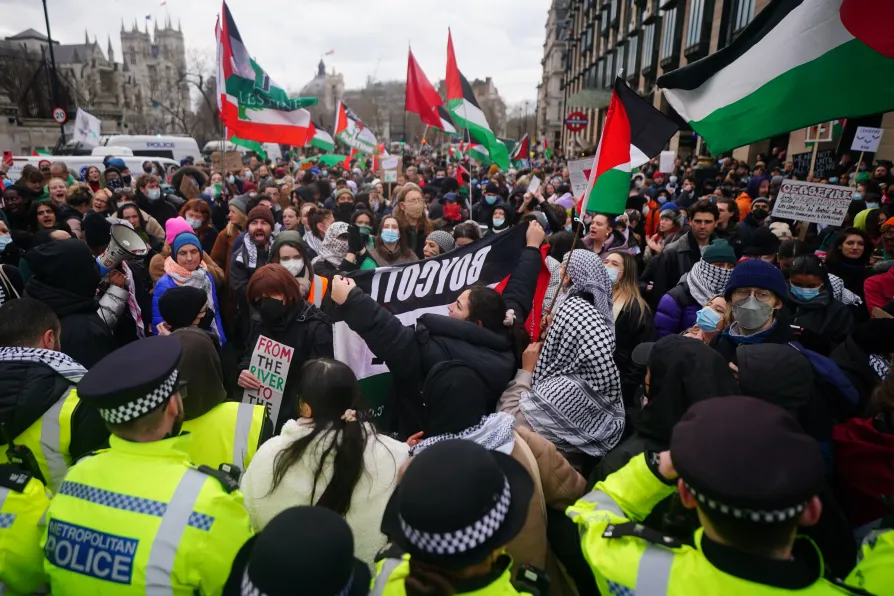
 Metropolitan Police officers form a cordon at Parliament Square to prevent protesters reaching Westminster Bridge during a Free Palestine Coalition demonstration in central London, January 6, 2024





THE right to protest is facing an “unprecedented crisis” in England and Wales with legal reforms in the past years “fraying the fabric of democracy itself,” two major reports said today.
Law reform organisation Justice and Human Rights Watch called for the changes to be repealed and proposals for more curbs halted.
Justice chief executive Fiona Rutherford said: “Year by year, we see police powers grow, as our fundamental right to protest is treated more like a privilege.
“The law in this area has become dangerously unbalanced, empowering the state to silence voices it should be safeguarding.
“Reversing this trend is essential to restoring trust, protecting rights and preserving a healthy democracy.”
Human Rights Watch senior researcher Lydia Gall said: “The UK is now adopting protest-control tactics imposed in countries where democratic safeguards are collapsing.
“The UK should oppose such measures, not replicate and endorse them.”
The Crime and Policing Bill currently going through Parliament seeks to give police more powers to limit repeat protests and ban demonstrators wearing face coverings.
It builds on the banning of previously lawful protest activity and a greater emphasis on preemptive containment of protest brought in by the Police, Crime, Sentencing and Courts Act 2022 and the Public Order Act 2023.
The Human Rights Watch report said the government “risks silencing dissenting voices, discouraging civic participation, eroding democratic accountability, and ultimately fraying the fabric of democracy itself.”
It urged ministers to reverse the proscription of Palestine Action as a terrorist group, and in the meantime issue guidance to police and prosecutors that peaceful protesters expressing opposition to the decision should not be arrested or charged.
More than 2,700 people have been arrested for taking part in protests opposing the ban on the direct action group in July.
A spokesperson for Defend Our Juries, which organised the protests, said: “For several years now we have been warning against — and actively resisting — the roll-back of our hard-won protest rights.
“We have seen how lobbyists from arms companies, oil companies and the state of Israel have pressured governments to protect their interests — and how our governments jump to appease them rather than listen to the cries of its citizens.
“This report shows we need to wake up and defend our fundamental rights before it is too late.”
A spokeswoman for the Stop The War Coalition said: “These reports confirm what the Palestine coalition has been warning of since we began our sustained campaign against Israel’s genocide in Gaza. We have faced more severe restrictions on our right to assemble and protest than any other protest group, and four leaders of our coalition face charges in court in the coming weeks relating to an entirely peaceful demonstration nearly a year ago.
“We oppose all attempts by the government to further restrict the right to protest, which is fundamental in any democratic society, and we will continue to campaign to defend it as part of our mobilisation against the ongoing atrocities against the people of Palestine and in building the anti-war movement generally.”
While Unison general secretary Christina McAnea pointed out that the right to protest was “a fundamental democratic principle and must be defended. Ministers need to withdraw proposals and repeal legislative changes that put lawful demonstrations at risk.”
Tom Southerden, Law and Human Rights Director at Amnesty International UK, said that “we have seen the first ever terrorist proscription of what was previously a direct-action group, Palestine Action. Peaceful protesters have since been routinely hauled from the streets into police vans in their hundreds – scenes that just a year ago would have been unimaginable.
“The continuous and increasing creep of anti-protest legislation is a worrying trend that signals an authoritarian stamp down on challenges to those in power.“
