
The US administration is endangering lives by reversing environmental protection laws, CHAUNCEY K ROBINSON argues

The path forward starts with a conversation
Amid rising hostility and division, the answer to fear and frustration is not isolation but the organised solidarity that built working-class communities, says MATT KERR

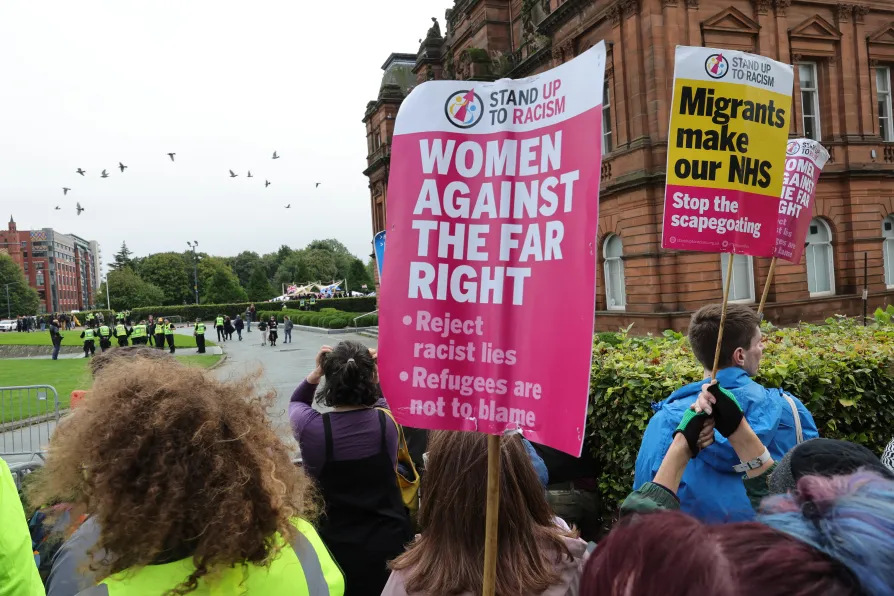
 CHALLENGING HATE: An anti-racist protester in Glasgow

It’s time to stop retreating and go on the offensive to promote working-class interests, argues DOUG NICHOLLS
Marco Rubio wants to defeat socialism in Nicaragua, not restore ‘democracy,’ writes JOHN PERRY
Believe it or not, there was a time when the US government built beautiful homes for working‑class Americans to deal with a housing shortage, writes ERAN BEN-JOSEPH
DIANE ABBOTT provides an analysis of the reasons for EU and British voters’ dramatic swing to the right
Train drivers’ union Aslef general secretary DAVE CALFE speaks to Ben Chacko about his hopes that Burnham’s devolution agenda will include the importance of the railway





THERE’S a dog barking at the end of the road. Every day it yelps its heart out, to no avail. The neighbours have all tuned it out now.
A century ago the street stood in Renfrewshire, but in what would turn out to be Glasgow’s last flush of expansionism before the gerrymandered retreats of the 1990s. In the intervening period it has grown from a smattering of cottages along the carriageway from Paisley to Glasgow into a series of schemes along the carriageway from Paisley to Glasgow.
It’s always been a fascination to me that paths not only seem to outlive people, their buildings and even their destinations, whether they be buried under some roaring eight-lane monster or quietly a grass mohawk in silence.
Even the paths on the sea that built the Kingdom of Strathclyde are still plied today as they have been for millennia, one reason perhaps that at one time you would have been more likely to hear the lilts of a Welsh dialect in Govan than the Gaelic, never mind English. Some might be tempted to argue that Welsh is merely a dialect of Govan of course.
On Friday “Unite the Clans” became the latest migrants to Govan. The patch of lush green which stands before what used to be UCS (now BAE Systems), will be astroturfed by fascists for the evening, in an effort to terrify the locals just enough to bounce them into a pogrom.
It’s a tried and tested strategy. Head into a neighbourhood systematically milked dry by industry, taken for granted by politicians, and abandoned by government, and explain that all their woes stem from the guy who came from half-way around the world to wipe their grandparent’s backside or the family on the run from the gun-sights being built down the road in Thales.
Some of that seems too obviously racist though, so the tactic has been honed to focus on the safety of women and children and “saving” them from this predatory threat. The result of this elsewhere in the city is men of colour being hounded down in the street and branded a “beast” for daring to hold a mobile phone in public, people being driven from their homes after being falsely accused of being paedophiles, and endless content for that temple of grift, Reform.
On Thursday, a Glasgow Reform MSP, Thomas Kerr (no relation), posted a video on social media. Nothing new about that, he does it all the time, and has a knack of getting attention. To the tune of oddly uplifting music, he invited the viewer to join him “on a walk around lawless Glasgow City centre.”
What followed was a montage of him walking around in a sunlight evening — flanked by what I presume is some sort of a flunky — interspersed with pictures of people standing around and one shot of a huge pile of bin bags put out for collection by shops.
The faces of the people standing around were blurred out, but not quite enough to hide the colour of their skin. At this point, he may have been able — at a stretch — to claim some plausible deniability to charges of racism. Then he opened his mouth.
Wagging his finger at the viewer, he proclaims: “I’ve been out for about half-an-hour and within that time I have witnessed four migrants staring at a young girl who is about 15 years old.
“I witness large groups of young men hanging about a St Enoch’s Square
“I witnessed a drug deal take place, I witnessed people taking drugs, I’ve witnessed misbehaviour and alcohol.
“That all within a half-an-hour radius [sic] down at Glasgow city centre.
“Now you tell me again that this city isn’t lawless.
“This is the disgrace we have seen in the city centre. It’s shocking and it needs cleaned up.”
The city centre is a mess, I’ll grant him that one.
Some of that has been bad luck like a confluence of major fires, roadworks, and a downturn in the high street, but no-one will convince me it’s not more than that. Decades of austerity are now etched on the city’s countenance, and no amount of make-up can truly mask the damage done.
The concept that the city is however now uniquely dangerous, has somehow descended into anarchy, or that the presence of a few more people of colour in one of the least diverse parts of Britain lies at the root of this rot is not only for the birds, but frankly seems to misunderstand what a city is.
Not an era of history has passed without the claim that “incomers” arriving in this city (or any other, for that matter) are changing its character, making it scarier, more dangerous or more lawless.
In that respect, Mr Kerr, who spent most of the last decade as a Tory councillor, stands in a long line of Cassandras who have chosen to ride on discontent to offer hallucinations of a glorious past — he even started where Enoch Powell did as a one-nation Tory.
We all go on journeys, but from a party that entrenched austerity to a party that blames people coming here to save their life or build a new one for its effects feels more like a doom loop.
As he pressed “send” on that post, down the road in the Gorbals, two trade unionists stood outside a housing office to try to reason with people hyped-up by Unite the Clans to believe “illegals” were taking their housing and putting women and children in danger.
Surrounding her as she began to speak, they made a mistake in trying to drown out the voice of local resident Denise Christie. As a former firefighter, she was more than up to the task of resisting provocation, keeping a cool head and getting on with the job of telling the truth.
She posted on social media: “If we truly care about women and girls, we need to stand together against racism, against misogyny, and for the services that support survivors.
“If they really cared about women and girls, where are they at ‘cuts against women’s services’ demos, where are these protests when politicians take away women’s protections at work?
“You don’t protect women by shouting them down.”
Food for thought, for Mr Kerr too, but it’s not all about him. To pin it all on him would be to blame the surfer for the tsunami.
The rising tide of righteous anger after generations of looting of the wealth of the working class, the more recent unpicking of the slightest concessions hard-won is being ridden by a combination of a handful of out-and-out fascists and politicians happy enough to be elevated by it. The former seems to be on an ideological search for racial “purity” honed in their own insecurities; the latter on a nihilistic grift-drift.
We either stand by and watch the spectacle as this crashes ashore, taking everything that passes for decency with it, or we take a leaf out of Denise’s book — and thousands like her — and get to work.
We can respond by writing pieces like this, or deeper analyses, but we all know what we’re looking at.
Working-class communities have seen their cries for help unanswered, their institutions attacked and even mocked for years.
As we see these bigoted groups pop up in communities across the land, their lies unchecked on social media and dog-whistles regurgitated for mass consumption in broadcasting, the odds can seem overwhelming.
They always were.
The answers lie on a well-trodden, but neglected path. In place of want, we organise for plenty, in place of fear we organise for knowledge and hope resting not on saviours but on confident solidarity.
It all starts with one step: what’s a good walk without a good conversation?

Similar stories

Whether it’s dented bike frames or broken ferries, MATT KERR wishes politicians had the same steely staying power of elite engineering instead of chasing disposable self-importance

While riding the No 3 bus in Glasgow MATT KERR has ample time to dissect the moribund Scottish Labour decline into near oblivion and watch intriguing bus passenger dynamics

The present drive to war is a cynical and deliberate diversion from deteriorating living standards, argues MATT KERR