

 Latest editorial

JOHN WIGHT pays tribute to the day in history when Randolph Turpin dealt the world of boxing an almighty blow
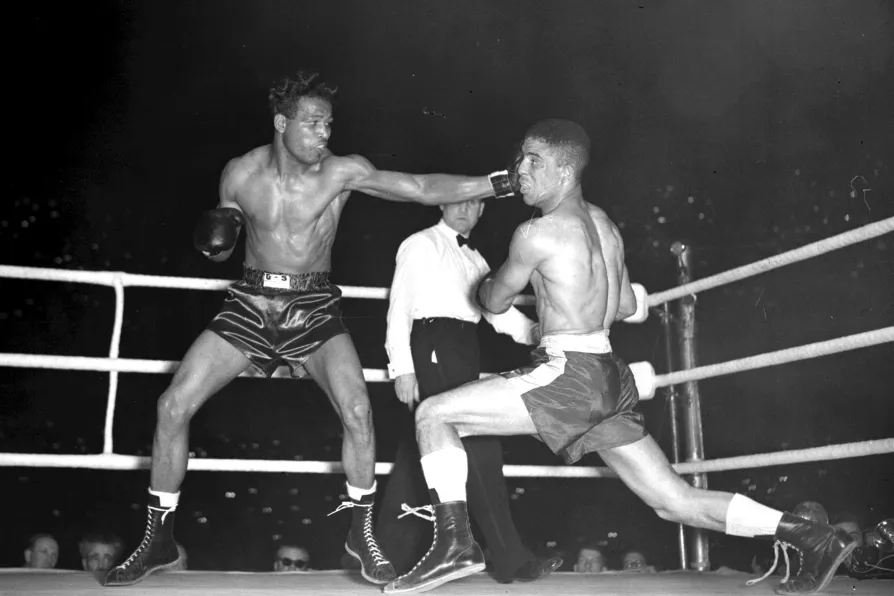 TWO IN A MILLION: Sugar Ray Robinson (left) throwing a long left to the head of Randolph Turpin during their title bout at Earls Court in London, in July 1951.





THE YEAR 1951 was not a good one within the broad sweep of British social history. The deep wounds cleaved by the second world war had yet to fully heal, a large part of the country’s infrastructure remained in a state of disrepair, and gloom stalked the land.
In 1951 rationing was still in force and would not finally end until 1953. The same with conscription, which itself would go on until 1960. This as the country’s ruling class fought a losing battle to maintain its empire overseas. Overall, life for the broad masses in 1951 was lived in monochrome, redolent of grey clouds, a bland functional diet for most, and little to look forward to as the Attlee Labour administration’s postwar reforms were yet to take full effect.
Amid the general gloom of 1951, sporting events took on added importance. And no sporting event typified this importance more than the July 10 1951 middlewight title contest between Britain’s Randolph Turpin and the legend that was Sugar Ray Robinson, considered by many, still to this day, to be the greatest fighter of all time.
The venue was Earl’s Court in London, and such was the anticipation in the weeks leading up that there was an almighty clamour for tickets. Those who succeeded in getting their hands on one would not be disappointed.
Born in 1928 in Leamington Spa, Randolph Turpin was the child of mixed-race parents. His father, Lionel, came from colonial British Guiana and had fought in the first world war. He met Randolph’s mother, Beatrice Whitehouse, after the war, during which he’d been wounded and suffered gas poisoning. Not long after his son’s birth he died, leaving Randolph’s mother the Herculean task of raising three boys and two girls on her own.
Grinding poverty leaves psychological and spiritual scars on those affected, even though it has long been the business of well-fed middle-class ideologues to proffer a romantic notion of poverty as a character-building experience.
Boxing has long been one of the very few routes out of poverty for the sons of the British working class, and so it was for Randolph Turpin and his two older brothers, Dick and Jack. Adding to their difficulty was not only poverty but the colour of their skin. In Britain in the period concerned, it placed you in the category of a three-legged table when it came to life chances.
Sugar Ray Robinson carried the same dark skin, but in his case in the US it proved no obstacle to his progress in the squared circle, which by the time he turned professional in 1940 was fertile ground for the rise and prominence of black fighters, particularly in major northern cities such as Chicago, New York, Philadelphia and Boston.
Robinson approached his work with the sensibility of an artist. He moved around and across the ring with effortless grace and possessed the agility of a ballet dancer, confounding his opponents to the point of leaving them demoralised. Poetry in motion was a term that could have been devised with him in mind, as he soon acquired a devoted fan base.
As his fame and wealth grew, he also acquired an extensive entourage that travelled around America and the world with him. It included, Robinson’s entourage, a personal barber, masseuse, voice coach, multiple personal assistants and an entertainer. On one memorable trip to Paris in 1950, his party arrived off the boat with 50 pieces of luggage and a pink Cadillac.
Randolph Turpin earned his shot at Robinson’s middleweight world title having faced and defeated top US contender Jackie Keough in London at the White City Stadium just a month earlier. It was a time when fighters fought with alarming regularity, with Turpin himself fighting an astonishing eight times in 1951 alone.
All throughout he fought like a man standing on the edge of a cliff, such was the intensity of his work and his determination to succeed. The alternative in this grim postwar period was a return to the pit of despair from whence he had come, and no young man in his fighting prime such as he was could even contemplate for a second such a fate.
Regardless, Robinson entered the ring at the old Earl’s Court as heavy favourite. Randolph Turpin and London was the last stop on a European tour of fights that had begun two months earlier and seen the American legend defeat six opponents before facing Leamington Spa’s finest. To all intents, Sugar Ray Robinson was expected to roll over Turpin prior to returning Stateside with his title intact and a bag of loot in hand.
Unlike most of Robinson’s opponents, Randolph Turpin did not show the American any respect as he set about closing the distance and beating him to the jab time and again. It was a 15-round slugfest, of a type that Robinson was not accustomed to. Throughout the fight, Turpin’s confidence and strength grew, as roared on by the home crowd he hardly took a backward step.
When he deservedly got his hand raised by the referee after the final bell, Turpin entered ring history as only the second man to defeat the great Sugar Ray Robinson up to that point.
The Leamington Licker, as Randolph Turpin was popularly known, went on to lose against Robinson in their rematch in New York in September 1951, just a few months later. His ring career continued all the way up to 1964 thereafter. Tragedy bedevilled Tupin in retirement. The crushing weight of bankruptcy led to severe depression to the point that in 1966, at age 37, he took his own life.
Today his statue, which was unveiled in 2001 by Sir Henry Cooper and Turpin’s brother Jack, can be found on Market Square in the centre of Warwick, close to where he grew up. Sugar Ray Robinson fought on until 1965, before finally retiring at age 44 after 25 years and 201 fights as a professional. He died in 1989.
There is currently no statue of him anywhere to be found.

MAT COWARD writes on Ghost Runner John Tarrant

SYLVIA HIKINS recommends a fascinating, revealing, superbly acted evening of theatre
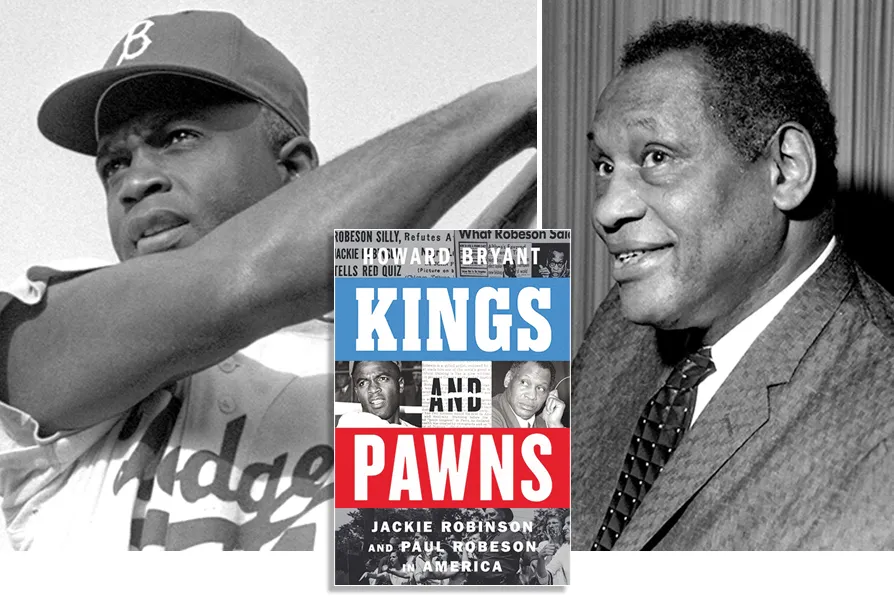
RON JACOBS recommends a book that charts the disparate circumstances that defined the lives of two prominent black Afro-Americans — one a communist, the other an anti-communist