Preferable to Starmer he may be, but there is scant sign of a sharp political break in Burnham’s policies so far — while left challenges aren’t making much of a running either, finds ANDREW MURRAY. How can socialism be put back on the map?


 Latest editorial

Organising to Win in Unison: from transactional support to transformational power
Unison director of organising KEVIN LUCAS explains the Organising to Win strategy, its successes to date and key tests on the union’s horizon
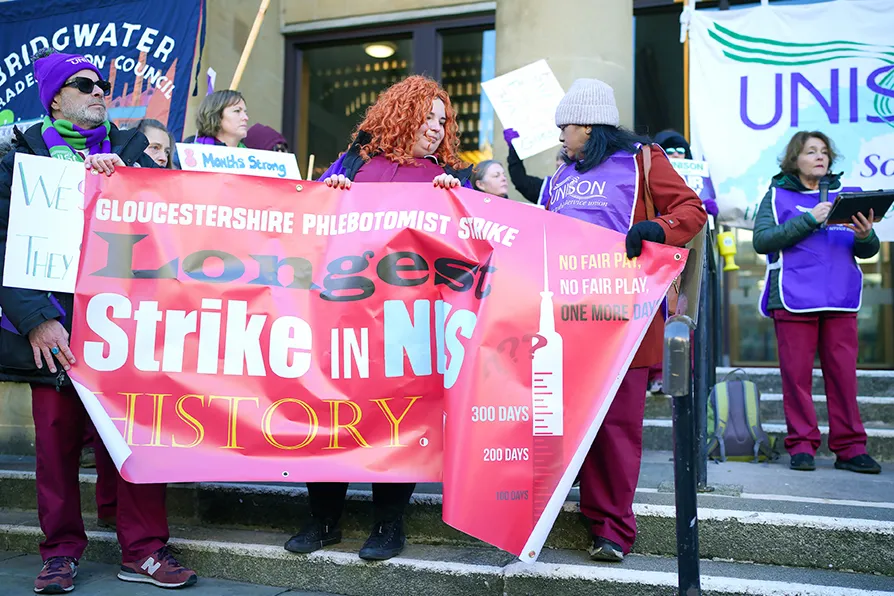 RESILIENCE: Phlebotomists in Gloucestershire, members of Unison, mark their 236th day of industrial action during a rally outside Gloucester Shire Hall last November

CHARLEY ALLAN reports from Clacton on Farage’s fears his by-election stunt has backfired
JEREMY CORBYN says we should never forget the horrific reality of nuclear weapons, or cease our efforts to rid the planet of them entirely
The new TUC Cymru general secretary speaks to Morning Star Wales reporter David Nicholson about her trade union background and ambitions for the movement
Internationalism is deeply embedded in socialist theory and practice. Examination illuminates its complexity asserts the Marx Memorial Library and Workers’ School
The Claudia Sheinbaum government is no pushover and is holding firm despite US abuses of the relationship, says DAVID RABY
As we approach the grim anniversaries of Hiroshima and Nagasaki, SIMON BARROW sounds the alarm over the dangerous and murderous direction our government is heading





UNISON’S Organising to Win strategy is built on a simple premise. When we deploy organising resource to bargaining campaigns that build member participation through best practice organising, we deliver significant growth in membership and activism and collective material wins for members.
The strategy is delivering results. Over £300 million of back pay has now been won by NHS Health Care Assistants in local disputes across England and Wales. And Unison organisers and activists are applying the same methods for successful local disputes in schools, social care, housing, local government, and health — laying the foundations for a bigger, stronger and more confident union.
Unison delegates gather in Brighton this week in our fifth consecutive year of membership growth, with a total net increase of over 90,000 members. A long-term decline of the activist base has also been stabilised, with early signs of growth as members who engage through campaigns step into activist and leadership roles.
This is one reason why campaigns that resonate with workers under-represented in union structures are so important. Like Unison’s Fair Visa campaign, which last week again saw hundreds of migrant health and social care workers march on Downing Street, the Home Office, British and Scottish Parliaments, and the Northern Ireland Assembly, demanding that politicians end unfair visa rules that trap workers in exploitative employment. Individually these are amongst the most precarious, exploited and abused key workers in the UK. But together, in Unison, they have led a campaign so powerful, we can be confident of a win.
And what can be more important to unions than winning? Unison will always provide individual support and protection when members need it. But we must be honest with members about the limits of servicing individual issues in isolation. The question is not whether we want to be an organising or a servicing union. The question is whether we want to be a transactional or a transformational union.
A transactional approach deals with problems one case at a time. It is often necessary, but it is not sufficient. It encourages a passive membership and can lead to activist and organiser burnout particularly where membership growth comes from outside of established union organisation and structures. A transformational approach builds collective capacity, ensuring a strong and organised activist base to support members, prevent workplace problems from arising, and drive collective wins that improve workers’ lives on the big issues like pay, equality, safety and dignity.
Over recent years we have seen what is possible. But progress has not been consistent across the union. Organising success remains concentrated in pockets. Our challenge now is to ensure that best-practice organising becomes part of the day-to-day work of every function at every level of the union, not the exception of specialist projects or a small minority of branches.
In July, Unison’s ability to break new organising ground will be tested with a selective and disaggregated strike ballot of over 200,000 local government members in their fight for fair pay.
In a departure from previous national strike ballots, Unison has called on members to step into active roles to help get their workplace ballot ready, achieve turnout above 50 per cent, and ensure that any resulting industrial action is effective.
Early signs are positive with over 2,000 members already pledged to undertake the role, the vast majority of whom have not been active in the union before. We may not achieve the required ballot turnout in every employer this year. But it will be an important step on the journey to members taking responsibility for their own workplace and for the collective strength of the union.
Andrea Egan was elected Unison general secretary on a manifesto commitment to support and extend the Organising to Win strategy.
Her goal to build a union of 1.5 million members by 2031 is ambitious. It will require Unison to double the rate of growth achieved in recent years. But it is achievable.
Last week’s launch of Unison’s new digital member communication and engagement systems will allow Unison to connect more effectively with members, identify potential activists earlier, and support activist development more systematically.
At the same time, the provisions of the Employment Rights Act 2025 should bring significant opportunities through new rights of workplace access and union recognition. And the long-awaited removal of statutory 50 per cent industrial action will be an important spur to collective action in large public-sector bargaining units.
But even more important is Unison’s recent success to build from. Winning is contagious, increasing the confidence of members in their union and strengthening the hope and belief that participation and activism can make a tangible difference. Alongside this Unison’s organising capacity has significantly increased through our Branch Support and Organising Fund and the development of organiser and activist skills, knowledge and confidence through training, action, and reflection.
Sustaining and building on organising success and union growth is by no means inevitable.
Organising as a concept is simple. Delivering it successfully in real workplaces, with real people, and existing union organisation and industrial relations is complex and challenging.
But Unison has the fundamentals in place to make successful organising a defining characteristic of a bigger, stronger, and more successful Unison. That is the challenge — and the opportunity — before us.
