
ROB WARZYNIAK wades knee deep through a pile of ‘dead canaries’ of Trumpist policies which exacerbated the horrors of US capitalism domestically


Rally now to stop Europe’s leaders driving us to war
JOHN REES looks at why the June 20 international anti-war conference is such a vital initiative
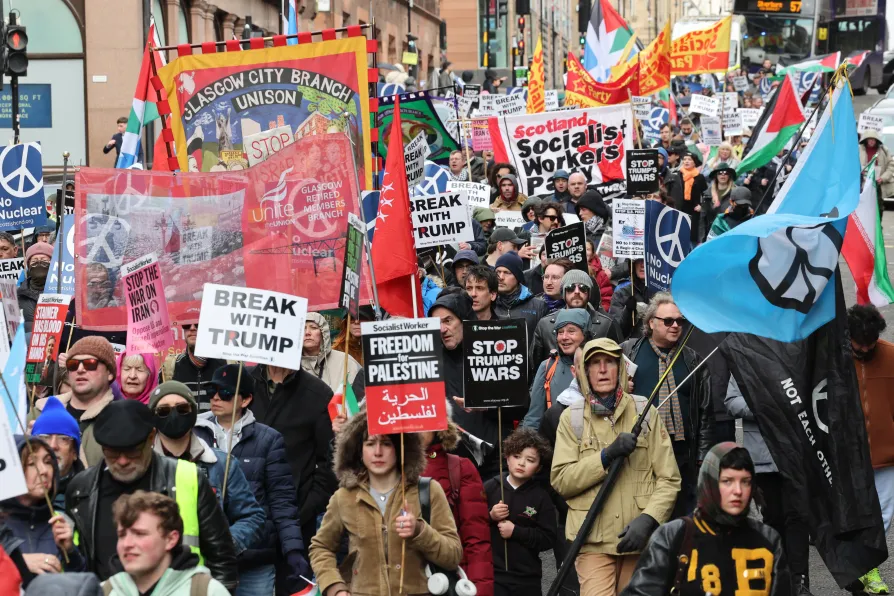
 STOP AGGRESSION: People take part in a "Break With Trump" demonstration in central Glasgow, organised by Stop the War Coalition and CND No War on Iran

Without evidence or Nato consultations Berlin’s answer to the Leipzig incident is a rupture of relations. SEVIM DAGDELEN examines why
FRANCISCO DOMINGUEZ introduces the background to a conference on defending Latin America’s sovereignty
The glacier collapse in Nepal is yet another warning that a warming planet is making Himalayan disasters more frequent and destructive – but the countries facing the greatest risks are often those least responsible, says LI YANG
Nick Blair is set to benefit from a hugely lucrative contract to ‘virtually’ train the British army for its next war. Like father, like son, writes SOLOMON HUGHES
Even when tragedy strikes, Western media cannot resist the opportunity to turn it into a sordid propaganda opportunity, as the Nepal-China border tragedy shows, writes CARLOS MARTINEZ
Trade unions should be at the heart of the anti-racist push for reparations for the historic legacy and continuing impact of slavery, writes ROGER McKENZIE





WAR-DRIVEN austerity is a storm about to hit Europe. Indeed, the first gales are already blowing through the political system.
Energy prices are due to rise 13 per cent this autumn, a rise directly caused by the Iran war.
In the short term, the Iran conflict has mainly raised living costs through energy and fuel prices, but European rearmament will keep the pressure on over a longer timescale, affecting households through increased taxes, borrowing costs, inflation and budget cuts over the coming decade.
Energy bills across the continent will likely rise by between 10 per cent and 60 per cent depending on which country and what fuel source is being considered. Petrol and diesel are going to rise by over £200 a year for European drivers. Food prices are being driven higher by increased transport and fertiliser costs.
The cost of flights will spike as a result of the increase in oil prices. Mortgages will rise as a a result of inflation and interest rate rises. Taxes are being increased to pay for rearmament and welfare and infrastructure budgets will be slashed for the same purpose.
But at least one section of society is having a bonanza: arms companies. Across Europe ploughshares are being beaten into swords and the profits of the armourers are booming.
In the last three years Rheinmetall, Germany’s massive arms manufacturer, has seen profits rise by 71 per cent, Britain’s BAE Systems has seen a profit hike of 29 per cent, and Leonardo has seen its profits rise by 24 per cent.
The British military are keen to prepare for war in Europe.
General Sir Patrick Sanders, the head of the army, said in January 2024 said Britain was part of a “prewar generation” and argued that society needed to be placed on a war footing to deter Russia. He warned that citizens might need to be trained and mobilised in the event of a major European conflict.
Later the same year General Sir Roly Walker, after succeeding Sanders as army chief, warned Britain had roughly three years to prepare for a possible major conflict. He said the army must “double its lethality by 2027” and be prepared for a confrontation involving Russia, China, Iran and North Korea.
Air Chief Marshall Richard Knighton warned that growing international threats meant Britons needed to think more seriously about national defence and military preparedness. Reports summarised his message as “Britons must be prepared to fight.”
Keir Starmer is obsessed with war preparation, repeatedly arguing that Britain must move to “warfighting readiness.”
Launching the Strategic Defence Review, he said Britain must become “a battle-ready, armour-clad nation” with armed forces ready for conflict against advanced military powers.
In June last year Starmer said Britain must be ready to “confront and defeat” hostile states with modern military capabilities.
In February he had said British industry, universities, businesses and the public would all have to play a larger role in national resilience.
In many ways he already has his wish. Militarisation of society is certainly not limited to the increasingly frequent statements from political leaders and armed forces chiefs that Europe should prepare for war.
Arms companies are embedding themselves in schools, sponsoring school events at which their brands are prominently on display. In addition, they issue teaching materials for use in classrooms that promote the defence sector, sponsor competitions and award prizes.
One company even deployed a high-profile children’s television presenter to promote its activities in a school, while another developed a missile simulator for pupils to “play with.”
Hyett Education, a partner of the RAF and the Ministry of Defence Nuclear Enterprise, runs programmes in more than 1,000 schools.
In response to the war drive from the generals, politicians, and arms corporations the entire labour movement and the anti-war movement needs to change course.
From at least the Afghan and Iraq wars at the beginning of the century we have become used to resisting neocolonial wars led by the US. That element persists, as the Iran war has proven.
But a weakened US led by Donald Trump is reordering its priorities, leaving previous allies to pay the cost of their own defence. European leaders are enthusiastic rearmers. Indeed, they are much less interested in Trump’s war in Iran than they are about preparing for war in Europe.
European guns and money are not mainly flowing to Israel, although they play a role here too. Much greater amounts of cash and missiles are keeping the meat-grinder war going in Ukraine.
Comparing European financial aid, European military aid, and European weapons transfers, the amount going to Ukraine is overwhelmingly larger — by at least an order of magnitude in most categories — than that which European governments collectively provide to Israel. Since 2022, Ukraine has been one of the largest recipients of military and financial support in modern European history.
The US has also plied Ukraine with guns and money, but its long-term commitment to Israel is out of all proportion greater than that of the European powers.
So, what the entire European anti-war and trade union movement needs to do is focus on continued opposition to US-Israeli wars in the Middle East but to increase its resistance to the war drive across the European continent, linking it to the austerity which that militarisation is now inflicting on working class communities who are yet to recover from the last cost-of-living crisis.
A spectacular beginning to that international co-ordination was made at the Paris anti-war conference last October where 4,000 trade unionists and peace campaigners rammed into the Dome de Paris.
Now the second conference is due in London on June 20. It has drawn support from Unison, the NEU, PCS, RMT, UCU, TSSA, Aslef, FBU, BFAWU, and hundreds of local trade union branches, trades councils and campaigns, and from the organisers, the Stop the War Coalition.
They will be joined by some 800 French trade unionists and campaigners, including MPs from Jean-Luc Melenchon’s La France Insoumise, by Genoa dockers who stopped shipments to Israel, by a national leadership delegations from Italy’s CGIL, and from Spain’s UGT, as well as MPs from Podemos, and from the Belgian Workers’ Party, and many more.
There hasn’t been an international gathering of trade unionists and anti-war campaigners like this for many years. But it will require exactly this kind of movement if the war-drive in Europe is to be stopped.
Stop the War’s International Anti-War Conference is being held on June 20 2026 at 12pm at Westminster Central Hall, London. For more information visit www.stopwar.org.uk.
