Cuban trade union federation CTC leader OSNAY MIGUEL COLINA speaks to Ben Chacko about life and work under a crippling US siege


 Latest editorial
The price of the Iran war is being paid by workers and the poor
DIANE ABBOTT debunks claims made politicians drumming up support for an enhanced militarisation of the British economy
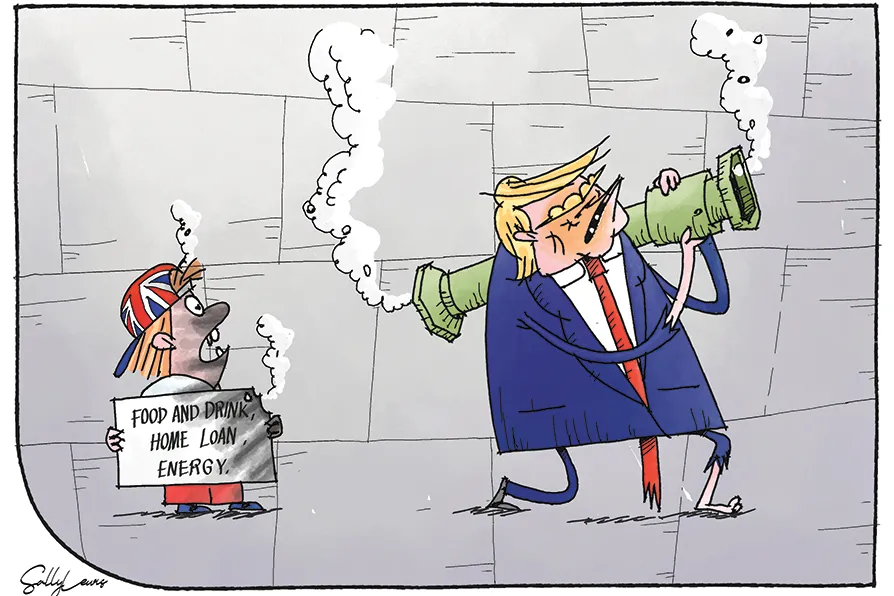 Cartoon: Sally Lewis
A part of the British empire’s network of slavery, today the Caribbean island of Nevis faces a new form of exploitation in the form of crypto-colonialism, CLAUDIA WEBBE writes
A new book by Victoria Holmes illuminates the many hidden histories of the oppression experienced by Gypsy/Roma/Traveller community, writes ROGER McKENZIE
Even the oligarchs of the artificial intelligence industries are warning that their creations have the capacity for the ultimate destruction of the planet and its population. ANDREW MURRAY suggests that there might just be other solutions
The Labour government must deliver on its commitment to bring back privatised services into the public sector. This not only saves money but also creates accountability and generates wider social benefits, argues ANDY MCDONALD MP
Public ownership of Great British Railways has enormous potential to improve our railway network, but that can’t happen unless jobs, employee rights and union recognition is at the heart of the transition, argues MARYAM ESLAMDOUST
Challenges from the unscrupulous misuse of AI to steal actors’ voice and physical likenesses is being met with a firm union response, writes LYNDA ROOKE





THERE is a growing recognition that the illegal war on Iran conducted by the US and Israel is exacting a huge cost on the population, and that the price will go higher the longer the war is continued.
Of course, the biggest price of all is firstly paid by the Iranian people, with outrageous incidents such as the bombing of the Minab elementary school, which killed 158 civilians including 120 schoolchildren.
There has been no accountability of the US and not even an apology for what could amount to a war crime. But the impact of the war goes far beyond Iran or even the region.
The countries of Asia are in general large-scale oil importers, and the poorest of the Asian countries are being badly hit by fuel shortages, leading to short-time working and even layoffs in some countries.
In Africa in particular there are widespread fears that the US blockade and the consequent shortage of fertiliser could lead to widespread hunger.
The head of the UN World Food Programme says the war is already driving historic global levels of hunger, with 363 million people around the world now at risk of acute hunger, 45 million of them because of conflict.
Yet even in the richer countries of Europe there is already a significant negative impact on living standards, with the poor and low-paid the hardest hit. In all cases, the longer the war continues the greater the misery created.
The blame for all this lies squarely with the US and its Israeli ally, which launched an illegal war without justification or even pretext.
They have never sought to defend the earlier assertion that the US was under imminent threat of attack. Instead, Trump seems to relish the role of ruthless lawbreaker in pursuit of US interests.
The same is true of the blockade of the Strait of Hormuz, which usually sees up to one quarter of the world’s oil trade, as well as a third of international fertiliser shipments and much else besides.
Aiming to destroy the Iranian economy by preventing its oil exports, the US has invited inevitable retaliation and pushed up the price of key commodities globally.
In Britain and elsewhere public opinion is stirring even more strongly against a war that has never been popular.
IPSOS (Institut Public de Sondage d’Opinion Secteur) recently conducted a global survey on the war. The US had the lowest unfavourability rating for the war, yet still 52 per cent say the military action has not been worth it, against 23 per cent approval. Nearly all other countries were much more hostile to the war.
In Britain, disapproval stands at 65 per cent and has hardened by 9 points in just a month. Naturally, much of this antipathy is driven by personal circumstances, with almost 9 out of 10 people concerned about the impact on them of the cost of living.
Some of us have decided to bring these elements together in an Early Day Motion (EDM 65794), which highlights the war as the cause of the rise in prices and shortages.
Crucially, we call on the government to end any support for the war, to use its influence to call for a speedy end to hostilities and calls on the US to allow the free passage of shipping through the Strait of Hormuz.
Individuals can lobby their MP to add their name to those supporting the EDM. They can also raise it in their labour movement bodies and campaign groups.
Naturally, these calls face strong opposition from supporters of the war drive, which now includes most of the leading political figures in this country. Their common outlook is that Britain must support and participate in Trump’s war drive and must embrace sharply increased austerity to finance it.
This widely supported politic platform has a number of consequences. The principal effects would be to sharply increase the risks of all-out war and to inflict widespread misery on the population to fund the war drive.
As a result, here is both a current attack on living standards and a more medium-term propaganda campaign for government budgets promoting warfare, not welfare. Both are a threat to the living standards of workers and the poor.
The war and blockade are a present danger which must be tackled now, and should include the demand an end to this war.
The threat of a warfare state budget also hangs over us. The latest claims, for example that the problem of NEETs (young people Not in Education, Employment, or Training) is spiralling out of control, is simply false.
The rate of NEETs among young people is below its medium-term average and is not rising. But the claims are necessary to fuel the campaign for intensified austerity.
That campaign has strong support across the political spectrum. So, a recent extraordinary bulletin of Radio 4’s Today programme was given over to a chorus of former army top brass, Nato apparatchiks and failed politicians to tell us we will all have to make huge sacrifices to create to the warfare state that they demand.
The lead vocalist was Tony Blair, but his warm-up act was Rishi Sunak and there was not a note of difference between them politically. It turns out that supporters of austerity and war are agreed on this reactionary programme. Not much of a spectrum.
In Blair’s widely-discussed 5,000 word essay, The Labour Party is Playing with Fire, he argues that Britain is not close enough to Trump and does not do his bidding on war, that far-reaching cuts to welfare and state pensions will be required to achieve that.
Along with it came the usual support for deregulation and privatisation policies that are supposed to revive growth, while net zero targets should be abandoned for the same end and the current level of demonisation of migrants and asylum-seekers should at least be maintained, because fighting Reform UK is futile (and, unstated, scapegoats will be even more necessary under this policy mix).
However, it is a notable fact that none of these voices are current or aspiring politicians, although some are political retreads, advising the government or the opposition parties.
This is because these policies are unsurprisingly massively unpopular with the public whenever there is an attempt to apply them. It is easy to get opinion polls to say we should spend more on defence. It is much harder to get backbenchers to vote to make their voters worse off.
So, we must intensify our efforts. No Trump’s war on Iran. End the blockade. No to warfare, not welfare. No to more austerity to fund the war drive.
Diane Abbott is MP for Hackney North and Stoke Newington and Mother of the House of Commons.
