New releases by Interpol, Phoebe Bridgers, Lambchop


 Latest editorial

‘A clear-minded, if taciturn, Marxist’
On the centenary of her birth, JOHN GREEN celebrates the life — and politics — of Marilyn Monroe
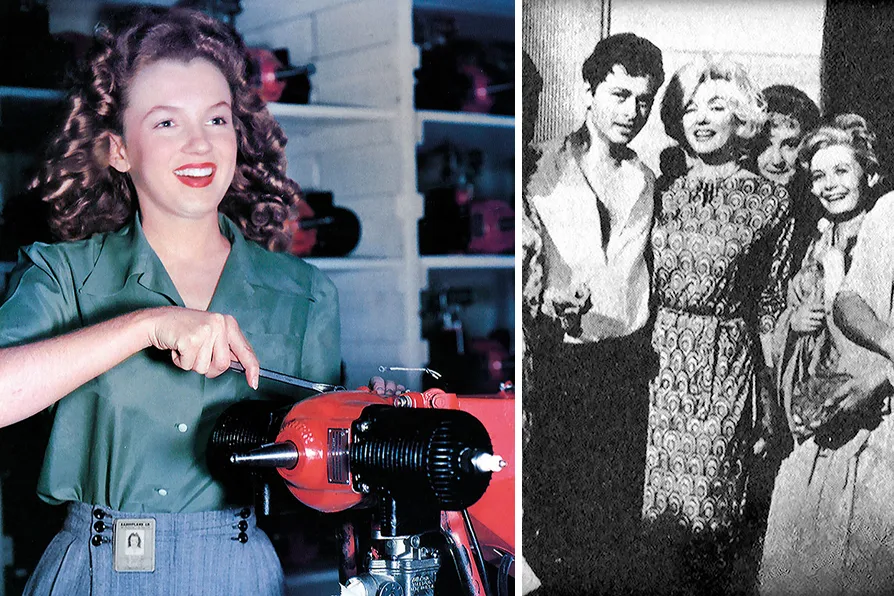 NOT NATURALLY BLONDE: (L) A photo of Monroe taken by David Conover in 1944 at the Radioplane Company; (R) Monroe posing with actors from Luis Bunuel's film The Exterminating Angel (1962) during her trip to Mexico [Pic: David Conover/CC; Public Domain]
ANGUS REID urges us to understand the persecution of Jason Arday from a political and historical perspective, and to see the victim in human terms
Re-releases of the classics Gypsy Rhumba and Buena Vista Social Club, and a stunning album by Palestinian artist Faris Ishaq
Nothing, says ANDY HEDGECOCK, can rescue this undistinguished amalgam of ponderous melodrama and shallow philosophical speculation
JAMIE BRITTON invites readers to visit 3,500 locals as part of a marathon artistic pub crawl
JOHN GREEN welcomes a valuable and incisive analysis of a world become hyperpolitical but without the mass movement institutions to represent it





THIS year marks the centenary of the birth of Marilyn Monroe, and is being celebrated by the British Film Institute and the National Portrait Gallery. The BFI is showing a two-month season of her films, while the National Portrait Gallery charts the construction of her image.
For much of the mainstream media and even among the general public, Monroe was seen as the epitome of the “dumb, beautiful blonde” and an icon of the silver screen. She was, however, not a natural blonde and certainly far from dumb.
Despite the image cultivated by the misogynist Hollywood publicity machine, she was a highly politicised woman, a performer of sharp comic intelligence, a canny architect of her own image, and a woman who reshaped the possibilities for female stardom on screen.
Norma Jeane Mortenson was born on June 1 1926 to Gladys Pearl Monroe Baker in Los Angeles General Hospital. Gladys put the name of Edward Mortenson as father on the birth certificate but his address was given as unknown. Throughout her life Marilyn always denied Mortenson was her father. In fact, a more likely candidate was Stanley Gifford. Gifford and Gladys worked together as film cutters on the fringes of the Hollywood dream factory. The couple had a brief workplace fling but by the time Gladys realised she was pregnant it was over and she was on her own again.
Monroe spent most of her childhood in foster homes and an orphanage before escaping the misery by marrying at the age of 16. After leaving school with no qualifications, she took a job working in the Radioplane Company factory during the second world war when she met a motion picture photographer and began a successful pin-up modelling career, before being discovered by 20th Century Fox and launched on her extraordinarily successful film career. Her childhood experiences and working on the factory floor probably helped shape her lifelong sympathy for the oppressed in society.
Norma Jeane Dougherty, as she was then known, wasn’t that unusual among the many women war workers at the Radioplane Munitions Factory, part of the growing Californian wartime aircraft industry. However, she did score particularly well on the compulsory IQ test they gave all applicants. Marilyn scored very highly at 174. IQ tests have lost a deal of credibility since the 1940s but just to give you a comparison, both Albert Einstein and Stephen Hawkins score about 160, considerably lower than Norma Jeane.
For the Cold-War anti-communist and red-baiting authorities in the USA during the 1950s, Marilyn Monroe the sex bomb movie star presented a real dilemma. Edgar Hoover, the boss of FBI, was a visceral anti-communist and, at the same time, Senator Joe McCarthy was leading the House of Un-American Activities Committee (HUAC) in its witch hunt of communists and progressives in general. They both had their eyes, and bulging files, on Marilyn.
FBI surveillance began after Monroe — along with other entertainers — applied for visas to visit the Soviet Union in 1955. The surveillance continued until her death in 1962.
She made no secret of her left-wing views, her pro-union position or her anti-racism and support for the civil rights movement; she also campaigned against nuclear weapons and never hid her admiration of Mao’s China. She numbered many communists and left-wing activists among her friends, lovers, employees, and associates.
FBI files reveal that the organisation was particularly concerned about Monroe’s contacts with the strongly left-wing Frederick Vanderbilt Field, then residing in Mexico. Field had been disinherited by his own ruling-class family due to his views. In the FBI files on Monroe there is an account of the trip she took to visit Field in Mexico several months before her own death. Field, in his memoirs, described his friend Monroe as “a clear-minded, if taciturn, Marxist.” In 1962, the file says: “Monroe visited a group of American communists in Mexico (Communist Group in Mexico ACOM). There she met [Field] and a mutual infatuation developed.”
When in 1954 the Fox studio was reluctant to change Monroe’s contract, she founded her own film production company, Marilyn Monroe Productions (MMP) with her friend Milton Greene, an action that has later been called “instrumental” in the collapse of the studio system.
The FBI found itself in a difficult position. What to do about someone who was one of the most famous US icons and beloved around the world? If it denounced Hollywood’s most glamorous sex goddess as a dangerous Red what would the impact be on every red-blooded American man? From the president in the White House to pimply adolescent gas station attendants, everybody loved Marilyn.
She went on to cultivate close friendships with a number of communist artists. The director Elia Kazan became a long-term lover and worked with her on several films. Then, in 1956, she scandalised the right-wing establishment by marrying the renowned playwright Arthur Miller, who had been a member of the Communist Party.
An FBI file from that time quotes the anecdote that The New York Daily News had received an anonymous telephone call from an unidentified male in which it was stated that Arthur Miller had been and still was a member of the CPUSA, and that money from Monroe found its way to the CPUSA.
So was Marilyn Monroe actually a member of the Communist Party of the USA? The answer is no doubt buried in those FBI files, and that’s where it is likely to stay – buried. We can’t be sure, but she was clearly a sympathiser.
In 1950s Cold War America the witch-hunts were finding Reds under every bed. With communists getting sacked, blacklisted, exiled and jailed, Marilyn or any other communist would have been stupid to admit to being a card-carrying member – and one thing Marilyn wasn’t was stupid.
She was, though, a thoughtful, intelligent, but troubled woman who stood for what she believed in and who, behind the camera, read, studied and involved herself with social issues. She became a strong advocate for black civil rights.
In his autobiography, From Right To Left (Lawrence Hill, 1983), Field described Monroe’s deep passion for justice: ”She told us about her strong feelings for civil rights,” he wrote, “for black equality, as well as her admiration for what was being done in China, her anger at red-baiting and McCarthyism and her hatred of [FBI director] J Edgar Hoover.”
When once asked about her favourite singers, Monroe answered: “Well, my very favourite person, and I love her as a person as well as a singer, I think she’s the greatest, and that’s Ella Fitzgerald.” By the 1950s, Fitzgerald’s enthralling singing voice had won her fans across the country. But the venues that hired her were often smaller clubs.
In November 1954, Monroe got to see Fitzgerald perform in Los Angeles. The two were soon friends, so when she learned of Fitzgerald’s inability to get a gig at the Mocambo, a renowned LA nightclub, she decided to help. The club’s owner argued that Fitzgerald lacked the glamour to draw crowds, so Monroe came with a proposition — if he booked Fitzgerald, she promised to sit at the front of the house for a few nights and to bring along other stars.
The club owner agreed. During Fitzgerald’s run, Monroe kept her word to sit up-front, and showed up on the opening night with Frank Sinatra and Judy Garland.
In the months prior to her death, members of Monroe’s inner circle, including her hairdresser, interior decorator and therapist, became alarmed at her growing interest in and embrace of communist ideas. These individuals and others became informants, reporting directly to the FBI.
As a super-exploited commodity in a sexist world, where women were degraded and made objects of violence, she continued to deepen her allegiance to the oppressed.
Her life has all the elements of a Greek tragedy and would make for a fascinating biopic, but it is unlikely to happen. The establishment will prefer to peddle the “blond bombshell” image rather than the thoughtful proto-feminist and socialist.
Marilyn Monroe: self made star, runs at the BFI from May 29-July 31. For more information see: bfi.org.uk
Marilyn Monroe: a portrait runs at National Portrait Gallery from June 4-September 6. For more information see: npg.org.uk
