MAYER WAKEFIELD is entertained but let down by an audacious production that, sadly, doesn't ring true


 Latest editorial
A forensic survey of Israel’s genocide
JAMIE BRITTON recommends this fine analysis of the architectural, ecological and infrastructural destruction of the Gaza Strip
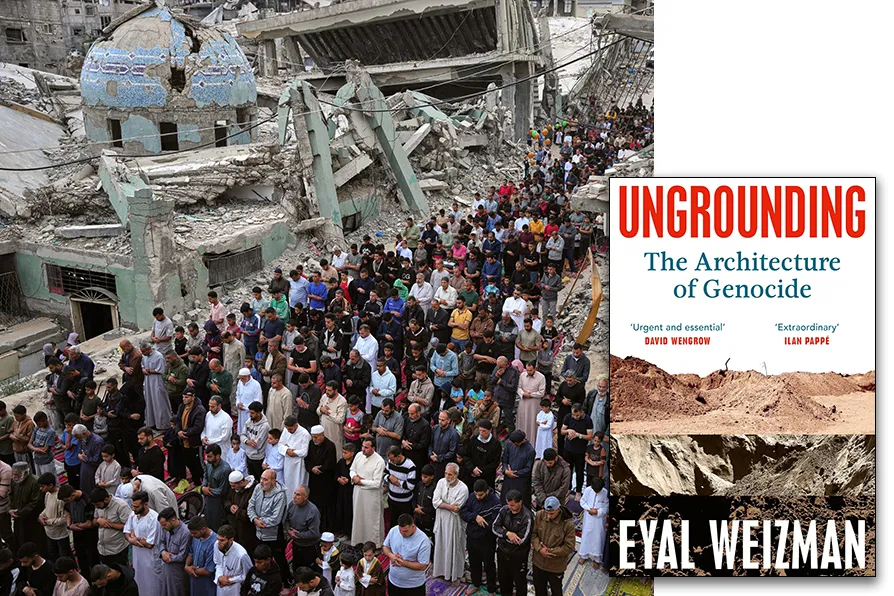 Palestinians offer Eid al-Adha prayers beside the ruins of a mosque destroyed by Israeli bombardment, in Khan Younis, southern Gaza Strip, Wednesday, May 27, 2026

MARY CONWAY is disappointed by drama that, despite accomplished performances, cannot overcome an unfocused script
New releases from Sam Carter, Spell Songs and Les Thomas
KEN COCKBURN traces the one original language – that of the Yamnaya pastoral nomads – from which all European and Indian languages derive
PAUL DONOVAN is fascinated by the debunking of the iconic British war hero
ALEX HALL recommends a searing panorama of our global predicament





Undergrounding: The Architecture of Genocide
Eyal Weizman, Fern Press, £25
EYAL WEIZNAN is the founder and director of Forensic Architecture and Professor of Spatial and Visual Cultures at Goldsmiths University in London. I read his essay on the demolition of Gaza called All They Will Find Is Sand in The London Review of Books on April 23 2026. I was so impressed by the content and the clear style of his writing; I wanted to read more. This new publication is it.
Many books have been written about the horrors of the genocide happening in the Gaza Strip, but what makes this book stand out is, as Ilan Pappe states on the back cover, “a timely and crucial contribution tracing the trail of the Israeli architectural, ecological and infrastructural destruction of the Gaza Strip.”
The book is in split into sections, almost like the layers of soil that have been destroyed in Gaza. The introduction, called The Earth-Storm, narrates the ditch carved in the soil in August 1950, dividing what was to become the Gaza Strip from the rest of Palestine. Farms were destroyed. The Colombian UN officer posted to the frontier only “took off his shirt to sunbathe” while Israelis taunted farmers, saying: “Take a photograph of this place because you will not see it again.” They pocketed the fruit from their side of the line, consumed them and threw the stones back at the farmers saying “Eat some!”
Part One, Soil, lists in precise detail how the expulsion of the Palestinian people took place from the Balfour Declaration in 1917 to the leafleting dropped on Gaza on Friday morning, October 13 2023. Each chapter has a precise map showing what the Palestinians had lost and what others had gained. The chapter also details many of the horrific crimes committed by Israeli soldiers that have recently come to light.
Part Two, Subsoil, discusses how and why tunnels were built and how the constant bombardment by Israel has poisoned the water supply.
Part Three, Undergrounding, describes what happened on October 7 2023, and the events thereafter.
The last section of Part Three is called The Genocide’s Riviera and has maps, photographs and detailed content of the story up to now, bringing the reader back to the start, when the plough blade cut through the soil in the 1950s. As Weizman states “Israel had camouflaged its atrocities with humanitarian rhetoric.”
The Coda that forms the last part of this book is from when Weizman sent it to his publishers in late 2025. The Israeli military is in control. The bulldozers have removed any trace of Palestinian habitation and (worryingly) Weizman says “The Israeli government hopes that what ‘two years of war did not accomplish [namely the destruction of Palestinian resistance and the expulsion of Palestinians] will be done by market forces’.”
Boycott Israeli goods. Continue to protest. And buy two copies of this book. One for yourself and one for those that need to be educated.
