


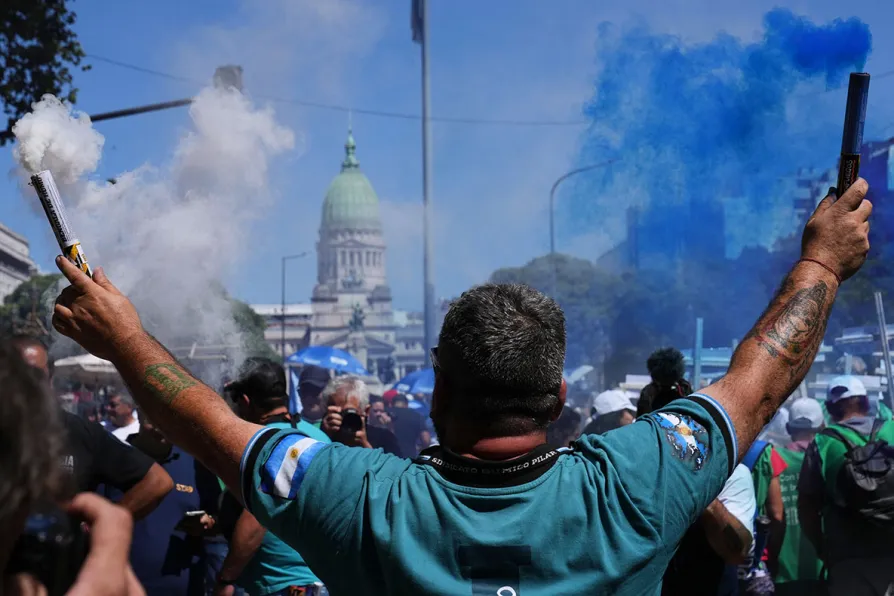
 Demonstrators rally outside Congress as they protest against a labor reform bill proposed by President Javier Milei's government in Buenos Aires, Argentina, February 27, 2026






ARGENTINA’S Senate has passed legislation attacking workers’ rights and collective bargaining.
Far-right President Javier Milei hailed the “historic” win, which follows huge protests by trade unions and a general strike on February 19.
As the debate took place in the upper house on Friday, police attacked a demonstration led by unions, community campaigns and left-wing parties.
The country’s trade union federation the CGT plans a march tomorrow in protest at the legislation, which it says it will challenge in the courts. However, the CGT leadership’s decision to rule out more general stoppages has been attacked by some unions.
Unions in the education, transport and some industrial sectors including tyre manufacturing staged walkouts on Friday.
Mr Milei’s reform raises the maximum legal working day to 12 hours, makes it easier to fire workers and reduces redundancy and sick pay. It allows companies to negotiate terms and conditions with individual employees in defiance of sectoral agreements, and restricts strike rights by imposing minimum service levels in the healthcare, education, rubbish collection, port and aviation sectors.
It also requires unions to seek management permission to hold meetings in the workplace, and allows employers to penalise staff whose union activities interfere with the work of workers not taking part.
A railway worker taking part in Friday’s protests told reporters: “It makes me incredibly angry.
“Passing a law is one thing, but implementing it is another,” Ariel Somer said. “In Argentina, progress only happens when workers organise. We will find ways to resist.”
