


Debutants deliver as rugby league’s new campaign recognises its roots, writes JAMES NALTON
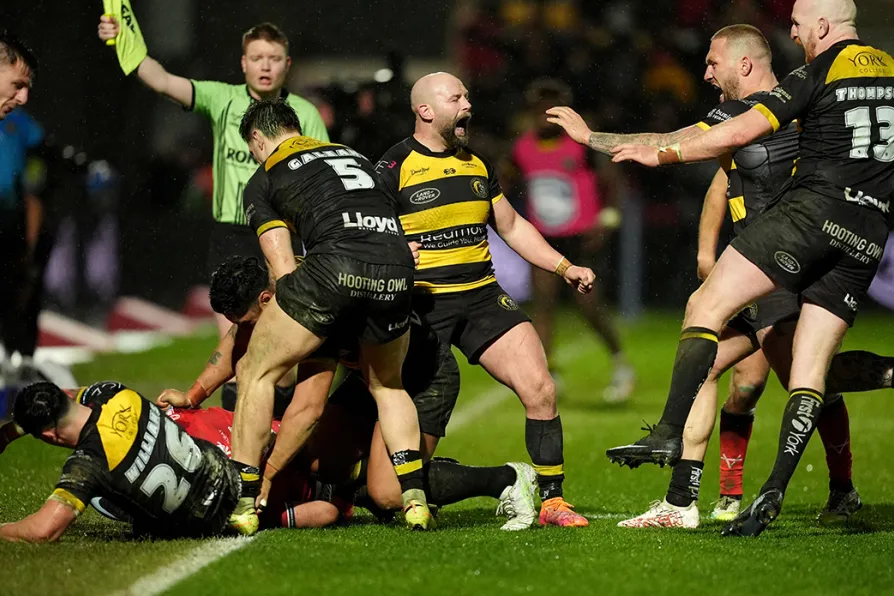
 York Knights' Paul McShane (centre) celebrates a decision during the Super League match at the Community Stadium, York, February 12, 2026





A NEW season of Super League is already under way in dramatic fashion as the new campaign brings an expanded league and plenty of talking points.
Week one of the 2026 season continues this weekend, following games on Thursday and Friday night, and there has already been an early highlight.
From a competitive standpoint, things couldn’t have got off to a better start as the newly promoted York Knights defeated last season’s treble winners Hull KR by 19 points to 18 on Thursday.
Hull KR were 18-6 up at one point in the second half, but a York comeback was rounded off when Ata Hingano dropped a goal to give the home side the win by a single point.
The victory was made all the sweeter for York as Hull KR had requested an easier opening fixture ahead of facing Brisbane Broncos in the World Club Challenge this Thursday.
As it turned out, pitting the champions against a newly promoted team was a masterstroke for the competition on opening week, as a packed crowd at York Community Stadium witnessed a historic result.
York join three other new teams in Super League for 2026, as the league expands from 12 to 14 clubs.
Despite the sport’s attempts to expand the professional game at the top level to new areas in recent decades, the competition is once again largely concentrated in major heartlands of rugby league in Europe, namely the M62 corridor in the north of Britain, from Lancashire to Yorkshire, and the south of France.
Of the 12 British-based teams, the furthest south are Warrington Wolves, and the furthest north are debutants York Knights. In France, Toulouse Olympique return to the top division alongside fellow French team Catalans Dragons to make up the 14.
This season’s expansion meant there would be at least two new teams in Super League in 2026. It was a test of the grading system, which now decides which teams participate in Super League and the Championship below it.
This recently introduced system replaced the previous one of promotion and relegation based on league standings, though teams’ performance in their respective leagues does play a part in their grading. Other considerations include fan support, financial, stadium facilities, and community work.
It soon became clear that one team would lose its Super League status in 2026 as Salford’s financial troubles led to a tough 2025 season for all involved with the club.
There were numerous occasions when players and staff were not paid, and the club went into liquidation in December. The new version of the club chose not to apply to play in Super League in 2026, and will attempt to rebuild in the Championship as a newly formed phoenix club, Salford RLFC. It at least ensures that a team whose history goes back 150 years maintains a presence in the sport at the professional level.
This left three spots open in the newly expanded league, which were duly taken by the top three teams in the 2025 Championship table. On this occasion, the grading system seemed to reflect performance and results.
Bradford’s rise to tenth in the grading system, above existing Super League teams Castleford and Huddersfield, did cause some controversy, but their return has sparked plenty of conversations in rugby league around the system itself and the attempt to revive a sleeping giant.
Bradford were one of the most successful teams in the early years of Super League, winning the championship four times in the competition’s first 10 years between 1996 and 2005. They play at one of rugby league’s most historic venues, Odsal stadium, which, very much like the club itself, carries a big name but is in need of improvement.
The stadium’s attendance of 102,569 for a Challenge Cup final replay between Warrington and Halifax in 1954 remains one of the biggest in the sport’s history. The unofficial attendance is thought to be much higher, and would put it up there with the highest-attended games in any code of football.
Accompanying events this season include a Magic Weekend round of games at Everton’s new stadium, Bramley-Moore Dock, while Leeds and Hull KR will play each other in Las Vegas later this month as part of the sport’s attempts to grow the game in the United States.
The return of Toulouse adds some more variation outside the north of England, giving the English teams an additional trip to France on top of their fixtures against Catalans and the 2026 Challenge Cup is already under way, featuring amateur and professional teams from across the country, culminating in its traditional Wembley final in May.
It means there remains plenty of historic familiarity in the sport and some historic clubs and stadiums, but as York Knights showed on night one of the new season, there remains plenty of scope for breaking new ground.
