
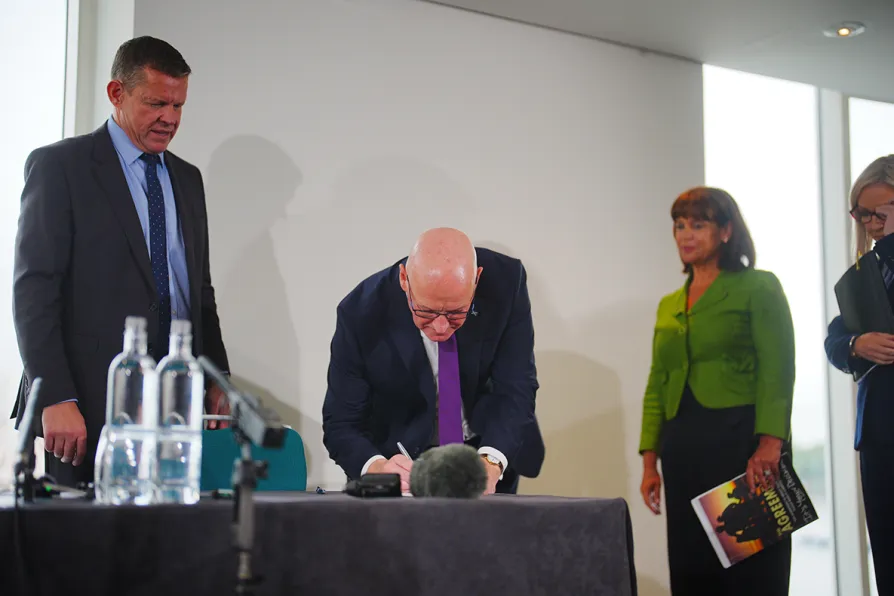
The UK Prime Minister may have the regal touch in northern England, but he’s been wrong-footed on the constitutional challenges posed by the Celtic Alliance of first ministers from Scotland, Wales and Northern Ireland, argues KENNY MacASKILL

What’s the meaning of ‘revolution’?
Beyond a riot, revolt or rebellion lies a revolution – a fundamental change in who runs society for what purpose, explains the MARX MEMORIAL LIBRARY

 What distinguishes Marxism from social democracy is the recognition that only through sustained struggle can the working class win political and state power
NEIRLAY ANDRADE, a member of the Communist Party of Venezuela’s political committee, outlines her party’s position on the crisis facing the country
A look at Taylor Wimpey’s accounts shows why Labour’s market-led housing strategy won’t deliver more, cheaper homes, as promised, says SOLOMON HUGHES
DAVID HORSLEY remembers the remarkable life and death of US black revolutionary George Jackson, whose politically passionate prison letters were published as Soledad Brother
Cuban trade union federation CTC leader OSNAY MIGUEL COLINA speaks to Ben Chacko about life and work under a crippling US siege
A part of the British empire’s network of slavery, today the Caribbean island of Nevis faces a new form of exploitation in the form of crypto-colonialism, CLAUDIA WEBBE writes
Challenges from the unscrupulous misuse of AI to steal actors’ voice and physical likenesses is being met with a firm union response, writes LYNDA ROOKE





REVOLUTION means the transfer of state power from one class to another.
Apart from the earliest “primitive” pre-feudal communities, all class societies, everywhere, throughout recorded history, have a state, defined as the structures and institutions of governance, law and administration.
The state is often presented as the “honest broker” of society, the guarantor of social stability and “freedom,” working in the interests of “the many.”

Similar stories

MML director MEIRIAN JUMP outlines the recently refreshed library’s busy autumn schedule that ranges from book sales, archival exploration, community work with online education and the ever popular site tours

Class struggle is the motor of history but the direction and detail of change at any time and place is the outcome of many factors, suggests the Marx Memorial Library and Workers’ School

Dignity is important to all humans, argues the Marx Memorial Library and Workers’ School, but it does not come about automatically. In a less than perfect world, dignity can accompany suffering, but the collective dignity of working people is achieved through acting together to change the world.

Nature as well as society works dialectically, asserts the Marx Memorial Library and Workers’ School