


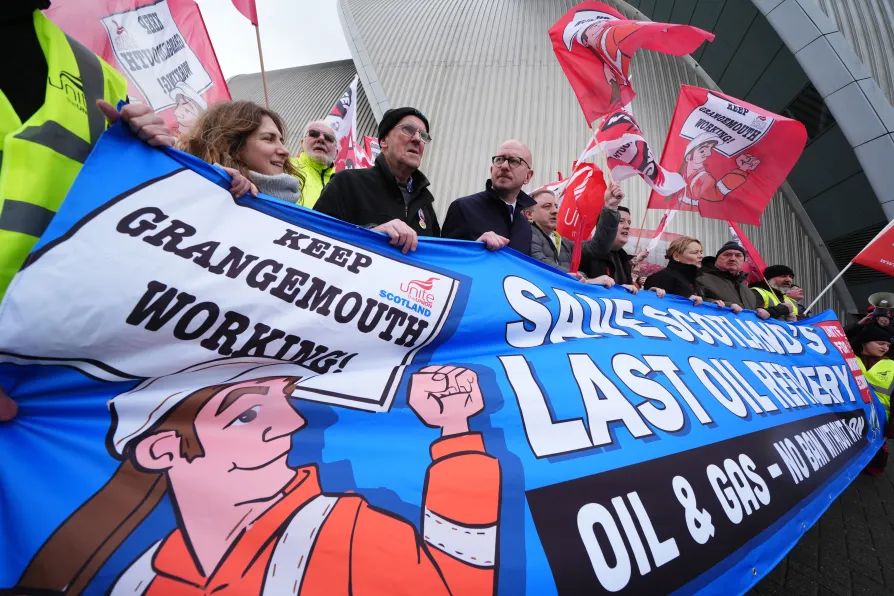
 Members of Unite union take part in a demonstration to protest at Petroineos plans to close Grangemouth oil refinery, February 21, 2025
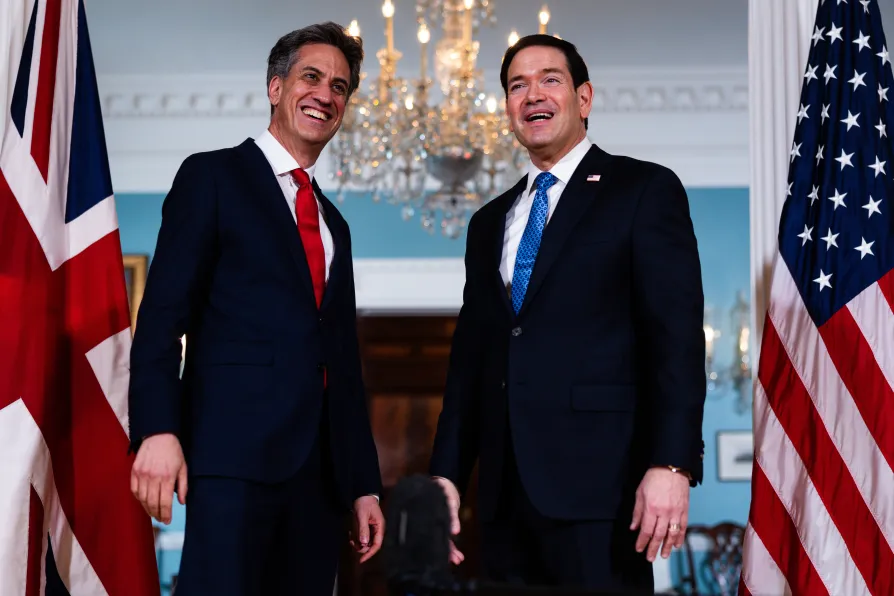





BRITAIN is importing Russian oil-produced jet fuel after the government ignored shortage warnings when it allowed two refineries to close last year, Unite said today.
The Labour-affiliated union said that the controversially produced aviation fuel could have been made by the Grangemouth and Lindsey refineries in a strong-worded criticism of ministers’ “lack of a cohesive plan” for energy.
The closures of two of Britain’s six refineries, which both produced aviation fuel, went ahead despite Unite warnings on energy security.
Britain is now facing a shortage of aviation fuel following the US war on Iran and the blockade of the Straits of Hormuz.
Ministers have responded by importing fuel from refineries accused of human rights violations and even to bring in jet fuel made from Russian oil.
Unite general secretary Sharon Graham said: “The government is guilty of industrial vandalism.
“It has allowed two of our six UK refineries to close.
“We could be producing our own green aviation fuel, which would be better for jobs, the environment and energy security.
“Instead, we are now importing fuel from questionable sites using Russian oil. The government needs to learn its lessons from this.”
Unite produced a detailed plan about how the Grangemouth refinery could be transitioned to produced Sustainable Aviation Fuel (SAF) and have it help meet the government’s green aviation strategy.
But because it went “missing in action” to ensure that SAF can be produced domestically, the government is set to be reliant on importing SAF to meet its own targets, said Unite.
The failure to develop a cohesive plan for the production of aviation fuel and SAF “is mirrored throughout the North Sea,” where workers are facing a jobless transition, added the union.
Ms Graham said: “The government’s current ‘clean energy jobs plan’ is a jobs plan without any jobs. The only investment commitment in it is £22.5 million on a few training schemes.
“Until we have a real plan, with real investment in our future jobs and energy security, the government should not be abandoning what we already have in the name of net zero.
“Put simply, they should not be letting go of one rope before they have hold of another.”
The Department for Energy and Net Zero was contacted for comment.
