


Negotiations over pay, conditions and league structure could have a longer-lasting impact than the 2026 tournament and high-profile signings, writes JAMES NALTON
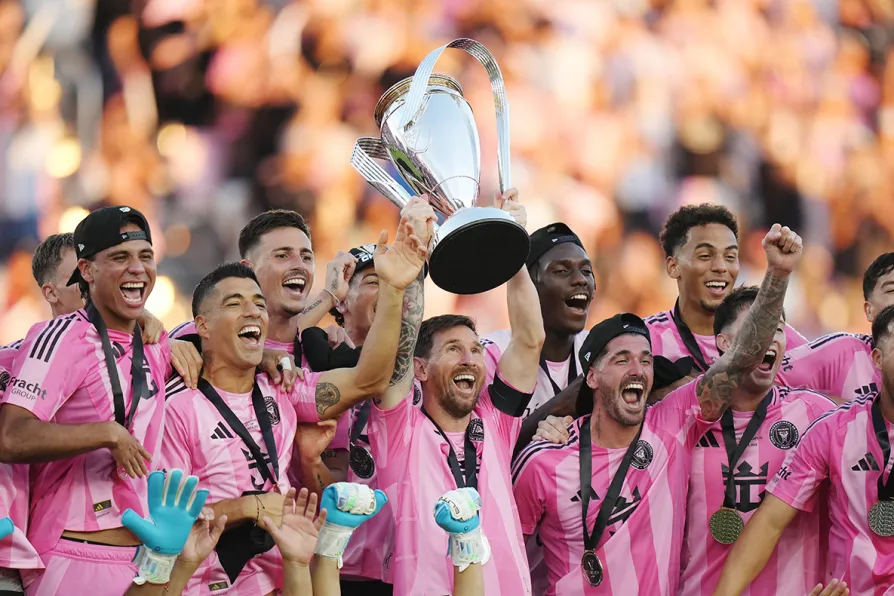
 Inter Miami's Lionel Messi hoists the trophy alongside teammates after defeating the Vancouver Whitecaps in the MLS Cup final, in Fort Lauderdale, Florida, December 6, 2025





TWO things will dominate American soccer in 2026. The World Cup and the continued presence of Lionel Messi playing his club football in the region.
But it’s an ongoing collective bargaining agreement in the lower leagues that may have the biggest long-term impact on the sport in the region in 2026.
Soccer in the US rarely makes the wider sports news agenda, let alone the overall general news beyond the sports pages, but Messi and the World Cup are rare instances where soccer headlines reach a larger audience.
Their simultaneous presence only amplifies that attention, but beneath all of that, there are developments in soccer in the United States that could have a big effect on what the game in the region looks like going forward. More so than Messi, and arguably more so than the World Cup.
The headlines when approaching American soccer from this angle concern the United Soccer League (USL), its plans to introduce promotion and relegation and establish a new top-tier league in 2028 that operates separately from but parallel to MLS in the league pyramid.
The most important aspect of all of this, though, is a players’ union, the USLPA, asking where their members stand as part of these big ideas.
The USL has existed in various iterations since the late 1980s, but since the late 1990s and the turn of the century, it has operated as the second and/or third tiers in the US Soccer league system.
USL now plans to introduce promotion and relegation within its professional leagues and expand to include a Division I (top-tier).
Crucially, all of this has coincided with the expiration at the end of 2025 of the collective bargaining agreement (CBA) between the players and the league.
The need to renew this CBA has come at an important time. It has meant the grand plans on paper and in theory have met the everyday reality for clubs and players: financial sustainability, fair working conditions, and player compensation.
Rather than going ahead with such moves in the middle of an existing CBA, the need to negotiate has exposed potential flaws and raised numerous issues as to the benefits of these changes beyond the aesthetic.
USL has put these changes forward as part of their, and many others’, desire for the game in the US to align with the way other popular leagues around the world work and introduce some kind of promotion and relegation, which has long been a contentious topic in US sport.
The idea that a club can rise from the bottom of a league pyramid through the leagues is a romantic one. In the modern game, it has become, like everything else in football, heavily dependent on money and investment, to the point where attempts at promotion through the leagues could be seen as a type of venture capitalism for some, or for others, a rich person’s hobby.
Nevertheless, it remains important that a team, whether community-owned or privately owned, should have the opportunity to make the next steps and not hit a brick wall as they try to progress.
The American system can offer this partially in its own way. If a team impresses in their ‘market’ in a lower division, they can sometimes make a move to join a higher division via expansion, using previous success, on or off the field, to make their case to join the higher league.
Some current MLS teams, including FC Cincinnati and Seattle Sounders, existed previously as USL teams that made the step up to MLS in this manner, but it is too often a closed shop, and space for expansion teams is limited and costly.
It is right to push for promotion and relegation, but it has to be done in the right way. This is where the USL Players Association (USLPA) has an important part to play as a players’ union, not just in this landmark moment for USL, but in setting the tone for how players are considered in future developments in American soccer.
The negotiations between USLPA and the league have brought to light structural issues within USL that might not otherwise have been raised.
The problem is that even though the players are negotiating with the league, they are paid by the clubs. One could argue that the clubs should first be negotiating with the league to get a greater share of league revenue and a greater stake in the league as a whole, which can then be passed on to the players.
As it is, the league keeps most of the money from considerable expansion fees and from the annual fees paid by the clubs. These USL clubs are effectively franchises, even more so than those in MLS, which has a single-entity structure where player contracts are controlled centrally by the league.
USL is taking the fees from clubs but then leaving those clubs to fend for themselves financially without substantial revenue sharing from that income. This can lead to a temptation for over-expansion at the expense of sustainability.
In a recent example of this, a USL League One (third-tier) team, South Georgia Tormenta, announced last week that it will not compete in 2026 due to financial issues.
The USLPA then pointed out that a USL team has folded every year, and highlighted that the issue with South Georgia Tormenta is “not an isolated breakdown.”
Adding: “It is a broken system that prioritises expansion while allowing instability to fester within its ecosystem.
“Players deserve a league that stands behind them and a structure that protects them. This is not it.”
USL’s intentions to move towards a more open league system, even if only within USL itself, and the ambition to create a top-tier league are admirable, but such progress needs to factor in structural stability, especially when teams are being relegated.
It also needs to take the players along for the ride and treat them as a top-tier professional league should. The USLPA has been very forthright in highlighting that there is no sustainable plan in place from USL to back up these new developments in reality.
Ahead of last year’s USL Championship (second tier) final, players of FC Tulsa and Pittsburgh Riverhounds wore T-shirts bearing the message: “Pro rel? Try pro standards first.”
Among other things, players are looking for more security in their contracts, healthcare befitting professional sportspeople, and more of a return when their image is used to promote the league. There is a long list of issues being raised, though, including what happens to players’ contracts when a club folds or goes on hiatus.
The USLPA has shone a light on the structure of USL and, by extension, US soccer, but across the world, league organisation and ownership issues have become more prominent.
This has especially been the case as more money has flowed into the game. This money doesn’t always go where it is useful for the sport as a whole and for those playing and supporting it.
The independent franchise (rather than single-entity) nature of USL does, at least in theory, allow for community- or supporter-owned teams to enter the league.
And if it opened up its own amateur and semi-pro lower leagues to others that already exist at the local and regional levels across the US, it could get closer towards being a genuinely open system rather than promotion and relegation within a closed league system.
For now, though, there is much to be resolved if the league is to succeed in its ambitious plans for the future. The players’ union, the USLPA, will play an important role in ensuring this future is sustainable for players and by extension, their clubs, in a moment that could have a bigger impact on the future of US soccer in real, practical terms than Messi and the World Cup.
