


Fifa’s empty promises of affordable access collapse as the 2026 World Cup becomes a showcase for profit over people, writes JAMES NALTON
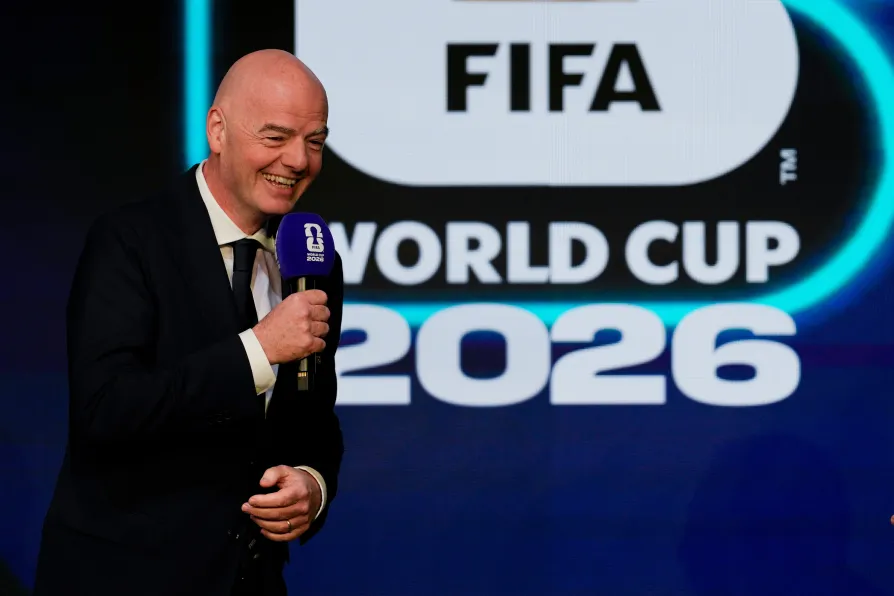
 FIFA President Gianni Infantino speaks during the match schedule reveal for the 2026 soccer World Cup in Washington, December 6, 2025





RATHER than being a World Cup of ultras, passionate fans who decorate football with colour and sound, 2026 will be the World Cup of ultra-capitalism. A World Cup for the few, not the many.
The list of ticket prices was released this week by the national FAs of each participating country and confirmed long-held fears that this tournament would be inaccessible to most fans.
The cheapest World Cup ticket for a member of the England Supporters Club is $220 (£164) for a group stage game against Ghana or Panama. The cheapest ticket for an England supporter for the final would be $4,185 (£3,128).
It’s a similar story for Scotland fans, with the cheapest being a $180 (£135) ticket to attend the group game against Haiti, but $265 (£200) if they wanted to attend Scotland versus Brazil in Miami.
A reminder that these are the cheapest listed, and most tickets will cost much more.
The $60 Category 4 tickets that Fifa boasted about, but could only be seen on the seating plans through a microscope, are now missing entirely.
Football Supporters Europe commented on social media today that: “The Fifa World Cup $60 ticket is a mythical creature that is said to inhabit the Fifa office in Miami.
“Popular interest and belief in the creature has varied since it was brought to worldwide attention in September 2025. Evidence of its existence remains anecdotal.”
The FBI might need to reopen the X-Files in order to investigate this unexplained disappearance.
At the recent Club World Cup in the United States, there were occasions when dynamic ticket pricing worked in the opposite direction.
Prices for some matches dropped below $20 the day before the game and were quickly snapped up by locals.
Cheap tickets for locals are a good thing, and have been an initiative used by Fifa at previous World Cups, but not this one. Why? Because they want to try to exploit local fans as much as international ones.
It’s unlikely those travelling from around the world to attend this tournament will be able to take advantage of any late drops in price.
Fans need to plan ahead for international tournaments, booking flights and accommodation around games, and then booking the tickets at the same time. These initial high ticket prices are taking advantage of that.
Given the already high prices of hotels in many of these host cities, which have risen exponentially during the tournament dates, booking accommodation at this price and hoping ticket prices drop around the time of the game is an expensive gamble to take.
If previous sporting events have been accused of sportswashing authoritarian states that exploit their citizens and their workers, then this one is sportswashing the exploitative world system of capitalism. It is doing so in host countries, the US in particular, where it is already prevalent.
There is little to no regulation on secondary ticketing markets, which are allowed to run free and exploit fans further, taking advantage of another capitalist phenomenon — “fear of missing out” — by encouraging fans to spend more than they can afford.
High ticket prices will be defended as supply and demand, and in some cases, even celebrated.
This was evident when Lionel Messi arrived on American shores, joining MLS franchise Inter Miami. Prices for their games skyrocketed and many original Inter Miami supporters, who had watched the team in their early seasons when they were pretty rubbish, were priced out for a while.
But this was celebrated by some, who claimed the expensive tickets meant “soccer had finally arrived” on US shores.
The truth is that soccer was already there, and it didn’t need the additional exploitation of its supporters.
It’s a form of commodity fetishism in the theatre of football, where the social relationship between the supporter, the game, and its participants diminishes and turns into a relationship between the supporter and the money-making event itself.
The connection between players on the pitch, extending to a connection between themselves and the spectators, is being lost.
When players go to appreciate their travelling supporters at the end of the game, will there be anyone there?
There’s a risk the games themselves will be as lifeless as the World Cup draw, where even Donald Trump’s mention of Pele didn’t get a response from the crowd, leading Trump to ask, having already mentioned the Brazilian’s name twice, “Pele, I assume one of the greats?” before Fifa president Gianni Infantino stepped in to request applause for Pele from the dozy audience.
These draw ceremonies are events for passive corporate types, sponsors, VIPs, and media. Given that many fans are being priced out, the World Cup games themselves could be very much the same experience.
One of the big American football events in the United States, the NFL’s Super Bowl, is notorious for its VIP feel and extortionate ticket prices, so it tracks that Infantino has described the 2026 World Cup as “104 Super Bowls.” There will even be a half-time show at the final.
That’s not to say some elements of American sporting tradition shouldn’t be embraced, but unfortunately, this World Cup is embracing the profit-making aspects (for the supposed non-profit organisation that is Fifa) the most.
Fifa and Infantino chose the United States for this reason. They can get away with it there. This is the sportswashing of unchecked capitalism.
But America isn’t the sole culprit, as these things are increasingly seen in the game at the top level around the globe. It’s been creeping in at club level for some time, especially noticeable in the desire to move domestic matches abroad.
It also shows how important fan movements have been at the club level in curbing this somewhat, but it is more difficult to create these kinds of movements on an international scale.
This World Cup is just the next part of the progression of football’s move away from being a pastime for participants and supporters combined. It’s an end-of-level boss that most won’t be able to, or won’t want to get past, whether on principle or simply because they can’t afford to participate. For many, it could be game over.
