WILL STONE samples the 20th anniversary atmosphere of this eclectic end-of-season indie festival


 Latest editorial
Science fiction and Fantasy with Mat Coward: May 26, 2026
Do frozen colonists carry the virus of empire? Why is monstrosity a great way to describe capital? Was God a dustman?

Comics are not just superheroes and spandex – it can be public art, telling public stories, suggests HARRIET EARLE
The bard serenades the Diggers of Wigan and their festive followers
ALEXEI SAYLE speaks to Angus Reid about a lifetime of protest, how to hone political art – and what to do now
ANDY HEDGECOCK, JAMES WALSH, LEO BOIX and MARIA DUARTE review Just An Illusion, Everybody Digs Bill Evans, Blue Film, Oasis: Don’t Look Back in Anger, and Runner
MARIA DUARTE recommends a nerve-wracking reconstruction of the 72 hours before the Normandy landings





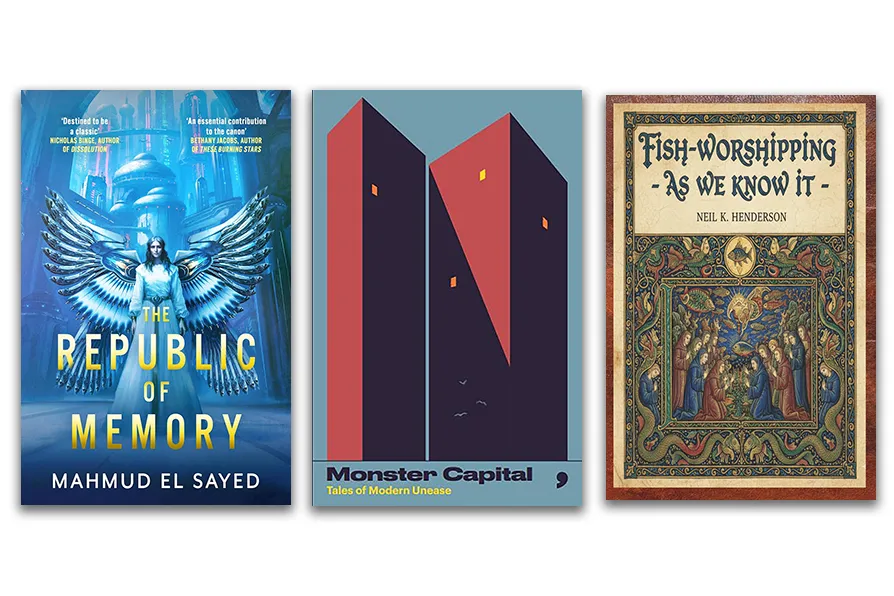
THE Republic Of Memory by Mahmud El Sayed (Gollancz, £22) is set on a city-sized spaceship sent from Earth to colonise a distant planet. The Safina is halfway through a journey which will take hundreds of years. Generations of crew live and die aboard, their mission to keep the vessel and its cargo of colonists, who sleep in suspended animation, alive long enough to make planetfall.
Early in the voyage the original crew broke with Earth, and the empires which ruled it, after a bloody uprising. Their descendants are determined that on their new home there will be a fresh start with none of the oppression and endless warfare of the old world. But when the frozen colonists are awoken will they accept the new order, or will they plot a return to the system they knew before?
This debut novel, the first half of a duology, is about revolution and the ways in which it can be corrupted, the divisions of identity that undermine solidarity, and also, fascinatingly, about the role of language in shaping human society. El Sayed is a natural storyteller and the book fairly races along, as rich in action and character as it is in invention.
What a great idea for a horror anthology! From “the invisible hand of the market” to “capital is dead labour, that, vampire-like, only lives by sucking living labour,” capitalism has for centuries been described using spectral, uncanny or monstrous terms. Thirteen authors in Monster Capital, edited by Ra Page and David Sue (Comma Press, £11.99), take that insight as the starting point for a wide variety of horrifying and entertaining tales of the zombie-like system which, though always on the verge of death, still controls our lives.
Crime writer Christine Poulson, for instance, scares us with a picture of shopping-to-live taken to its awful ultimate, while Morning Star contributor Andy Hedgecock’s ghosts remind us that philanthropy and poverty are two partners in a dialectical dance. The execution of this collection is as good as the concept, and that’s high praise.
I’m afraid “quotidian absurdism” is the best I can come up with as a category to describe writers such as Flann O’Brien, Robert Rankin and Spike Milligan, who ground whimsical or satirical tales of crazy logic in a world full of everyday details. Fish-Worshipping As We Know it — A Handbook For The Philosophically Unhinged by Neil K Henderson (Hendersonic Press, £11.99) is a splendidly engaging example of the type, quite indescribable except to say that its title is surprisingly accurate.
On every page it elicits laughs which first register on the surface of the mind and then, a moment later, at a deeper and more lasting level, like the flavour layers of a good pint.
On top of that, Henderson is kind enough to provide answers (of a sort) to “the three most fundamental questions anyone will ever need to ask about anything”: Where Did We Come From? Why Are We Here? And, obviously, Was God A Dustman?

Similar stories

A misfit couple unhappily ever after, a dead man walking, dodgy journos, and trench art trucking

Monster profits on the Tube, paternal dilemmas for time travellers, and an alien abduction buddy saga

Conman conned in a twisty thriller, blind trust tested to the limit, cunning murder methods, and tip-top police procedural

A ghost story by Mexican Ave Barrera, a Surrealist poetry collection by Peruvian Cesar Moro, and a manifesto-poem on women’s labour and capitalist havoc by Peruvian Valeria Roman Marroquin