


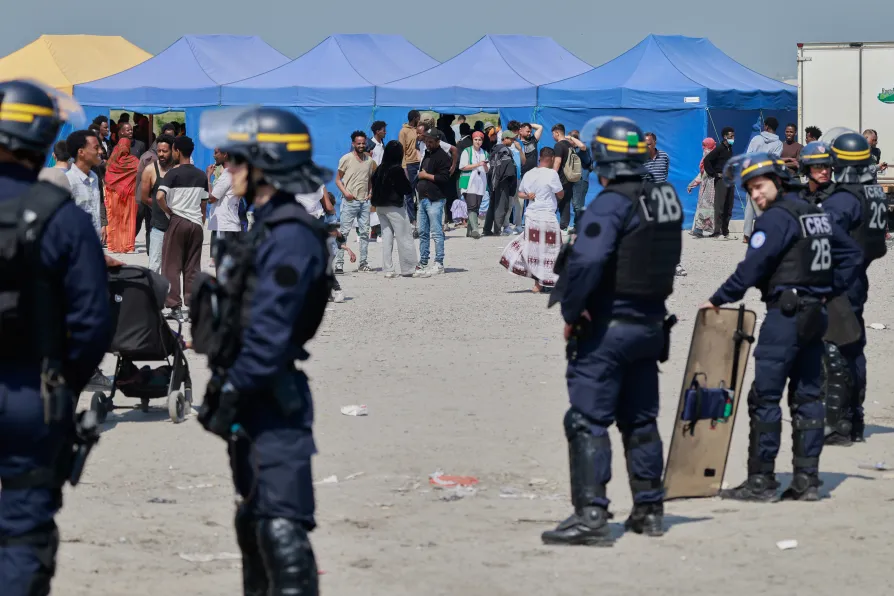
 Police conduct a search operation at a makeshift camp of migrants who want to cross the English Channel to Britain near Dunkirk, northern France, May 27, 2026





HUMAN rights groups have blasted the European Union as the bloc moves ahead with a vast overhaul of its migration policy, aiming to boost deportations and sign deals to build detention centres abroad.
Activists compared the proposals to the aggressive immigration policies of the United States.
“The new regulation will speed up the return process and increase returns of persons who have no legal right to stay in the EU,” said Cyprus’s Deputy Migration Minister Nicholas Ioannides, whose country holds the rotating EU presidency.
The deal was struck between the the bloc’s three main institutions — the European Commission, the European Council and European Parliament — during a so-called “trilogue” on Monday evening.
Critics compared the regulation to the immigration strategy of US President Donald Trump’s administration, which has struck a series of secretive agreements with nations around the world to deport thousands of people to countries that are not their own.
Under the Tories, Britain also planned to deport migrants to Rwanda, but the plan became bogged down in legal complications and the new government dropped it immediately on taking office.
“The regulation is going to create a draconian detention and deportation machine,” said Silvia Carter, spokeswoman for the Brussels-based Platform for International Co-operation on Undocumented Migrants.
“Across the Atlantic, we see the violence and fear created by brutal immigration enforcement. Europe should be learning from the harms of that model, not building its own version of it.”
The provisional agreement will now head to the European Parliament and heads of state, where approval is expected to be swift.
At least five EU nations — Germany, Austria, the Netherlands, Denmark and Greece — are already in talks with third countries, mostly in Africa, to host “return hubs” on the model of Italy’s detention deal with Albania.
