
The US administration is endangering lives by reversing environmental protection laws, CHAUNCEY K ROBINSON argues

Remember 1936
On the 90th anniversary of the outbreak of the Spanish civil war, ALAN MORRISON selects some poems from a new anthology
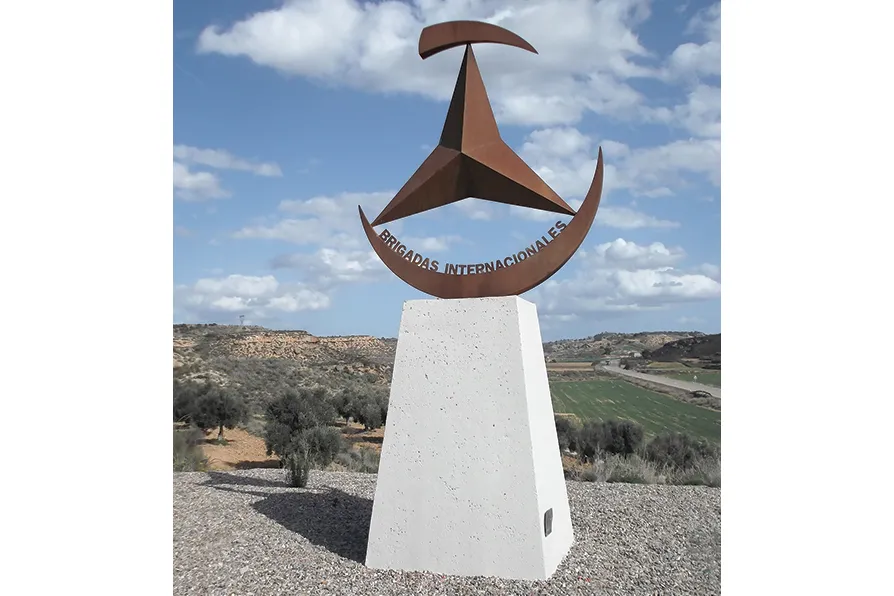
 A memorial to the International Brigades that took part in the Battle of Caspe on the Aragon front in March 1938. Caspe is a town in the province of Zaragoza. The memorial was designed by Maribel Loren Ros and unveiled in 2018 / Pic: Fran Ara/CC
It’s time to stop retreating and go on the offensive to promote working-class interests, argues DOUG NICHOLLS
Marco Rubio wants to defeat socialism in Nicaragua, not restore ‘democracy,’ writes JOHN PERRY
Believe it or not, there was a time when the US government built beautiful homes for working‑class Americans to deal with a housing shortage, writes ERAN BEN-JOSEPH
DIANE ABBOTT provides an analysis of the reasons for EU and British voters’ dramatic swing to the right
Train drivers’ union Aslef general secretary DAVE CALFE speaks to Ben Chacko about his hopes that Burnham’s devolution agenda will include the importance of the railway





AFTER a failed coup d’etat by a right-wing nationalist faction of the Spanish army against the democratically elected Popular Front government of the second republic, between July 17 and 18 1936, Spain was plunged into a bloody civil war which lasted until April 1 1939. The conflict culminated in the defeat of the republic and the ushering in of a fascist autocracy — retrospectively termed The Censorship — under “victorious” nationalist general Francisco Franco, who remained in power until his death in November 1975.
Although most European governments refused to get involved in the Spanish civil war, there was much popular support for the republican cause (typified by so-called “Spain Days”), and a sizeable number of mostly socialist and communist volunteers from around 50 countries joined the Soviet-backed International Brigades to fight against the nationalist forces, themselves composed of Carlists, Falangists, and other right-wing factions, and supported by Nazi Germany and fascist Italy. In these respects, the Spanish civil war is now seen as having been an unwitting dress rehearsal for the second world war, from which, ironically, Francoist Spain abstained.
This new anthology includes poems composed by British Brigader poets either whileon active service or post-service: survivors Clive Branson, Margot Heinemann, Jack Lindsay and Tom Wintringham, and fatalities John Cornford, Marxist cultural critic Christopher Caudwell, and the little known Alex McDade. These period poems are interspersed with selections from some present-day poets who have written extensively on the conflict.
These poems are even more resonant in 2026 as, once again, we face the rise of fascism throughout Europe, and in the US. They ask us now, and hopefully not too late, have we learnt the lessons of 1936?
The Rose Held In The Teeth is available price £10 from Culture Matters.
International Brigades
by Tom Wintringham
Men are tied down, not only by poverty,
By the certain, the usual, the things others do,
By fear for and fear of another. Liberty
Is a silly word, in this flat life, and used
Usually by a Lord Chief Justice. It smells of last century.
There are free men in Europe still:
They’re in Madrid.
Men are so tired, running fingers down football tables
Or the ticker-tape, or standing still,
Unemployed, hating street-corners, unable
– Earth–damned, famine-forced, worn grey with worklessness –
To remember manhood and marching, a song or a parable…
While the free men of Europe
Pile into Madrid.
Men who could not be broken even by Hitler’s prisons,
Rubber truncheon, police spy, surrender of friends,
From the Lipari islands, from the divisions
Roadmaking in French Morocco under the sun;
And from comfort, good wages, home – each of them made his decision
The free men of Europe, not yet ten thousand,
Raid forward from Madrid.
Forming today the third of the brigades, equipping Italians,
Frenchmen, Germans, Poles, Jugo-Slavs, Greeks,
— The names mean languages only: these are Europeans —
The staff, corduroy-trousered, discuss when Franco will use it:
‘Two weeks’ or ‘a month yet’? How many gas–masks by then?
Will Europe, will England, will you ‘have given the gas–masks’
For the free men of Europe
Entrenched in Madrid?
Estado Mayor (general staff), Brigada Internacional, 28 November 1936
Tom Wintringham (1898-1949), a co-founder of The Daily Worker, was Spanish correspondent for the paper before joining the International Brigades. Wounded at the battle of Jarama, and later Quinto, his highly regarded memoir of these experiences is English Captain (Faber, 2011). This poem is from We’re Going On! The Collected Poems of Tom Wintringham (Smokestack Books, 2006).
By The Canal Castilla
by Clive Branson
It is difficult to think
of the noise of guns while men die
while we sit and in the hot sun lie
beside the lazy still water of the canal.
Get up, dive and shatter illusion!
The guard’s bayonet splinters the sun.
A gilded iris shrivels up.
A poppy’s crimson cup
breaks petal by petal to the wind
that carries memories
of other trees, stretches of water, wings.
An unseen shadow sings.
Everything waits what the next journey brings—
Even the authorities.
Clive Branson (1907–1944) was an English artist and poet, and an active communist in the 1930s. He survived the Spanish civil war and was later killed in Burma, commanding a tank. A number of his paintings are in the Tate Gallery. This poem is from The Selected Poems of Clive Branson (Smokestack, 2022).
To the International Brigade
by David Kessel
What was this rabble doing here?
Miners, poets,
Poet-miners.
They leave their stars and bones
With ungentled plains
And in the blood of the Asturias.
Miners, poets,
Poet-miners.
They leave their stars and bones
With ungentled plains
And in the blood of the Asturias.
David Kessel (1947-2022) was a doctor and trade unionist who lived and worked in the East End of London
This poem is from O The Windows of the Bookshop Must Be Broken: Collected Poems 1977-2006 (Survivors’ Press, 2006)
A Letter From Aragon
by John Cornford
This is a quiet sector of a quiet front.
We buried Ruiz in a new pine coffin,
But the shroud was too small and his washed feet stuck out.
The stink of his corpse came through the clean pine boards
And some of the bearers wrapped handkerchiefs round their faces.
Death was not dignified.
We hacked a ragged grave in the unfriendly earth
And fired a ragged volley over the grave.
You could tell from our listlessness, no one much missed him.
This is a quiet sector of a quiet front.
There is no poison gas and no H.E.*
But when they shelled the other end of the village
And the streets were choked with dust
Women came screaming out of the crumbling houses,
Clutched under one arm the naked rump of an infant.
I thought: how ugly fear is.
This is a quiet sector of a quiet front.
Our nerves are steady; we all sleep soundly.
In the clean hospital bed, my eyes were so heavy
Sleep easily blotted out one ugly picture,
A wounded militiaman moaning on a stretcher,
Now out of danger, but still crying for water,
Strong against death, but unprepared for such pain.
This on a quiet front.
But when I shook hands to leave, an Anarchist worker
Said: ‘Tell the workers of England
This was a war not of our own making
We did not seek it.
But if ever the Fascists again rule Barcelona
It will be as a heap of ruins with us workers beneath it.’
* High Explosive
John Cornford (1915-1936), an English poet, communist and member of the International Brigades was killed in action at Lopera on 28 December 1936. This poem is from Poems from Spain (Lawrence and Wishart, 2006).
Jarama Valley
by Alex McDade
To the tune of ‘Red River Valley’
There’s a valley in Spain called Jarama,
That’s a place that we all know so well,
for ‘tis there that we wasted our manhood,
And most of our old age as well.
From this valley they tell us we’re leaving
But don’t hasten to bid us adieu
For e’en though we make our departure
We’ll be back in an hour or two
Oh, we’re proud of our British Battalion,
And the marathon record it’s made,
Please do us this one little favour
And take this last word to Brigade:
“You will never be happy with strangers,
They would not understand you as we,
So remember the Jarama Valley
And the old men who wait patiently”.
That’s a place that we all know so well,
for ‘tis there that we wasted our manhood,
And most of our old age as well.
From this valley they tell us we’re leaving
But don’t hasten to bid us adieu
For e’en though we make our departure
We’ll be back in an hour or two
Oh, we’re proud of our British Battalion,
And the marathon record it’s made,
Please do us this one little favour
And take this last word to Brigade:
“You will never be happy with strangers,
They would not understand you as we,
So remember the Jarama Valley
And the old men who wait patiently”.
Alex McDade (1905-1937) was a Glaswegian labourer and poet, killed on the first day of the Battle of Brunete at Villanueva de la Cañada on July 6 1937. This poem is from The Book of the XV International Brigade (ed. Frank Ryan, Commissariat of War, Madrid, 1938).

Similar stories


Tragic loss of young footballer sparks fresh scrutiny of ground safety standards